
United CitiesReport
English:United Cities · Factions
The largest feudal slave empire on the continent, where a person's worth is measured in Cats — and where poverty itself is an offence you can be sentenced for.
- A nation that defines people by money
- Origins: out of an older empire's ashes
- The Red Rebellion: the Empire's fracture line
- Politics: an emperor and a set of self-governing fiefs
- Economy: the Guild, slaves and taxes
- Society: who is on top, who is underneath
- Hashish and double standards
- Military: samurai and the conscripted
- The frontier: the ruins of Bast
- Cracks on the inside
- For the player
- Points of disagreement
- Books found here
The United Cities is the largest political entity on the continent of Kenshi. Its own citizens simply call it "the Empire"; paladins of the Holy Nation sneer at it as "the Desert Empire". Its cities are scattered across the Great Desert, Heng, The Hook, the Bonefields and the Stormgap Coast, and they vary enormously in scale — from Heft, a capital with an armoury and a robotics workshop, to frontier settlements that amount to a wall and a handful of collapsing huts. The full roster is usually given as Drifter's Last, Clownsteady, Catun, Mourn, Brink, Heng, Bast, Sho-Battai, Stoat, Bark and Heft[V1 0:00:14].
It is the most "civilised" faction in the game: imported luxuries, well-made equipment, written law, and no persecution on grounds of race or faith. It is also the faction that most thoroughly treats people as merchandise. There is no contradiction here — in the Empire's value system these are two faces of the same logic.
A nation that defines people by money
The Empire's official literature makes no attempt to hide its position:
Money will find the men who deserve it… and the poor are weak, and it is these weak masses that will drag the whole ship into the sea. The beggar's place is in the mines. — The United Cities, A United Power
In imperial culture, property is the primary measure of a person's worth. This is not rhetoric: the destitute are officially regarded as latent criminals, and are routinely arrested and sold into slavery. Those too poor to get through the gates live in the shacks and vagrant camps outside the walls — and beyond the shacks are the bandits and the animals.
Origins: out of an older empire's ashes
Neither the United Cities nor the Traders Guild can be dated with any confidence; estimates range loosely from one hundred to one thousand years ago, in any case later than the founding of the Shek Kingdom. A widely repeated account has them rising out of the wreckage of an older empire — most likely the Second Empire — but no surviving record confirms it.
Both lore channels are considerably more confident than the wiki. They describe the United Cities outright as a polity founded on a claim to be the successor state of the Second Empire, assembled from an alliance of southern and north-eastern settlements and marketing itself as a secular great power indifferent to race and gender: a citizen who obeys the law is, broadly, free[V2 0:02:43]. The price of that sales pitch is spelled out in the same breath — poor land, an emperor and nobility spending without restraint, and, after the alliance with the Guild, both parties topping up their own pockets year after year[V3 0:13:21].
There is a further angle that is easily missed: much of the Empire's vast territory was not conquered but inherited, absorbed from cities left standing when the Second Empire collapsed — on this reading the United Cities simply raised its own flag over somebody else's skeleton[V4 0:18:02]. The observation carries a political consequence. Since a good number of imperial cities sit directly on Second Empire ground and ruins, Cat-Lon — should he ever march south — would have grounds to package an invasion as the liberation of his homeland from corrupt pretenders[V5 0:08:30].
Humans were not the only founders. After the Second Empire dissolved, the Enforcers — the ancestors of today's Shek, now stripped of their function — scattered. Some were absorbed into remote human villages, some took part in founding the United Cities, and the largest group withdrew into the ruined hills of the Stenn Desert to live tribally, fighting one another and killing anyone who wandered in[V6 0:10:41]. That thread explains why Shek still hold a place in the imperial nobility.
Clearer than the dating is the founding promise: on seizing power, the United Cities and the Guild rewrote slave law and proclaimed that the people were free of the old empire's tyranny — only criminals would be sent to the mines and farms.
Then the definition of "criminal" began to drift. This is exactly the road the Second Empire walked: first pirates, then dissidents, and finally anyone in the way. The Empire re-enacted the thing it claimed to have ended, only this time the test is money rather than political loyalty.
The Red Rebellion: the Empire's fracture line
Some decades ago a severe drought struck the southern plains, and the famine that followed came close to bringing the entire United Cities to its knees.
The southern cities depended completely on Guild supply lines to stay alive, but Shek raiders and assorted bandits cut the roads and carried off the cargo. What little food did arrive was auctioned away by the nobility the moment it was unloaded. The lower classes, offered a choice between starving and revolting, chose the latter: nobles were dragged into the streets and cities were burned and looted[V7 0:07:56].
The Red Rebellion was extraordinarily bloody. The dead included a great many nobles and even Emperor Anzai himself. The uprising was eventually crushed and the surviving rebels reduced to slavery. Lady Tanaka, one of the surviving nobles, wrote afterwards:
The ground was stained red, and those desperate souls were as drowning rats clinging to a sinking ship, dragging us all down into the depths with them. — The Red Rebellion
The rebellion left three lasting consequences:
- Emperor Tengu's accession — the Noble Circle chose from among its own a new emperor noted chiefly for impulsiveness and a lack of common sense.
- The collapse of agriculture — farming became barely viable anywhere inside imperial borders, and the farmers pushed off their land became the recruiting pool of the Rebel Farmers.
- Deepened dependence on slavery — with the agricultural system broken, the Empire leaned still harder on slave labour to cover the shortfall.
There is a fourth, less often mentioned. Once the Empire regained control it did not merely sell the surviving rebels into slavery as a warning; it used the moment to overhaul internal security and launch a manhunt for "terrorists"[V7 0:07:56] — which is where the official designation of the Anti-Slavers as a terrorist organisation comes from.
One base-building creator wrote a matching economy into his "Anzai Vault" settlement: convicts sent out to mine, stone and iron plates processed on site, the finished goods carried over the ridge to Catun for the local smiths to turn into weapons and armour — that is, the pre-Rebellion imperial economy, before mass slavery became the norm, running on convict labour instead[V8 0:26:21]. It is that channel's own invention rather than existing lore, but it turns the speculation above into something you can actually look at.
Politics: an emperor and a set of self-governing fiefs
The Empire is ruled by the Noble Circle, and the emperor is drawn from it. In practice it behaves less like a centralised state than like a bundle of private estates, each with its own troops and tax base: military authority is divided between the emperor and the regional nobles, each of whom administers his or her own sphere of influence.
| Noble | Seat | Sphere of influence |
|---|---|---|
| Emperor Tengu | Heft (capital) | The imperial army, sustained by the slave farms and the stone and south stone camps |
| Lord Inaba | Stoat | The Bast front; responsible for conscription |
| Lord Yoshinaga | Heng | The Skimsands front |
| Lord Nagata | Sho-Battai | Patrols in the Heng region, Port North |
| Lady Sanda | Bark | The Great Desert |
| Lady Tsugi | Brink | Stormgap Coast |
| Lady Merin | Drifter's Last | The Hook |
| Lord Shiro | Catun | The Bonefields |
| Lord Ohta | Heft | Not stated |
This structure has a direct consequence in play: kill the right noble and an entire region loses its defenders. The Empire is not a single slab that collapses all at once; it is a stack of cards you can pull out one at a time.
One reading: this is Edo Japan
One commentator has long argued that the whole design of the United Cities is modelled on Edo-period Japan, and maps the power structure straight across: Emperor Tengu as the Emperor, holder of legitimacy but of little more than ceremonial power, and Longen, head of the Traders Guild, as the Shogun who holds the actual military and economic weight[V9 0:01:15]. The same analogy appears inside a broader table of correspondences: the Holy Nation as Dark Age Europe (religion suppressing science, an agrarian base, knightly privilege, divine right), the United Cities as shogunal Japan (a puppet emperor, self-governing daimyo squeezing their peasants into mass uprisings), and the Second Empire as Rome — internally corrupt, overextended, administratively fragmented, rotting slowly under sustained conflict with the barbarians to the north[V10 0:07:15].
Economy: the Guild, slaves and taxes
The imperial economy rests on three pillars.
The Guild
The Traders Guild is nominally neutral and in practice the backbone of the imperial economy. It is controlled by Longen and headquartered at Trader's Edge, next door to Heng. It holds the supply lines into every imperial town, and the rations of the great majority of townspeople arrive on Guild caravans; the Guild also maintains private troops and is even permitted a limited draft. Neutrality lets it trade with the Empire's enemies — including the Holy Nation. Swamp sake in imperial bars, greenfruit in samurai rations, Catun-made blades in Shek weapon shops: all of it is residue from that grey pipeline.
Slaves
The Slave Traders are nominally an independent faction and effectively an arm of the Guild: every "Slave Master" and "Slave Mistress" holds Guild membership. They run the slave farms, the stone camps, Eyesocket and the slave markets, and work with manhunters and slave hunters to recover runaways. The supply is drawn reliably from the bottom of society: starving vagrants, rebel farmers, escaped slaves, petty thieves of every kind. See Slavery.
Taxes
The Empire taxes every settler within its borders, the player included. A tax collector calls each week for roughly 3,000 Cats; if you cannot pay, he reminds you that poverty is itself a crime, gives you three days, and comes back with company.
Society: who is on top, who is underneath
The nobility is drawn mainly from humans (Scorchlanders slightly outnumbering Greenlanders) and Shek, while the Hive are disproportionately concentrated at the very bottom. The imperial weekly Unity has long tied Hivers and Shek to rising crime rates, and that line of coverage produced the "city heroes" and the United Heroes League — self-appointed vigilantes who admire the Empire's peace and stability, hold no official authority whatsoever, and in practice spend most of their energy bullying and assaulting non-human races[V1 0:02:44]. Their violence has no legal sanction, but it reflects mainstream opinion with some precision.
Hashish and double standards
Hashish is a serious offence in the Empire, and even raw hemp is contraband. The samurai police are close to obsessive about it: build a hemp farm, a processing shed or a biofuel still on imperial soil and a narcotics raid will follow.
And yet almost every noble is carrying hashish and bloodrum in their personal effects. This law was never about eliminating the drug; it was about making sure of who holds the power to enforce.
Military: samurai and the conscripted
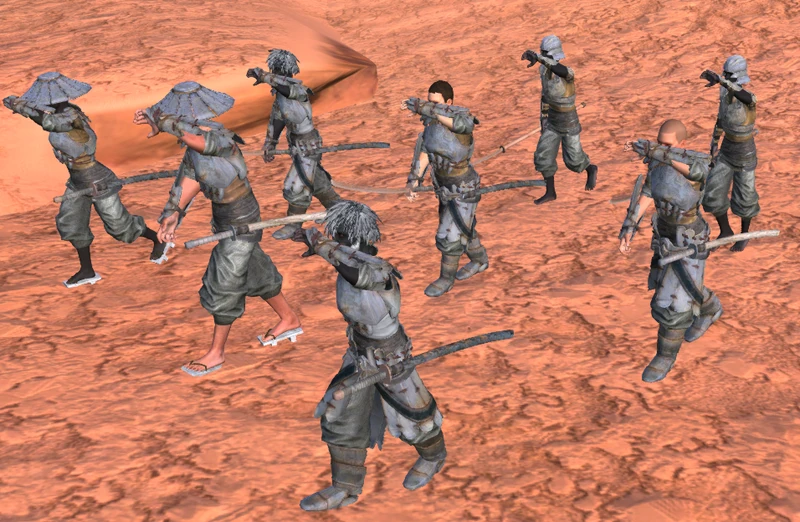
The Samurai are simultaneously the Empire's army and its police. A typical imperial squad is a few samurai, a scout or two, some conscripts and a sergeant; in a war zone like Bast you instead meet "weakened" formations dominated by conscripts — ten to twenty of them stiffened with three to five regulars. A high conscript ratio is itself a battlefield report.
The strongest individual in imperial service is Eyegore, a hiveless Southern Hive soldier drone regarded throughout the Empire as the final answer to every problem. Kidnap or kill the emperor and Eyegore leads the response party personally.
Comparing imperial and Holy Nation strength calls for care: the Holy Nation fields roughly 2.2 times the Empire's numbers in Bast and about 4.8 times in the Skimsands, and every one of its troops is male. That tells you the two states mobilise differently; it is not enough to infer relative population.
The frontier: the ruins of Bast
Bast was once the Empire's rich agricultural belt, dense with farms and trading villages. The Holy Nation levelled it in a single day, burned the local nobles alive before the eyes of Okran, and marched every young person off to Rebirth.
I've heard of that place. Whole city wiped out by the Holy Nation in a day… mind you, that noble probably had it coming. — in-game dialogue
The front has been frozen in place for at least fifteen years since, leaving Bast and the Skimsands as permanent attrition grounds. The Empire has not given up its ambitions: the diplomat Koin will bluntly ask the player to assassinate or abduct the Holy Nation's High Inquisitor Valtena so that the Empire can move into the gap, seize the mines, and take anyone usable as slaves.
Cracks on the inside
The real threats to the Empire mostly come from within:
- Rebel Farmers — farmers evicted for unpaid rent and taxes, led by Boss Simion, raiding caravans and travellers across imperial territory. Officially treated as a nuisance rather than a rebellion.
- Vagrants — the destitute and the small-time thugs around Heng, robbing their way across the Great Desert and serving as the slavers' favourite prey.
- Anti-Slavers — elite ninjas under Tinfist dedicated to wrecking the slave economy. The Empire classes them as terrorists.
- Reavers — Valamon's slaving outfit, whose goal is to replace the Empire's lazy, corrupt nobility with a "more efficient" regime. What they object to is not slavery but mismanagement.
- Luquin — an assassin, and the most famous product of the Empire's poverty laws. See below.
Luquin: the poverty law in one life
The principle that poverty is guilt has a named victim, and his story has been told several times over by both channels.
Luquin was fourteen when the family business failed and his entire household was sold into slavery for "being a burden on society" — in plain terms, for failing to pay their taxes[V11 0:05:57]. His father died in the mines; his mother traded herself for his chance to escape[V12 0:05:57]. Once out, he was taken in by a ninja family and trained as an assassin[V3 0:19:37].
Seven years later he came back. He pinned Lord Kurusaga to the wall with the lord's own sword and left a note at the scene: "One down, five to go." After his capture the Empire paraded him through the streets, tortured him in Tengu's vaults, and finally forced him to write a book in praise of the emperor[V2 0:06:27].
For the player
There are three routes to an alliance: money (roughly 100,000 Cats in total), influence (hold a level-two or better outpost, then pay around 10,000 Cats), or force (hand Tinfist over to the police). Relations of 50 trigger the alliance automatically. The rewards are tax-free settlement, freedom from slaver harassment, samurai escorts and medical treatment, access to police training facilities, and nobles who stop treating you as prey; the cost is that the Rebel Farmers and Anti-Slavers turn hostile.
Points of disagreement
- The date of founding, and whether the Empire is a direct successor to the Second Empire, are speculation rather than settled fact.
- Some video readings describe the Empire as a secular state free of racial or gender discrimination. That does not sit entirely comfortably with the Hive underclass or the existence of the United Heroes League. The more accurate formulation is that the Empire has no institutionalised racial law, while social discrimination is widespread.
- One account holds that Tengu is merely a puppet installed by the nobility (see Noble Circle); it derives from a single anonymous letter and is not settled.
Books found here
The Blessing Of Slavery, The Red Rebellion, United Weekly Series, Puppet, Letter Of The Condemned, Beautiful Tengu: A Tribute, The United Cities, A United Power, Money is Freedom, Letter Of Parting
Video citations
- Kenshi: Major Powers | United Cities and Holy NationCivilizationEx
- Kenshi: History of the United CitiesCivilizationEx
- The History of Kenshi | DocumentaryCivilizationEx
- Which Faction Can Succeed on Kenshi?HeroInHisHead
- What If Cat-Lon Tried To Take Back Kenshi?HeroInHisHead
- The Origins of the ShekHeroInHisHead
- What If The Rebel Farmers WinHeroInHisHead
- Kenshi Base Building - Anzai's VaultHeroInHisHead
- The Real Villain Of KenshiHeroInHisHead
- The Origins of the CannibalsHeroInHisHead
- Kenshi: All Unique CompanionsCivilizationEx
- Kenshi: Unique Companions | ScorchlandersCivilizationEx