
Shek KingdomReport
English:Shek Kingdom · Factions
A warrior nation that holds an honourable death in battle as its highest value — the same creed that makes them the hardest enemy on the continent is currently driving the whole race towards extinction.
- Origins: descendants of the Enforcers?
- Kral's unification
- How honour became an institution
- A country that produces nothing
- A century of blood with the Holy Nation
- Shager's war
- Contraction under the Stone Golem
- The ones who broke away
- The arithmetic of population
- Territory
- Further readings and unsettled accounts
- Is Mukai the last of the Invincibles?
- Is the Flying Bull actually an "Invincible"?
- Who took Ghost's sword?
- What Tora's wanted poster says
- A few softer conjectures
- See also
- Books found here
The Shek Kingdom is the homeland of the Shek: a thinly populated, strongly tribal warrior nation. It occupies the rocky hills of the Stenn Desert, and its capital Admag is built on a plateau with a single entrance. The country has no farms, no mines and almost nobody who can read; it lives off raiding and tribute, settles every question of rank by force, and believes that dying on a battlefield is the only respectable end.
Which is precisely why it now stands at the edge of extinction.
Origins: descendants of the Enforcers?
Shek origins are unsettled. The strongest clue comes from the Skeletons of Black Desert City — on meeting a Shek they call out "Enforcer" outright, and remark that these people "were always spiky in character, and now they finally have real spikes to match". The Holy Nation's scripture The Guiding Light IV says instead that the horned devil was originally a brother to the followers of Okran, and fell into a beast's shape by rejecting Okran's light. The two accounts take opposite positions but share a premise: the Shek were once human, and the plates and horns came later.
The inference drawn from this is that the Enforcers were a military class created by genetic engineering in an ancient empire, with heavier builds and greater aggression. After the Second Empire fell apart they lost their masters and migrated south into the Border Zone, the Stenn Desert and the Spider Plains, and for a long time afterwards remained a set of mutually warring tribes[V1 0:03:26][V2 0:00:36]. Those "masterless centuries" are the only period in Shek history without a king, and the origin point of every institution they later built: all rank was fought for, because at the time there was nothing else to rely on.
Kral's unification
The exact date of the founding is unknown, falling somewhere between one hundred and one thousand years ago — certainly after the Shek grew horns, and before the United Cities and the Traders Guild were established.
The turning point was a warrior named Kral. He welded the scattered tribes into a kingdom, taught his followers a code of honour and strength, and led them on a path of conquest. Legend has it that he was finally surrounded and killed by an enemy that outnumbered him a hundredfold — after his death he attained near-divine status, and the manner of his death became the template for the whole race.
Only after unification came cities. Squin, Last Stand, the Great Fortress and the capital Admag were all built after the founding, along with the Old Frontlines and a border outpost in the north-east[V2 0:00:36][V1 0:03:26]. The composition of that list is worth noting: apart from two towns, every entry is a military installation.
The Shek had raided their neighbours since the tribal era, and did not stop after founding the kingdom.
How honour became an institution
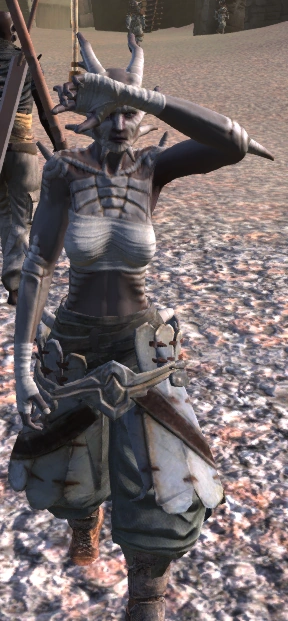
Shek society has only two classes: warriors and retainers. The dividing principle is crude and simple — the weak produce, the strong take.
Within the warrior class there is a clear ladder: at the bottom are the Shek adventurers who travel about looking for strong opponents; above them the scouts who patrol in small teams and report incursions; above them the Shek warriors who serve as guards and the bulk of the army; the elite are the Hundred Guardians, who lead patrols and raids and garrison Squin and Admag; and at the very top are the Five Invincibles, who live in the capital and lead troops into battle in person. When the state is in danger, kamikaze-style suicide charge squads are formed on top of that[V1 0:05:23]. The definition of the Five Invincibles is itself a boast: legendary warriors who have never tasted defeat, representing the highest standard of Shek martial practice[V3 0:00:44].
The retainer class takes in everybody else — labourers, artisans, farmers, household servants[V4 0:03:32]. In other words, every genuine producer in this country is institutionally classified as a loser.
- Horns are status. Those who are defeated but survive are ceremonially dehorned on returning home, stripped of the right to fight and demoted to retainer, serving a warrior lord for life[V5 0:03:59]. Two recruitable Shek happen to act out the two stages of this slide: Rane the Giant was an elite Hundred Guardian whose nickname was given to him by Esata herself, then lost his place after losing a single duel and could only become a mercenary; Oron fell further still, becoming a retainer who has to scrape together 3,500 Cats to buy himself back from his master before he can pick up a sword again[V6 0:15:29].
- Rank is ordered by fists. Every rung of that ladder has to be fought for personally, and war names are granted only to the very top few.
- The throne is taken by challenge. There is no hereditary succession, no election, and no council able to check the king's will; the only way to change ruler is to strike down the incumbent in an honourable duel to the death[V1 0:04:42]. This system of succession guarantees that the leader is always the best fighter in the country, and equally guarantees that he never has to be the best administrator.
- How you die determines where you go. Those who die in battle pass to Gateway (also called "the other side"), a spirit realm where the great warriors gather.
- The same measuring stick is used on outsiders. The Shek discriminate against every other race by default, until that race proves itself in combat — a rule with no exceptions, including for the player[V2 0:01:47].
Glory does not come looking for you. We tear it from our enemies with our own hands. — Hundred Guardian
Intellect has no place in this value system; the overwhelming majority of Shek cannot read, the queen included. The only non-Shek race that earns even grudging respect from them is the Skeletons — unafraid of death and physically hard, which fits their definition of a warrior.
The weight of dehorning can be inferred from its consequences: the humiliation is heavy enough that many of the disqualified simply never come back, fleeing the kingdom for breakaway organisations like the Band of Bones[V5 0:04:33]. The institution is designed to weed out the weak; what it actually weeds out are the people willing to stay.
The same values have one more rarely mentioned side effect. As one commentator notes: in a society where strength is everything, having your property taken is public proof that you are not strong enough, and the government will not recover it for you — it will look down on you further for being "weak". So there is no meaningful security of property inside Shek territory, and no meaningful freedom of movement either[V7 0:12:27]. That is the bill that comes due once individual strength is equated directly with rights.
A country that produces nothing
The Shek Kingdom has no farmland, no mines, no refineries, and by default not even a single crossbow. The wind generators in its towns are Tech Hunter-grade tier-two units, which means their electrical infrastructure was built for them by outsiders — implying they did without electricity before that.
So what do they eat? The granaries in the towns are stacked with food from every climate zone: riceweed, cactus, greenfruit, ration packs, even dried fish — and the Stenn Desert has no rivers. None of it was grown; it was collected. The Western Hive has long been one of their tribute payers, with grain and supply caravans crossing the Stenn Desert on a regular basis; and if the player builds an outpost near their territory, Shek squads will show up demanding all their food.
Laid out end to end, the Shek in fact occupy only the middle of the supply chain: the goods mostly come from the Western Hive, Tech Hunters and scavengers, and the Shek act as middlemen rather than producers — some commentators therefore judge that this country has no economy of its own at all, and could not sustain itself once isolated by the other factions[V7 0:09:15]. And this is not recent: the cycle of living off raiding and demanding tribute from neighbours has been running for centuries[V5 0:04:33].
One line of commentary calls this a parasitic economy: it produces nothing and only consumes, living entirely off plunder and tribute, and therefore requires victims in order to function. The logic has a sharp summary — a parasitic economy can feed a predator but cannot feed a victor; the moment the victims are gone, the predator dies with them[V8 0:11:26].
Another commentator splits the same point into two endings: take the plunder route, and either you run into an opponent you cannot beat and stagnate — which is exactly where the Shek are now — or you actually do conquer, by which point the land has been wrecked in the fighting and the only people who knew how to farm it have been turned into your enemies[V5 0:10:05].
At present only one thing holds this dead end even slightly open: Bayan's push to "allow outsiders to trade inside Shek cities". It is the sole lifeline of the Shek economy, and its precondition is nothing more than the queen's temporary consent[V8 0:07:32].
A century of blood with the Holy Nation
The Holy Nation defines the Shek as "beasts who must be enslaved and their corruption purified"[V2 0:01:47], and so attacks any Shek approaching its cities without a human "master" in attendance. Conversely, Shek hatred of Okranites is close to instinct — patrols frequently attack Holy Nation people on sight, and a player allied to the Holy Nation will simply be hunted. Seventy-three per cent of the slaves in Rebirth are Shek.
Shek historiography puts the blame on the other side: "those Holy Nation dogs poked the sleeping giant, so the Shek bit back." But the line deliberately skips what History of Kenshi records — that they never once stopped raiding their neighbours from the founding of the kingdom onwards.
So when did the total war begin? Here is an inference worth setting alongside that. No record shows Kral fighting the Holy Nation during his reign, while the in-game book King Shager's Reign states that conflict with the Holy Nation "only truly began in his generation". From this one can infer that the two nations may have hated each other for a long time, but the total war was lit by Shager[V9 0:11:49]. This is a reading derived from a gap between texts, not the game's stated conclusion.
Shager's war
The previous king, Shager, took "death in battle is glory" to its limit. When the Holy Lord Phoenix of the day launched a crusade to stamp out Shek raiding, Shager's response was to throw most of the country's population into an all-out offensive, while also fighting the United Cities in the south — in practice he was at war with the Holy Nation, the United Cities and anything else that counted as an enemy, all at once[V2 0:02:23].
His justification is written in that same King Shager's Reign, the barest statement of the old Shek dogma: when your enemy has you pinned, you can bow your head, or you can stand up and fight to your last breath — and even with no chance of victory, you carry blood and destruction to the enemy's door[V10 0:05:04]. The Shek under Shager fought exactly by that line, all the way until the army ran dry, and never saw a victory.
The Shek held the advantage in technique and were crushed on numbers. However strong the individual, it cannot make up a difference in headcount, and every battle cost another slice of the population, until the whole race had been pushed to near-extinction figures[V9 0:12:23]. The Great Fortress, the Old Frontlines and several border outposts fell one after another, and Shager consistently refused to change tactics[V2 0:02:23]. They did take and hold The Hub at one point, only to set it alight and withdraw at some later moment — Holy Nation scouts found not a single body in the town, and to this day nobody knows why.
With defeat clearly settled, Shager proposed one last move: throw every remaining warrior into a suicidal general assault on the Holy Nation, so the whole army could die like warriors[V2 0:02:23].
The warrior Bayan objected publicly, and Shager flew into a rage and called him a coward. At that point Esata, one of the Five Invincibles, stepped forward and stopped the assault[V8 0:07:32].
This man speaks the truth. If you want to silence Bayan, you cut me down first.
The two drew. Esata won, and put her blade to Shager's throat. Shager said "do it — I would rather die like a warrior than live like a coward", and she did.
Contraction under the Stone Golem
Esata is the first Shek leader to admit there is a population problem. Her measures are, by Shek standards, radical:
- Pull the main force back from the Holy Nation front, keeping only low-intensity harassment raids
- Sign a truce with the United Cities
- Forbid attacking outsiders inside Shek cities
- Open the cities to outside trade
- (Grudgingly) tolerate other races entering Admag
Placed in Shek cultural context, every item on that list is a radical act[V11 0:13:01]. What she and Bayan actually pursue is a pragmatic line: rebuild first, prepare first, no more mindless charges[V10 0:08:26].
The price is a torn society. Warriors in the cities generally regard this as cowardice: "We are warriors, not farmers… those Empire cowards, those Okranite dogs — they are laughing at us!"
Esata is quite honest about her own attitude to these policies:
Flatskins. I despise them, and if it were up to me they'd be chased away at our gates… but Bayan tells me their trade is necessary to the growth of the Shek… so I'll tolerate them. For now.
"For now" is currently this country's only basis for peace.
The traditionalists' opposition is not merely verbal grumbling either; their charge is theological: Kral's teaching grants warriors a sacred right — to die on a battlefield — and to stop fighting is to deprive them of it. Hence a very Shek form of protest: large numbers would rather exile themselves and look outside the kingdom for the glorious death they are denied inside it[V10 0:08:26]. The war with the Holy Nation had already eaten most of the population, and of the survivors who made it to the truce, a considerable number simply left, or joined the Berserkers, Kral's Chosen and other splinter groups advocating a return to tradition[V8 0:01:18]. The queen won that duel, but she has not won this argument.
At the game-data level, this kingdom has only four uniquely named leaders: Esata the Stone Golem, Mukai the Mountain, Bayan, and the Stone Golem's daughter Seto[V12 0:00:46] — and of those, Mukai does not normally exist in the world at all (see below).
Bayan: the adviser who never got his sword back
Bayan is a rare exception in this system — a voice that is listened to without force behind it. The official short story Bayan's Story, written by Lo-Fi's lead writer, explains how he came to be this way.
In the story he is beaten down, and wakes up lying in the desert with broken bones all over, raises a hand to his head and finds nothing but a stump of horn. That is the verdict: branded a coward for life, never a warrior again. What carries him back to the plains north of Admag is a passing human caravan; and what greets him at the gate is a glare and a mouthful of spit from a guard who had once been a comrade[V13 0:07:50]. Inside the heavy iron doors of the fortress, Esata does not speak up for him. She merely tears the broken seal from his chest, takes away his sword, and says: "Then you will have more time to read your books."
One commentator points out what really matters in this passage: contempt from your own kind is more total than hostility from strangers. The Holy Nation hates the Shek, but only the Shek themselves can delete a Shek from the category of "warrior" — that is how the Shek honour system actually works. And the man stripped of his sword, left with nothing but books to read, is the adviser who later talked the queen into opening the cities to trade.
The ones who broke away
| Group | Leader | Position | Range |
|---|---|---|---|
| Kral's Chosen | Flying Bull | Orthodox Shager line: Esata bowing to flatskins makes her a coward | Stenn Desert; New Kralia, west of the Great Fortress |
| Berserkers | Ghost | More thorough still — even Kral's unification should be undone, back to the tribal era | Spider Plains, and Berserker Country further north |
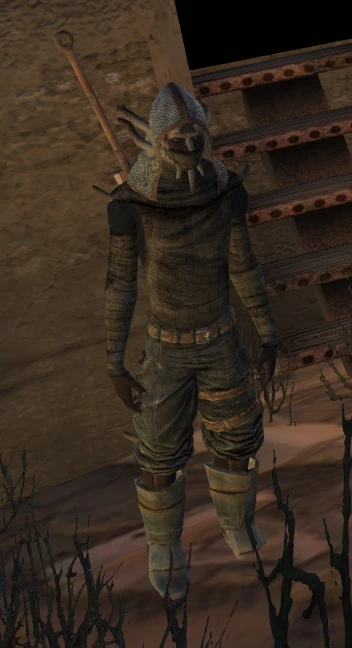
| Band of Bones | Tora the Fearless | Fugitives who were dehorned and demoted to retainer, and refused to hand over their blades | Roaming east of the Great Fortress, reaching south to the edge of Border Zone |
The composition and geography of these three is consistent across multiple lore videos[V2 0:03:40][V1 0:09:13][V14 0:11:10][V15 0:21:59]. Their common feature is equally clear: almost all their members are warriors expelled from the kingdom and humiliated by dehorning, still fighting for glory, for reputation, or simply to prove that "exile does not equal defeat"[V3 0:01:19].
Flying Bull was an old friend of Shager's. After Esata took power he judged that bowing to flatskins made her a coward, declared himself the warrior Kral had chosen, and left Admag with a body of old subordinates to build the base of New Kralia and the faction Kral's Chosen[V9 0:14:39]. Which is to say the Shek war party was not eliminated by Esata — it merely moved out.
The Berserkers went further. They could not tolerate even the minimal constraints of life in the kingdom, and broke away to return to the pre-unification tribal state of attacking anyone on sight[V11 0:16:58].
Tora the Fearless demonstrates how the honour system manufactures its own enemies: she was a loser expelled from the Hundred Guardians, but refused to surrender her sword, and the kingdom has called her "Tora the Gutless" ever since. She would rather give up honour than give up the right to die as a warrior, so she raised the Band of Bones and took up banditry[V9 0:02:24].
The largest of the three is Kral's Chosen. Judged by patrol numbers they are, in some regions, a match for the kingdom's regular army — this is not scattered rebellion but an organised minority, with their base at New Kralia sitting inside the kingdom's own heartland.
The clearest indication of their weight is the game's succession setting: if Esata is killed or captured, the Flying Bull takes over the leadership of the Shek Kingdom directly, with the kingdom's Hundred Guardians and Five Invincibles transferring en masse to his command[V4 0:14:16]. From this some commentators infer that Kral's Chosen is not a self-appointed clique but a traditionalist wing with substantial support inside the kingdom — the game's willingness to hand him the throne outright is itself a statement about the background setting. And if Esata and the Flying Bull both go down, a character who does not normally exist in the world, Mukai the Mountain, is spawned to take charge of the kingdom[V4 0:22:09] — the faction's last line of insurance.
The arithmetic of population
The Shek Kingdom's predicament can be quantified directly. Comparing force density, the Shek are outnumbered 9.3 to 1 by Holy Nation forces in the Border Zone and 8.3 to 1 in Skinner's Roam; count in the other human factions and the gap widens to 17 to 1 and 15.6 to 1. About ninety-five per cent of all Shek are concentrated in the single city of Admag.
More lethal still is the direction of the filter: the honourable-death system preferentially eliminates the strongest and bravest individuals. Every generation's best warriors actively go looking for death, while the ones who survive are the dehorned losers.
If Esata goes down — killed or imprisoned — the world answers immediately: the cities empty out, the survivors all convert to Kamikaze squads pouring into Holy Nation territory, Admag becomes a Berserker nest, and Squin falls to Mukai the Mountain or the Flying Bull. There is no transition, no regency, and no institution able to catch the fall.
Some commentators regard this as the core of the whole problem: the Shek Kingdom has no bureaucracy, no council and no mechanism of continuity, with rule resting entirely on the personal fighting strength of whoever is on the throne — so when the queen falls, all of her reforms are voided simultaneously[V11 0:00:10]. And the game data's reaction is not to retreat and regroup but to launch kamikaze suicide patrols outright, with traditionalists like Mukai the Mountain and the Flying Bull each taking over territory — taken as direct evidence that the system has no resilience at all[V8 0:05:15].
Territory
| Location | Type | Notes |
|---|---|---|
| Admag | Capital | Built on a plateau with a single entrance; home to the queen, Bayan, Seto and the Five Invincibles |
| Squin | Town | A canyon town in the Border Zone, purely wind-powered, frequently blacked out |
| Last Stand | Military base | Where elderly Shek prepare to head for Arach and ask Bugmaster for a respectable death |
| The Great Fortress | Military base | The name flatters it; most of the buildings are already ruined |
| Old Frontlines / Shek Ruins | Ruins | Former outward garrisons and border outposts |
The barman in Admag has an account of these ruins: they are not failures, they are scars.
Further readings and unsettled accounts
The game leaves a great deal about the Shek unsaid, and what the two lore channels have filled in is genuinely good — but every item below is inference or interpretation, with nothing stated in the game.
Is Mukai the last of the Invincibles?
One hypothesis holds that Mukai the Mountain is the person most likely to be a surviving member of the Five Invincibles. Three grounds are offered: his epithet "the Mountain" follows the same naming pattern as Esata's "the Stone Golem"; his combat stats genuinely match or exceed those of top serving warriors; and the reason he has not appeared until now may be that he left with the traditionalists after Esata took power, choosing self-exile — because he could not beat her, but did not agree with her either[V4 0:23:16].
The same commentator also notices another layer in the name: "Mukai" in Japanese can be read as "to oppose, to face, to go against", and he argues the name is deliberate — Mukai is the reaction force to Esata's reforms, and the Mountain will rise only when the Stone Golem falls[V4 0:24:26]. This is word association, and no stronger than that.
Is the Flying Bull actually an "Invincible"?
The community has long assumed the Flying Bull came from the Five Invincibles, on the evidence that his signature weapon's description calls him "the most loyal of the Invincible warriors". But one commentator, after comparing stats, points out that he only reaches the level of a senior Hundred Guardian, and therefore argues the line is a boast of the Flying Bull's own — and that the self-aggrandising tone of the weapon description's second half fits exactly the fanatical style of Kral's Chosen as a faction[V4 0:09:14].
Who took Ghost's sword?
Ghost and Tora come from the same mould: both were defeated in combat and dehorned, both refused to accept the fate of second-class citizenship, and both preferred to take their blades into exile and raise their own armed bands[V2 0:04:19]. As for who actually defeated Ghost, one account points at Gorrillo, leader of the Gorrillo Bandits — a group of pure bare-handed fighters who wear no armour, based in the old prison in the Bonefields, whose leader carries a 50,000-Cat bounty from the Shek Kingdom and the United Cities and, crucially, carries an Exile Plank of the kind issued to Shek warriors[V16 0:05:01]. That plank is the only physical evidence in the whole chain; the rest rests on matching names, and the game has never confirmed it.
What Tora's wanted poster says
One commentator notices that Tora's title on her wanted poster is not "warrior" but "disgraced retainer", and her wanted alias is the mocking "Tora the Gutless". From this he infers that she really was a warrior, and chose to flee rather than accept dehorning and demotion after her defeat; and that most of those who followed her were low-ranking defeated soldiers who likewise refused to give up their swords. If that reading holds, the Band of Bones is not merely a gang of bandits but a quiet revolt within the servant class[V4 0:03:32].
A few softer conjectures
- Who are the "Skull Collectors"? The recruitable Hive marksman Green mentions that his caravan was wiped out by "Skull Collectors". One commentator guesses this refers to Kral's Chosen, but it is purely a guess from matching names[V6 0:18:40].
- How did the ritual at Last Stand come about? One reading holds that the "last battle" in which an elderly Shek walks alone towards a certain-death opponent like the Bugmaster is essentially a cultural ritual evolved out of an ancient work assignment: originally they were simply sent to clear something out, and a thousand years later it had become a ticket to Gateway[V9 0:10:07].
- They ought to have a proving ground. The Shek habitually settle rank by challenging each other, and Esata herself won the throne by challenge, so one creator argues they should have a formal proving ground where warriors prove themselves against each other in front of their people, rather than only in battle or on hunts[V17 0:00:34]; he goes further and imagines such meets presided over by Esata in person, with winners potentially recruited into the Hundred Guardians or the kingdom's regular army, institutionalising "proving yourself" as a promotion track[V17 0:14:27]. This is a player's base-building concept; no such facility exists in the game.
- Shek outposts should not have assassination dummies. The same creator deliberately left assassination training dummies out when building a Shek base, on the grounds that assassination training is incompatible with an honourable martial people who prize face-to-face fighting; campfires, outdoor seating and tents — the "sit around the fire telling war stories" arrangement — fit their way of life instead[V18 0:30:14].
See also
Books found here
Kral's Last Stand, Way Of The Warrior: The Book Of Kral, Shager's Overthrow
Video citations
- Kenshi: History of the Shek KingdomCivilizationEx
- Kenshi: Major Powers | Shek Kingdom and HiversCivilizationEx
- Kenshi Colosseum: Esata | The Five Invicibles VS The Shek ExilesHeroInHisHead
- The Origins of the Shek ExilesHeroInHisHead
- What If The Shek And Holy Nation Were Allies? (ft. Muffintop)HeroInHisHead
- Kenshi: All Unique CompanionsCivilizationEx
- Which Faction Can Succeed on Kenshi?HeroInHisHead
- Why The Shek Kingdom Can Not Survive Victory (ft. Patostrophia)HeroInHisHead
- The Origins of the ShekHeroInHisHead
- The Origins of the ReaversHeroInHisHead
- Seto is the Shek Kingdoms ONLY HopeHeroInHisHead
- Kenshi Colosseum: Shek Kingdom Uniques VS Holy Nation UniquesHeroInHisHead
- Bayan's Story - A Kenshi Story by LoFi's Lead WriterHeroInHisHead
- History of Kenshi: Major Powers | DocumentaryCivilizationEx
- The History of Kenshi | DocumentaryCivilizationEx
- History of Kenshi: Minor Powers | Gangs and Bandit CrewsCivilizationEx
- Kenshi Base Building - The Arena of KralHeroInHisHead
- Kenshi Base Building - Shek Storm FortressHeroInHisHead