
Esata the Stone GolemReport
English:Esata the Stone Golem · Characters
The reigning Shek queen. She cut down the previous king to stop a suicidal final charge, becoming the first Shek leader to face her people's extinction head-on — but every one of her reforms rests on a single life, hers.
Esata, war-named "the Stone Golem", is the current ruler of the Shek Kingdom. She holds court in the faction HQ at Admag, flanked by her advisor Bayan, her daughter Seto, and the four surviving members of the Five Invincibles — the fifth seat sits empty, because it used to be hers.
I am undefeated. No one can beat me.
War Name and Standing
In Shek society a war name is granted only to the very best fighters. Esata earned "the Stone Golem" when she joined the Five Invincibles, the five strongest warriors in the kingdom. At the time she served the previous king, Shager, and was one of his inner circle[V1 0:07:26].
The title later came to be used as her formal designation, listed alongside head-of-state names like Holy Lord Phoenix and Eyegore[V2 0:00:44]. War names are handed down from above — and she hands them out too. The recruitable character Rane the Giant was once an elite Hundred Guardian, and "the Giant" is the name Esata gave her; Rane later lost a challenge duel, forfeited her seat as the rules require, and can now be found in a bar in Squin, Admag or Last Stand, recruitable for 7,500 Cats[V3 0:01:28].
Her stats are top-tier: Toughness and Melee Attack both sit around 100 (99.6–104.4), and all six weapon skills sit at 83–87. Her Meitou-grade Fragment Axe is one of the best heavy weapons in the game — though the axe needs 144 Strength to swing at normal speed and she has 91–96, which makes her attacks glacially slow and her still almost impossible to put down.
She is illiterate. The Shek Kingdom has no interest in scholarship, and its queen is no exception.
The Coup
Shager dragged the Shek into simultaneous wars against the Holy Nation and the United Cities, and the population collapsed under the constant bleeding. The ledger of those endless offensives reads as one lost settlement after another: the Great Fortress, the old front line, even the border outposts in the north-east[V4 0:09:24][V5 0:07:59]. Shager still refused to change tactics[V6 0:20:49]. When defeat became obvious, his answer was to lead the remaining wounded in one final charge so that the last army could "die like true warriors"[V5 0:07:59]. Given the numbers at the time, the practical effect of that order would have been to erase an entire people in a single stroke[V7 0:05:05].
The warrior Bayan objected in open council — in Shek culture, close to suicide[V8 0:15:15][V7 0:05:05]. Shager flew into a rage and began threatening him, calling him a coward.
This one speaks the truth. If you want to silence Bayan, you will have to cut me down first.
What nobody expected was who stepped forward: one of Shager's own most trusted Invincibles[V9 0:02:23]. Esata's intervention was not a political alliance. She staked her life, her rank and her name to shield someone arguing for survival[V1 0:07:26]. Shek custom being what it is, the two drew[V6 0:20:49]; she won, and set her blade against Shager's throat[V10 0:12:58][V11 0:12:35]. Shager told her to do it — he would rather die like a warrior than live like a coward — and she drew the blade across[V12 0:07:18].
That day became the dividing line in Shek history: the cut ended not just one king's reign but an entire era of recklessness[V12 0:07:18].
Her Line: Not Anti-War, Anti-Stupid-War
A common misreading casts Esata as a pacifist or an idealistic reformer. She is neither.
She still hates Okranites. She still intends to take Holy Nation towns, put their people to the sword and reduce the surviving farmers to grain-paying vassals. Her disagreement with Shager was never about the goal, only the method: she wants to actually win, not to die loudly. One channel compresses the point into a single line — she opposed Shager not because she rejected the warrior ethic, but because the plan was stupid[V1 0:11:54].
Flatskins. I have no respect for them. If it were up to me they would be turned away at the gate... but Bayan says their trade is necessary for the Shek to grow. So for now I tolerate it.
Even so, that "at least someone is doing arithmetic" posture counts as a generational breakthrough in Shek history. Their entire civilisation is built on a man who died fighting a hundred at once; Esata is the first leader to ask, through action rather than words, what would happen if they tried winning instead.
What She Actually Did
| Measure | Content |
|---|---|
| Frontline withdrawal | Main force pulled off the Holy Nation front, replaced by low-intensity harassment raids |
| Truce abroad | A ceasefire signed with the United Cities, buying a single front |
| No killing inside the cities | Attacking outsiders within Shek cities forbidden |
| Open trade | Cities opened to foreign traders in exchange for food and supplies |
All four cut against Shek instinct, and all four are held in place by her own sword arm[V9 0:03:00][V6 0:20:49]. She is also the first leader to admit publicly that the Shek population is in decline — the truce exists precisely to give it time to recover[V10 0:16:18].
Seen from outside, this is the most tangible turn in Shek policy on record: the southern United Cities fought Shager's Shek for years, and only once Esata took the throne did the two sides make peace and encourage trade[V13 0:08:22], turning the whole southern corridor from a front line back into a trade route[V8 0:15:15].
One reading holds that her method was not to abolish the warrior code but to rewrite its objective — swapping "die gloriously as soon as possible" for "keep the people alive" — and that this genuinely slowed the Shek decline[V9 0:03:00]. The same line of argument notes a loosening in who is allowed to "prove themselves": the core of honour is preserved, but the arena extends beyond the race. Outsiders are still looked down on, yet they can buy respect with martial skill, and an outsider who beats a major Shek enemy can even become a respected ally[V5 0:08:35]. That is the narrative basis for a player earning alliance by hauling in the Bugmaster or a Holy Nation leader.
The Price of Pragmatism: The Warriors Who Walked
The truce is a gain abroad and a bill paid immediately at home. To a substantial number of Shek warriors, halting military operations altogether in order to go and rebuild a society is cowardice by definition; they would rather leave and look for a glorious death — almost every Shek splinter faction alive today is a product of that exodus[V11 0:13:10].
Kral's Chosen, the Berserkers and the Band of Bones are therefore not evidence that she failed but a by-product of her success: she pulled the state back from suicide, and the price was pushing everyone who most wanted to die outside the system. See Shek Kingdom.
Bayan: The Sword and the Sheath
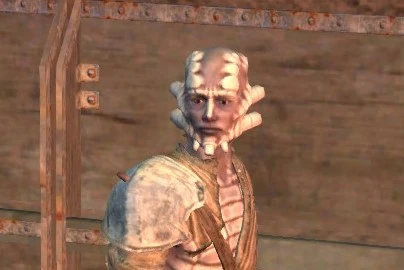
After the coup, the dissenter who had nearly been executed became the advisor beside the throne[V9 0:02:23][V4 0:09:24], and the one she trusts most[V5 0:07:59]. The idea of making peace with the United Cities in order to reverse the population decline is generally credited to him; his function amounts to supplying a brain for Esata's more impulsive instincts, and between them the two represent a new era in Shek culture[V10 0:16:18]. He is a textbook Shek anomaly: highly intelligent, dismal Toughness, timid by temperament — in a society that ranks people by how much punishment they can absorb, every number on his sheet says he should not still be alive.
The division of labour is spelled out in game: Bayan's greeting explains that the Stone Golem saves her strength for fighting rather than "the art of talk", which is why he is the one who speaks. She is the fist; he is the voice[V1 0:05:45].
Her assessment of him is the least Shek line in the game:
Bayan is the sheath to my sword. Without him I would have been lost in my own arrogance long ago, a corpse on Holy Nation soil. Those Okranite dregs do not deserve to be the ones who beat me.
In Shek society, publicly admitting that you need restraining is unthinkable[V1 0:05:45]. She not only admitted it, she killed a king over it.
A Scene Written by Fans
The game leaves most of the detail of their relationship blank, so one channel filled it in with short-form narrative instead. What follows is that kind of reconstruction, not in-game text, but it is a representative reading of Esata's style of rule.
In the story, a de-horned Bayan returns to Admag expecting the whole city to spit on him — Shek custom has survivors of defeat lose their horns and the right to fight. In front of every warrior present, Esata lifts his chin with two fingers, tears the ruined seal from his chest, takes his sword, and says only "then you will have more time for your books"; the piece makes a point of noting the tears in her eyes[V1 0:09:07][V14 0:09:29]. The author reads the scene as a miniature of her whole method of rule: she stripped him of warrior status exactly as the code demands, and with the same gesture reassigned him from the battlefield to being her brain — not demoting him, repurposing him[V1 0:09:07].
The same piece writes the two as each other's pivot: she is silent and volatile and needs someone holding the leash; he supplies knowledge and judgement, and treasures her barely audible replies. What finally brings Bayan to his knees on the battlefield is her line, "I am not ready to let you die"[V14 0:01:16]. The closing line — "for the Stone Golem, I would live through a thousand defeats" — is the piece's most direct inversion of Shek values: he is alive out of personal loyalty to Esata, not because of the narrow gate that Shek faith promises to those who die well[V14 0:10:04].
The Fatal Flaw in the Reform
Esata slowed the decline without solving a single structural problem.
The Shek Kingdom has no bureaucracy, no administrative layer, no law of succession, no agriculture — nothing that keeps running once the leader is gone. One channel went through the list item by item and concluded that the game contains no evidence at all of her pushing an agricultural programme, infrastructure, an administrative system or economic reform: no policy statements, no new institutions[V15 0:09:13]. She held the regime together; she was not rebuilding anything.
The game's world states put it about as bluntly as possible: if Esata dies or is imprisoned, the entire Shek nation converts into "kamikaze" suicide squads that pour into Holy Nation territory. Admag empties out and becomes a Berserker den; Squin passes to Mukai the Mountain, or to Kral's Chosen under Flying Bull if Mukai is dead and Flying Bull is not, or to the Berserkers if both are dead.
No regency, no transition, no buffer. Her policies are her person; the moment she falls, they zero out with her.
Put another way: what she bought was time, not institutions.
Her Answer: Send the Daughter Away
Esata is clearly aware of the problem. Once the player has proven strong enough and is an enemy of the Shek's enemies, she does something close to unthinkable in Shek culture — she hands her only heir, Seto, to an outsider and asks them to teach her.
Not protect her. Not look after her. Teach her.
See Seto for details.
For the Player
- Shek Kingdom relations of +75 allow you to join; hauling in the Bugmaster or one of the three Holy Nation leaders (Holy Lord Phoenix, Seta, Valtena) and handing them to Esata gets you there in one move.
- Allying with the Shek is incompatible with being allied to the Holy Nation, the United Cities, the Traders Guild or the Slave Traders.
- Harming Esata or Seto badly damages relations with the Shek Kingdom.
- Turning her in to the Holy Nation or the United Cities is worth around 50,000 Cats — at the cost of flipping the entire kingdom into suicide mode.
Divided Assessments
- One view holds that she is the only reformer the Shek have ever had, and the last chance this people will get.
- Another holds that "reform" is far too strong a word: shielding Bayan from Shager's rage was the strongest warrior in the room exercising patronage, not a leader changing a system — nothing institutional protects Bayan, and his survival has been tied to her personal capacity for violence from beginning to end[V15 0:04:07].
- Both readings find support in the text. What is certain is that she changed neither the Shek's goals nor their methods, only their timetable[V1 0:11:54].
Further Readings
The following are all lore-channel inferences or experiments. The game offers nothing corresponding to them; they are listed as angles on the character.
Stability is itself a loss on someone's books. One channel argues that Esata's accession is actually bad news for the Traders Guild: a Shek Kingdom that stops invading, concentrates on rebuilding and opens up to trade suppresses demand for war materiel and opens routes that do not need the Guild as a middleman — and to anyone profiting from permanent conflict, peace is a write-down[V16 0:08:53]. The game contains no Guild reaction to the Shek truce whatsoever.
How many bodies her best fighters are worth. One channel measured it in sandbox brawls: Esata plus the Five Invincibles wiped out thirty-odd Shek exiles in the first round without a scratch, and only after each exile faction was reinforced by ten more — thirty extra bodies in total — were the Invincibles beaten for the first time[V17 0:07:27]. This is a player-made experiment rather than official material, but it illustrates the point vividly: putting down the kingdom's best requires a multiple of their number.
If she ran an arena. Imagining a Shek-style arena, one channel supposes that captured Holy Nation troops would be thrown into the pit against Shek fighters, and that in Holy Lord Phoenix's case Esata would probably not settle for an execution but would step into the ring herself for the fight[V18 0:12:12]. Purely personal speculation, but it captures a judgement about her character that the rest of this article supports: to Esata, a good fight is worth more than a political execution.
See Also
Video citations
- Seto is the Shek Kingdoms ONLY HopeHeroInHisHead
- Kenshi Colosseum: Esata | Phoenix | Eyegore VS KingHeroInHisHead
- Kenshi: Unique Companions | Shek, Hivers, SkeletonsCivilizationEx
- History of Kenshi: Major Powers | DocumentaryCivilizationEx
- Kenshi: History of the Shek KingdomCivilizationEx
- The History of Kenshi | DocumentaryCivilizationEx
- What If The Shek And Holy Nation Were Allies? (ft. Muffintop)HeroInHisHead
- The Complete Known History of KenshiHeroInHisHead
- Kenshi: Major Powers | Shek Kingdom and HiversCivilizationEx
- The Origins of the ShekHeroInHisHead
- The Origins of the Shek ExilesHeroInHisHead
- The Origins of the ReaversHeroInHisHead
- Kenshi: History of the United CitiesCivilizationEx
- Bayan's Story - A Kenshi Story by LoFi's Lead WriterHeroInHisHead
- Why The Shek Kingdom Can Not Survive Victory (ft. Patostrophia)HeroInHisHead
- The Real Villain Of KenshiHeroInHisHead
- Kenshi Colosseum: Esata | The Five Invicibles VS The Shek ExilesHeroInHisHead
- Kenshi Base Building - The Arena of KralHeroInHisHead