
LogoCat (site creator)Report
English:LogoCat (site creator) · Other
The author of this site. This page logs two things, why this platform boots into a world map instead of an article index, and the methodology behind the "Creator's Compendium" articles, specifically where I extrapolate from game fragments and where I draw the line.
- Why I built this site
- It turned into a travel guide along the way
- The map is finished, so what are the wiki articles for?
- Notes from development
- I am just a player too
- A Kenshi diary entry that changes absolutely nothing
- A translation I coined along the way: 墾侍
- What I will extrapolate from
- What I will not extrapolate from
- How things are marked
- See also
Why I built this site
There is already a Chinese version of the Kenshi wiki, but using it always felt disjointed. I sat down and worked out why, and isolated two things: Kenshi leans very heavily on environmental storytelling, and your squads spend most of their existence traversing a very large map. The conventional wiki layout felt clunky purely because of how its information was ordered.
What draws me to Kenshi is that reading lore, scavenging ruins for fragments of truth, and fighting for your life all happen at the same time. The remains of an ancient machine, slaves in a Holy Nation quarry, a patrol of headless thralls — these are not database entries. They are hazards you collide with because you walked into their radius.
Yet almost every wiki files them as text articles. You have to know what you are looking for before you can find it. The whole point of Kenshi is not knowing what to look for.
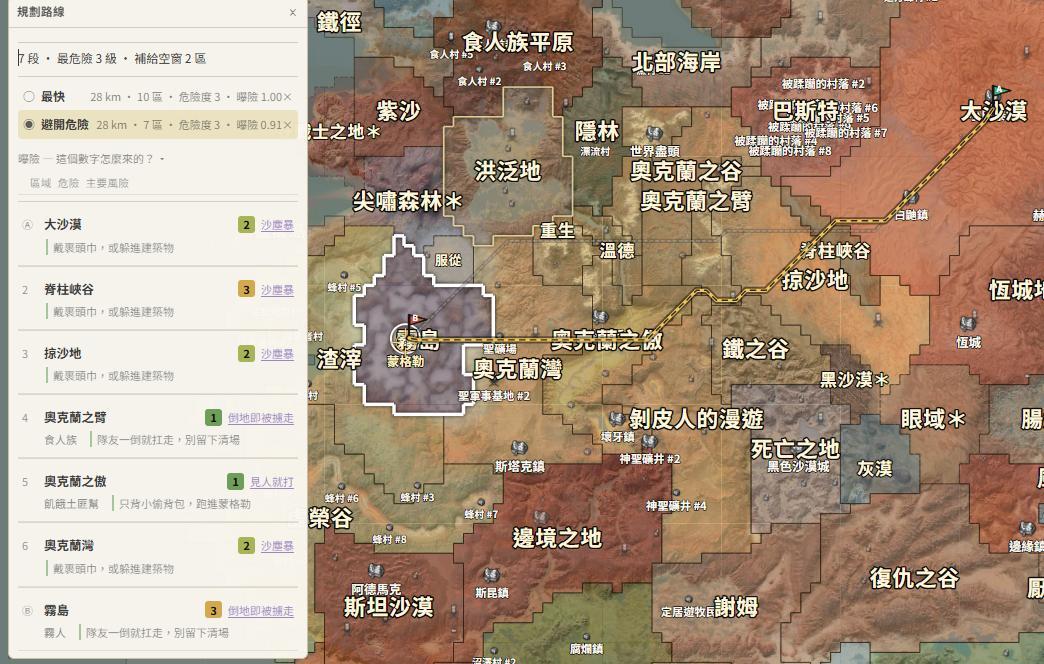
So this site's landing page is an interactive map ↗ rather than an article directory. Hover over a region for its races, religions, factions, threat level and history. Clicking opens the full entry: geography and local flavour, as if you had travelled through it yourself.
There was a practical motivation too. I read lore on my phone over meals, to kill time and steal design ideas. So this site had to work on a phone. Layout, type size, horizontally scrolling tables and the map's touch-drag controls were all calibrated for a mobile viewport.
It turned into a travel guide along the way
Another practical problem: back when I was actively playing, I got lost constantly. Mostly because I spent all my time tracking squad markers on the UI map, which meant realigning to north and reorienting myself over and over. What I wanted was a tool that could output "the safest route based on what is actually in the game files". That is where the navigation engine came from.
That is the question you actually ask while playing Kenshi, and no standard wiki answers it. A wiki will tell you what shops a town harbours. It will not tell you which regions sit between The Hub and the Ashlands, who will try to skin you on the way, or which leg of the trip runs three regions deep with nobody selling medical supplies.
So the site morphed into a survival travel guide: pre-trip logistics, terrain, resupply points, lethal zones. It works like a tourist guide, except the destination town may sell you into a mining pit for life.
Hence the route planner. Two clicks set origin and destination, and it generates the fastest route, the low-threat route, and the high-supply route. Each one breaks down the regions crossed, the local hazards, and concrete resource availability — explicitly checking for medical supplies, skeleton repair kits, food, or crossbow bolts — rather than showing a vague "settlement here" tag. A bandit camp is technically a settlement too.
Sometimes a squad is already fast enough (a rescue, say), so the raw fastest route stays available. But the primary use case is logistical: letting a squad pack the exact minimum kit before setting out, instead of hauling four sets of acid gear around just in case. XD
The map is finished, so what are the wiki articles for?
I leave Kenshi lore channels running in the background while I work, podcast-style. Over time I noticed every creator operates on their own isolated set of theories. So I extracted transcript data across multiple sources and used AI models to compile them into one coherent narrative.
I use AI because it is good at cross-referencing scattered text into a single logical timeline, and because it can aggressively steelman and then counter-argue a hypothesis. Let the model stress-test a claim from several analytical angles, and whatever structure survives is what makes the cut. That is not something a person can reasonably do in their spare time without losing the thread of a readable story.
To be clear, I am fully transparent about using AI in the research phase. The objective is straightforward: serve the Kenshi community, lower the barrier so players can drag their friends in, and let experienced travellers re-experience this bleak, oddly relaxing world through a new lens.
Where licensing permits, this site will keep ingesting community lore theories, folding them into the relevant entries, and crediting the original authors. What actually happened to end the world remains an insanely good subject.
Notes from development
Part of the motivation was that I no longer have time to actually play games, and still wanted to live in one vicariously. My head was fully occupied by world-building theories for the entire build.
Handing task pipelines to AI still generates plenty of hilariously obvious errors. Where it genuinely shines is raw game-data extraction: the region boundaries and visual overlays on the interactive map were parsed straight out of the game files and mapped onto an exact coordinate grid.
To check the model was reading lore and mechanics correctly, I ran spot-checks against parameters I already knew. In the first iteration of the supply-routing logic, it never cross-checked a town's actual infrastructure and went purely off the raw is_town flag in the data.
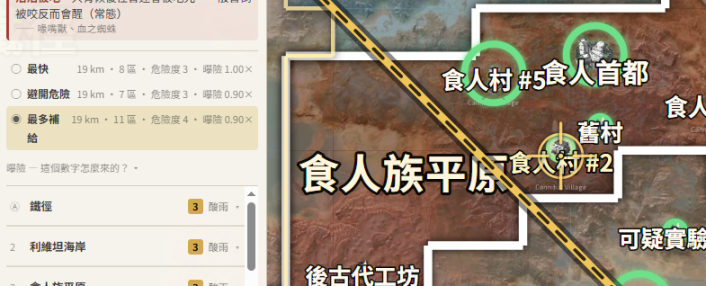
So when it planned a route through Cannibal territory that needed a mid-journey resupply, it cheerfully told me to stock up at the Cannibal Capital.
Right. Excellent. I am now a door-to-door hotpot delivery driver. XD
I am still thoroughly trapped in Kenshi lore with no realistic exit strategy.
The sections below were written for this site and were not in that original devlog.
I am just a player too
I am LogoCat, and I built this thing.
In February 2019 I left a review of Kenshi on Steam. I had 78.2 hours logged when I wrote it. I kept playing. It now stands at 491.6.
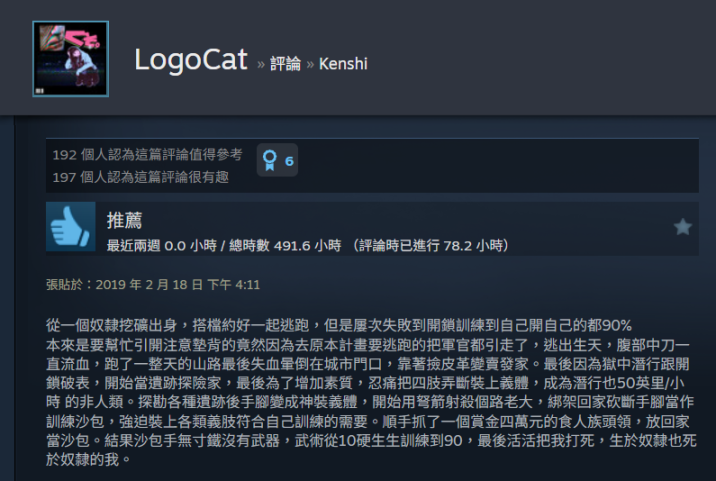
The review is essentially an audit of the game systematically dismantling my sanity: breaking out of Rebirth, taking a rusty blade to the gut, running a full day through mountain passes and collapsing directly in front of a city gate, surviving on scavenged beak thing leather.
Later I voluntarily severed my own limbs for masterwork prosthetics to go ruin-diving, then dragged a Cannibal Grand Wizard with a 40,000 Cat bounty back to my outpost to serve as a punching bag. The punching bag proceeded to level martial arts to 90 bare-handed and eventually beat me to death in my own base.
I love this game. I have also been beaten, eaten alive and enslaved more times than I care to count. This site is the direct product of those trauma logs.
A Kenshi diary entry that changes absolutely nothing
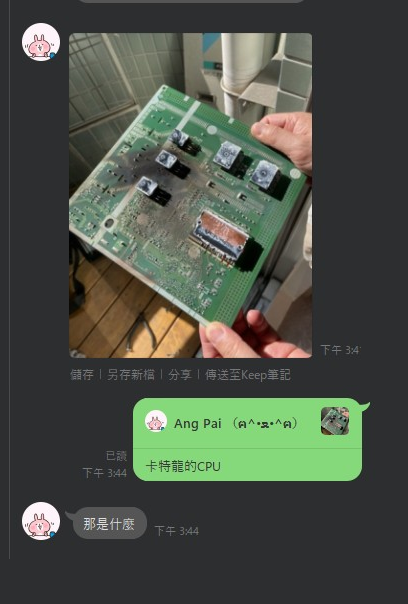
My wife held up a fried circuit board she had just pulled out of a broken air conditioner.
I looked at it and said, "That's Cat-Lon's CPU."
She said, "What are you talking about."
A translation I coined along the way: 墾侍
Maintaining this site meant processing localised terms constantly, and by the end I had come up with one of my own.
In Japanese, Kenshi is written 剣士, swordsman. What this game actually makes you do is reclaim soil on a miserable patch of wasteland, putting up walls in between bouts of being knocked unconscious.
The pairing I find far more fitting is 墾侍. 墾 (ken) is to break new ground; 侍 (shi) is the retainer kanji out of samurai. It keeps the pronunciation exactly, and it describes the actual gameplay loop.
Obviously non-official — the game has no official Chinese localisation to begin with. It is simply the pairing that best mirrors the experience.
What I will extrapolate from
Mechanical storytelling. A large part of Kenshi's lore is hardcoded into AI behaviour rather than written text. Cat-Lon prioritises holding his throne room over hunting invaders, a rule mentioned in zero dialogue and zero books; players deduced it from his pathing. My reading is that he is waiting for someone capable of putting him out of his misery, because that is the least forced explanation for the rule.
Divergent perspectives. Where one piece of physical evidence is read in opposite directions by different peoples. A crashed missile lies beside Stobe's body; humans revere him as a saviour, while the Skeleton Bandits teach that he was a hero and martyr who sacrificed himself to help exterminate humanity. I document those contradictions as they stand. The divergence is the narrative structure of this world, not noise waiting to be edited out.
Unavoidable causal links. A missing link in a sequence that logically admits only one bridge. The Behemoths were purged at Obedience, and the Skeletons then revolted. The unwritten sentence in between — that the Skeletons became convinced they were next on the list — is already an account on this site. I take it, because without that node the timeline does not join up.
What I will not extrapolate from
A single source that is itself guessing. When a video author says "I think", that is headcanon, not lore. I frame it strictly as "HeroInHisHead argues that…", never as fact, and never in my own editorial voice.
Motive the engine does not supply. Why Stobe walked to that exact valley and lay down is something the baseline wiki correctly flags as shrouded in mystery. I will write the prevailing reading, that he stopped the missile. I will not write "he killed himself out of despair". That is emotional projection, not documented data.
Numbers. Prices, stats and drop counts are copied from source as they stand. Where the source records nothing, the article says so, and nothing is back-calculated from an adjacent entry.
Absolutes. "Certainly", "inevitably" and "obviously" barely appear in a compendium article. This world has no reliable narrator. Neither am I.
How things are marked
Compendium articles reuse the site's existing markup rather than inventing rules of their own:
| What you see | What it means |
|---|---|
| Plain body text | A fact already written up in an existing article here, with the sourcing living in that article |
| A tinted callout box opening "Creator's conjecture:" | My reading of how the fragments connect |
| A tinted callout box opening "X argues that…" | Somebody else's inference, from a video author or a wiki editor |
| A small 🎬 icon at the end of a sentence | A video source, and the link jumps straight to that timestamp |
Compendium articles do not re-import the step-by-step sourcing. The original basis for each section stays in the corresponding factual article, and there is a mapping table at the foot of the page to click through.