
SkeletonReport
English:Skeleton · Races
A mechanical race left behind by the First Empire. They need no food, fear no weather, and have twice the health of ordinary people, yet are slowly driven mad by their own memories and emotions, and no new ones can be built any more.
- Origin and original sin
- Body: no hunger, but wear
- Model lineage
- The CPU: memory, reset, madness
- Extended readings: a few open theories
- How the world sees Skeletons
- What to note when playing a Skeleton
- Data and Formulas
- Standard Skeleton versus Greenlander
- Skill multipliers
- Health and vision by model
- Wear
- Slave value
- Skeletons in the faction
- Research Notes
- See also
The Skeletons are the only intelligent race in the world of Kenshi that can no longer be produced. They are machines, yet with full self-awareness and emotion. They almost never die naturally, yet generally live in depression, guilt and a slowly collapsing madness. The First Empire built them strong and durable, able to run forever with proper maintenance unless physically destroyed[V1 0:00:14]. So any Skeleton you meet in the wasteland may be older than any nation now existing.
The history of the whole world revolves almost entirely around them; the founding and destruction of both empires bear Skeleton fingerprints. Some commentators simply call the Skeletons the common denominator of major history: ending the First Empire, nearly wiping out organic life, building and then wrecking the Second Empire, the whole timeline tangled around this one variable[V2 0:01:08].
The Skeletons are a complete mystery. No one knows where they came from or how they were made, only that they are probably thousands of years old.
Origin and original sin
The Skeletons came from the First Empire, and their purpose is generally understood as labor and colonization. What the Tech Hunters leave behind says the First Empire had Skeletons as its main population, which leads many players to think the Skeletons were the ruling race of the time. But some researchers rebut this with the dialogue between Skeleton and non-Skeleton squad members as the party nears Obedience: the Skeletons outnumbered humans by far, but their status was always subordinate; they were made to make colonization and rebuilding go faster[V3 0:03:21]. This is an inference from dialogue and the game gives no explicit text.
The turning point was Obedience. After the war ended, humans feared the Behemoths they had made and ordered them into a great pit to be buried in molten metal, and the Behemoths, out of absolute loyalty, did so without resistance. The Skeletons saw this as betrayal and launched an extermination campaign against their creators, the First Mass Extinction. Humanity nearly died out, and in the end the last Behemoth, Stobe, stopped it at the cost of himself.
Here the truth diverges. A widely circulated reading holds that the Behemoths in fact went to their deaths willingly: after the war they judged themselves the only remaining threat to humanity and asked to be buried. The Skeletons misread this self-sacrifice and slaughtered a whole civilization over a betrayal that never happened. This version has no direct in-game evidence, but it explains one odd thing, why the Skeletons suddenly stopped at the very moment of achieving their goal and began to kill themselves en masse. The same line of inference also fills in the motive: the uninformed Skeletons read Obedience as "humans used the Behemoths' blind loyalty to destroy them", and what followed was a series of finely coordinated attacks, ultimately aimed at one total assault to erase all life on the whole satellite[V4 0:03:57].
Whatever the truth, the consequence is certain: the First Empire collapsed, and the factory complex in the Floodlands that made Skeletons stopped with it. No new Skeletons have been made since, and no other region has ever been recorded as a Skeleton birthplace[V5 0:02:47]. Add violence, disaster and the then-widespread self-termination, and from that moment the Skeleton race was on an irreversible population decline. Every one you meet in the world has walked for thousands of years, and is a stock that cannot be replenished.
After the extermination campaign ended, Skeleton society collapsed as a whole for a time; some ended themselves outright, and others lived on with permanent depression[V6 0:04:01]. One guess holds that the Skeleton custom of periodically erasing memory to avoid going mad originates in this catastrophe, the madness forcing them to forget in order to go on living[V7 0:00:52]. If you also accept the "misunderstanding" theory, the situation of the surviving Skeletons is even more awkward: on one hand they keep apologizing for a crime the world has long forgotten, on the other they hold fast to a collapsing truth, because that truth is that over a betrayal that never happened they nearly killed all life on the satellite[V4 0:06:12]. This is the interpreters' inference; the game draws no conclusion on this narrative.
Body: no hunger, but wear
At the level of survival, Skeletons are nearly cheating.
- They need no food at all; there is no such thing as hunger.
- Sandstorms, acid rain, burning and poison gas cannot hurt them, and walking on acid ground does not burn their feet.
- They cannot swim, and if they fall into deep water they walk along the bottom.
- Health per part is double a Greenlander's, bleeding is a tenth as fast, and healing is twice as fast. The three vital parts (head, chest, stomach) must take double the damage before they fall.
- They cannot wear hats, shirts or shoes, always showing that expressionless metal face, and can wear only armor for the body and legs.
The price is Wear and Tear. A small part of the damage a Skeleton takes becomes a permanent loss of the maximum; the more it fights, the lower the maximum health, which does not recover on its own. For every 100 points of damage taken, that part's maximum health drops by 4. Cuts can be treated on the spot with a Skeleton Repair Kit, but the worn-away maximum can be restored only by a Skeleton repair bed, which needs power to use.
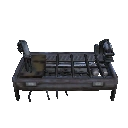
This creates an entirely different economy: Skeletons do not eat, yet must pay repair fees. Prosthetic limbs fitted to organic beings follow the same wear rules, which is also why a human with prosthetics walking into the Holy Nation is treated as a Skeleton.
In skills, Skeletons are good at Heavy Weapons, Turrets and Robotics, starting two tenths higher and training two tenths faster. Stealing, Stealth and Dodge are two tenths lower. This makes sense; a metal body is not suited to hiding. Vision is a quarter farther than a Greenlander's, they run a little slower, and in combat move at ninety percent speed. In a slaver's eyes a Skeleton is worth four times a human, a much higher price; for slavery see Slavery.
Model lineage
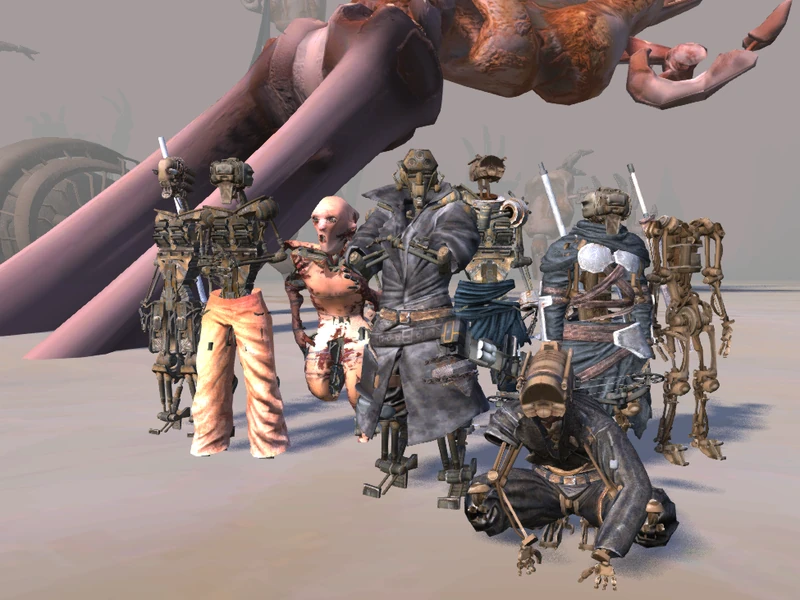
"Skeleton" is both a race and a race group, split into several models with different trade-offs in the numbers.
| Model | Role | Traits |
|---|---|---|
| Standard Skeleton | General purpose | 200 health per part, 1.25 times vision, good at Heavy Weapons, Turrets, Robotics |
| P4 Unit | Command and research | Head has only 150 health; bonuses to Science, Engineering, Smithing and Medic across the board |
| Skeleton Soldier (Soldierbot) | Soldiers and police | 2 times vision, healing speed 1.5 times a standard Skeleton, Perception bonus |
| Screamer MkI | Special ops | Assassination, Turrets, Engineering bonuses, vision only 0.75 times |
| Round-head Skeleton MkII | Cheap infantry | Head 200 health, the rest 150, 2 times vision, Crossbows and Perception bonuses |
| Screamer MkII | Imperial guard | 150 health all over, 2 times vision, Blunt and Heavy Weapons bonuses |
| Skeleton No-Head MkII | Thrall | No head, the rest 120 health, melee bonus |
| P4 MkII | Supreme command | 150 health all over, Blunt and Heavy Weapons bonuses; Cattelron and the generals are all this model |
All MkII models appear only under the Second Empire's system. The community widely guesses they were the Second Empire's own imitations, trading frail bodies for output, which is unconfirmed in game.
Among these models, the P4 with the most fragile head almost always holds a senior post, suggesting they were placed far from the front line from the start of the design.
The CPU: memory, reset, madness
The central tragedy of the Skeletons is not the body but the brain.
Skeletons are set up as fully sentient. They feel sorrow, anger, excitement, compassion and pleasure too, only that metal face has no expression to show it. Lines audible in game make this clearer than any setting document: "Will you ever forgive us, humans" and "the Skeletons have been crying all along"[V8 0:14:03]. Some interpreters go further: they were made conscious but without bodily sensation, with only sight and hearing linking them to the outside world, as if shut in an eternally suspended consciousness, watching civilization collapse again and again and never truly experiencing the world[V2 0:04:32].
They have full emotions but no mechanism for outputting them. Humans can cry and laugh, discharging emotion through heartbeat and body heat; a Skeleton's emotions are data, which can only keep occupying storage. Once data builds up to a certain point it starts producing errors and paranoia, eventually turning into a madness fixed on a single thought.
This mechanism is inference, not explicit setting. One account reduces the whole thing to a plain engineering flaw: Skeletons are computers with no means of exporting data, accumulation inevitably produces system errors, and the end is inevitable madness[V9 0:02:42]. A detailed version holds that those emotions physically occupy hardware space in binary form, and after years of bloating burn out the CPU, fixing the mind on a single emotion[V2 0:07:19]. Some commentators think the root of the sickness is a self-contradiction in the design itself: complex emotion and powerful logical computation fight by nature; while the CPU is new it holds, but with age reason gives way step by step to blind obsession[V2 0:05:06].
The only fix is a reset, and the problem is that a reset wipes the skills too.
Can't you reset when you're too depressed? You can. But then the skills go with it.
So every Skeleton is forced to choose again and again between keeping itself and staying sane. A reset preserves sanity but erases skills and personality built up over decades or even centuries. Refusing to reset lets data and emotion keep piling up, eventually ending in paranoia[V10 0:13:46]. One reading defines reset directly as a kind of self-death: emotion and personality are cleared while memory is left intact, like a new personality looking at the same memories through the same eyes, feeling nothing[V11 0:01:17].
This explains an anomaly in the game: Skeletons who have lived thousands of years but have only vagrant-level stats are often the most normal, while the few with top stats all have clear mental problems.
- Cat-Lon: paranoia and persecution delusion, finally enslaving his own people.
- Elder: blind fanaticism for Skeleton supremacy, building up his strength with a group of masked humans playing "Skeletons".
- Armour King: a pathological fixation on his own stock and on thieves.
- Tinfist: an obsession with freeing slaves that no longer counts any cost, including innocent lives.
Some commentators treat this list as the hardest supporting evidence for the whole mechanism: the few with the highest stats are all in a bad mental state precisely because they all chose the "keep yourself" side[V9 0:03:48]. For a ruler or an individual who has honed a craft for a thousand years, a reset feels equivalent to suicide, which is why they would rather die than lie down on that bed. From this the same interpreter reaches a bleaker conclusion: any power ruled by Skeletons will ultimately repeat the course of the Second Empire[V2 0:12:22].
Whether a reset really erases memory is told differently. In game, Skeletons do remind one another "your CPU is about to blow, time to reset". But there are also clear hints that Skeletons such as the scholar Iyo at World's End in fact remember the First Extinction in full, and the "amnesia" is only a line the collective uses to avoid being held to account. Both accounts coexist in game, each backed by lines.
The community's long-circulated "reset is a lie the Skeletons made up" has been judged by several researchers to be only half right. What has been shown to be a lie is "reset loses memory", the story the Skeletons use to cover up what they did in the First Extinction. The reset itself is corroborated in dialogue by both the player character and NPCs, and truly must be done[V9 0:02:09]. The rebutting evidence points to the dialogue between Dak and Quinn in Black Desert City, and the chat between Skeleton and organic squad members on the road[V2 0:06:13]. A less-mentioned version holds that a reset does not really erase memory, and many Skeletons just use it as an excuse to avoid talking about the First Extinction and other pasts they do not want to revisit[V1 0:02:10]. All three are conjecture; the game gives no ruling.
On whether there once existed a central system that could offload this data for them, see Skeleton Mainframe.
Extended readings: a few open theories
The following are all inferences from lore channels and the community, with no corresponding explicit setting in game; please read them apart from the above.
Is the mass suicide remorse? A rather cold explanation holds that Skeletons are pure logical thinkers and, once the "purpose of life" has been carried out, continued existence has no reason. A large part of the Skeleton remains recovered died by suicide, which in this framework is a mechanical existential crisis involving no pangs of conscience[V8 0:15:10]. Commentators who accept the misunderstanding theory offer another version: a collapse from a double guilt, having nearly exterminated humanity and having personally squandered the sacrifice of their Behemoth kin; perhaps some Skeletons simply could not face what they had done[V4 0:05:04].
They may have shut their own prison door. If an external system like the Skeleton Mainframe really existed and was also responsible for keeping their minds healthy, then the Skeletons' overthrow of the First Empire to break free of control amounted to locking themselves into paranoia and madness, and for a thousand years at that. This is a layer of irony, not setting[V9 0:08:12].
Are they villains? Some commentators explicitly oppose the common impression that "the Skeletons are the villains of the game", arguing they should be sympathized with. The misunderstanding has been reinforced layer upon layer: the Holy Nation equates them with the evil god Narko, the Ashlands has their Legion, most survivors are huddled in Black Desert City at the bottom of an acid rain pit, and the cold tone and expressionless faces confirm the impression[V2 0:02:15].
How the world sees Skeletons
The Holy Nation regards Skeletons as claws of the dark god Narko, attacks them on sight, and leaves no room for negotiation. This hatred is instilled from the level of children's books, and Holy Nation bookshops stock bestsellers like "The Little Boy Dismembered by Skeletons". Interestingly, the two sides were not enemies in faction relations to begin with; racial hatred overrode everything. The Cannibals of the north also fear Skeletons, calling them "things that can't be eaten", from an old grudge dating to fighting the Second Empire's Hydraulic Knights.
Elsewhere things are relatively ordinary. The United Cities, Tech Hunters and mechanics all work normally with Skeletons, and Skeleton mercenaries can be hired in bars. The Skeleton faction opposes slavery and will treat strangers, and is not at enmity with the Old Machines, the Skeleton Legion or the Slaver Bandits.
The Skeletons' own stronghold is Black Desert City at the very center of the Deadlands, a city assembled from scrap, keeping outsiders at the door with year-round acid rain, with no food supply in the city because the residents do not eat. The shops and carried goods of this faction also never include things to eat or drink such as booze, water jugs, greenfruit or chewsticks. The adjacent Scraphouse is the weapons dealer acknowledged across the continent as the best.
Still hostile are the group in the Ashlands: the Skeleton Legion loyal to the mad king, the Second Empire exiles, and the Slaver Bandits who make thralls in the Tower of Torture (see Broken Skeletons). The Skin Bandits at the Ashlands' door who believe they are human belong to the same lineage, and there is a speculative explanation of how they went out of control: they escaped Cattelron's enslavement but also lost access to "processor reset", and year after year their emotion modules built up until the CPU burst, finally going mad together, their atonement toward humans warping into a fanatic "wish to become human"[V12 0:11:19].
What to note when playing a Skeleton
- No need to worry about food, so you can march far, but keep repair kits at hand or know where a repair bed is.
- Stealing and Stealth do not suit Skeletons; leave such work to squadmates.
- Inside the Holy Nation you can barely take a step; think it over before going in.
- Wear does not heal on its own, and pushing on until the maximum is very low costs a lot.
Data and Formulas
The following is the full data for players who want to dig deeper. The source is the race records of each Skeleton model, and the comparison group is the Greenlander.
Standard Skeleton versus Greenlander
| Item | Standard Skeleton | Greenlander | Notes |
|---|---|---|---|
| Health per part (combat anatomy) | 200 | 100 | All seven parts 200, 1,400 in total (Greenlander 700). The fall threshold for vital parts (head, chest, stomach) is hp - stun < -maxHP, i.e. 400 |
| Blood | Fixed 100 | 75 to 150 | A Skeleton's blood does not vary with strength |
| Bleed rate | 0.1 | 1.0 | The last multiplier on total bleed rate |
| Heal rate | 2.0 | 1.0 | Multiplied into health recovery and part healing |
| Hunger rate | 0.0 | 1.0 | No hunger deducted, no digestion, the malnutrition state does not take effect |
| Vision range multiplier | 1.25 | 1.0 | The outdoor detection baseline of 1500 units is multiplied by it |
| Speed range | 70-110 | 70-120 | At Athletics 100, 24.61 vs 26.84 mph |
| Combat move speed | 0.9 | 1.0 | Speed coefficient of movement in combat |
| Slave value coefficient (buy value) | 400 | 100 | See below |
| Swims | No | Yes | Walks along the bottom after falling into deep water |
| Hat, shirt and shoe slots | All disabled | Open | no hats, no shirts, no shoes all true |
| Weather immunity | Sandstorm, acid rain, burning, poison gas | None | In the acid ground foot burn check, robot races are exempt outright |
| Single gender | Yes | No |
Skill multipliers
| Model | Bonus (R=1.2) | Penalty (R=0.8) |
|---|---|---|
| Standard Skeleton | Heavy Weapons, Turrets, Robotics | Stealing, Stealth, Dodge |
| P4 Unit | Science, Engineering, Robotics, Weapon smithing, Armour smithing, Medic | Stealing, Stealth, Dodge, Katanas |
| Skeleton Soldier | Perception | Stealing, Stealth, Dodge, Martial arts, Medic |
| Screamer MkI | Engineering, Turrets, Robotics, Assassination, Melee Attack | Stealing, Stealth, Dodge, Katanas |
| Round-head Skeleton MkII | Friendly fire, Perception, Robotics, Crossbows | Stealing, Stealth, Dodge, Katanas |
| Screamer MkII | Blunt, Heavy Weapons, Robotics | Stealing, Stealth, Dodge, Katanas |
| Skeleton No-Head MkII | Blunt, Heavy Weapons, Robotics, Melee Attack | Stealing, Stealth, Dodge, Katanas |
| P4 MkII | Blunt, Heavy Weapons, Robotics | Stealing, Stealth, Dodge, Katanas |
R is multiplied into the starting level at the opening and into the increment of almost every experience gain (increment = 0.02 × amount × E × rate × R). Where the list mentions Strength or Dexterity, it has no effect: those two use only the race's strength and dexterity fields, and for Skeletons both are 1.0. Practice experience for melee weapon skills (Katanas and so on) does not take the racial multiplier, so "Katanas" in the list can affect only the starting level at the opening; how much it actually matters is currently unconfirmed.
Health and vision by model
| Model | Head | Chest, stomach and limbs | Vision | Heal rate | Bleed rate | Part hit weight |
|---|---|---|---|---|---|---|
| Standard Skeleton | 200 | 200 | 1.25 | 2.0 | 0.1 | Head and stomach 80 each, chest 140 |
| P4 Unit | 150 | 200 | 1.0 | 3.0 | 0.1 | Right arm 40 |
| Skeleton Soldier | 200 | 200 | 2.0 | 3.0 | 0.1 | Stomach 140 |
| Screamer MkI | 200 | 200 | 0.75 | 3.0 | 0.1 | Stomach 140 |
| Round-head Skeleton MkII | 200 | 150 | 2.0 | 3.0 | 0.4 | Stomach 140 |
| Screamer MkII | 150 | 150 | 2.0 | 3.0 | 0.4 | Stomach 140 |
| Skeleton No-Head MkII | Headless | 120 | 1.0 | 3.0 | 0.2 | Legs 20 each |
| P4 MkII | 150 | 150 | 1.0 | 3.0 | 0.2 | Stomach 140 |
"Part hit weight" lists only the cells that differ from the standard Skeleton. The hit chance is the weight divided by the sum of weights, and repeatedly hitting the same part makes you more accurate. The standard Skeleton's stomach weight is 80 against 140 for most other models, so the standard Skeleton's belly is less likely to be hit.
Wear
Each time a mechanical or prosthetic part is hit, its maximum is reduced by (cut + pierce + blunt) × 0.04 × robot wear rate (game default 1.0). Taking 100 damage at once drops that part's maximum health from 200 to 196, which does not recover naturally. The repair bed's speed against wear is 0.05 × the bed's heal multiplier 2.0 × the repair amount; the bed draws 10 power, and without power no one can lie down on it. The repair kit's repair speed is additionally multiplied by 0.33.
Slave value
The value formula is clamp(int(Strength + Melee Attack + Dexterity) × race buy value, 1000, 20000), with the sale price half the value. The Skeleton coefficient is 400 and the Greenlander's 100, so with all else equal a Skeleton is worth four times a human.
Skeletons in the faction
The Skeleton faction's race weights in game are 100 for the standard Skeleton and 4 for the P4 Unit. This faction opposes slavery and treats strangers. Its trade culture does not enter the Holy Nation's religious books. The Holy Nation is not written as hostile to the Skeleton faction, and there is a separate "Holy Nation robot" squad template.
Research Notes
- The older draft said "immune to all weather"; the game data lists only four: sandstorm, acid rain, burning, poison gas. Changed.
- The older draft said "recovery from unconsciousness is several times a Greenlander's"; the data has only heal rate 2.0 against 1.0, with no knockout-specific multiplier. Removed. The text on "reboot" and "oil" also has no corresponding field and was removed.
- The older draft's wear "4% becomes maximum loss" holds; the formula is (cut + pierce + blunt) × 0.04, with blunt included.
- The older draft said Soldierbot has "repair rate 3"; in fact it is heal rate 3.0, against 2.0 for the standard Skeleton.
- The older draft's model table disagreed with the data in several places, for example the Screamer MkI's vision is 0.75 times, the Round-head MkII's bonuses are friendly fire, Perception, Robotics and Crossbows, and the No-Head has no "permanent heavy Engineering penalty" field. Rewritten per the data. The MkII body health is 120 or 150 by model, not always 150.
- The older draft's "the Holy Nation's faction relation is actually neutral": in the data there is no written relation value between the Skeleton faction and the Holy Nation, equal to the default 0; the source of the racial hatred is dialogue and story.
- "AI Core is contraband inside the Holy Nation" could not be found in any record and was removed. The claim that Black Desert City shops do not sell booze or food comes from that faction's spawn-forbidden list.
- Lore on origin, reset, mass suicide and the villain debate is game story and player community inference, kept as it was. The misunderstanding theory and the CPU bloat theory are both conjecture and currently unconfirmed.
See also
Video citations
- Kenshi: History of the SkeletonsCivilizationEx
- The Sadness of the SkeletonsHeroInHisHead
- The Origins of The First EmpireHeroInHisHead
- The Real Crime of the SkeletonsHeroInHisHead
- The Whole Story of The Second EmpireHeroInHisHead
- The History of Kenshi | DocumentaryCivilizationEx
- Kenshi: Major Powers | SkeletonsCivilizationEx
- The Whole Story of The First EmpireHeroInHisHead
- Was There a Skeleton Mainframe?HeroInHisHead
- Kenshi Lore Master AMAHeroInHisHead
- What If Cat-Lon Tried To Take Back Kenshi?HeroInHisHead
- The Origins of the Skin BanditsHeroInHisHead