
SlaveryReport
English:Slavery · Game Mechanics
One of Kenshi's largest industries — two slave systems with completely different motives, and how to get out alive once the player has been taken.
In Kenshi, people are a commodity. Money, food and unconscious bodies are all equally unowned out in the wastes — finders keepers. Slavery is therefore not the quirk of one evil faction but a continent-wide industry that serves as both punishment and commerce.
The parties who actually operate it are the United Cities, the Slave Traders, the Manhunters, the Slave Hunters, the Holy Nation and the Reavers.
Two systems, two motives
The key to understanding slavery in Kenshi is telling these two entirely different logics apart.
| United Cities system | The Holy Nation system | |
|---|---|---|
| Motive | Economic: labour and profit | Religious: penance and re-education |
| Targets | The poor, vagrants, bandits, escaped slaves | Criminals, non-human races, trespassers |
| Trades in slaves? | Yes — slave shops and slave markets | No; it takes people but never sells them |
| Main locations | Slave Farm, Stone Camp, Eyesocket, Slave Markets | Holy Mines, Rebirth |
| End point | Labour until you are no longer worth keeping | Release, in theory, once "cleansed" |
Before reading that table, hold onto an uncomfortable premise: these two systems belong to the only two states on the continent capable of offering commoners walls and a standing army. In practical terms there are exactly two ways to live safely in Kenshi, and both of them are large slave states — states that do not only take outsiders, but seize dissenters within their own borders too[V1 0:13:58]. The Holy Nation runs Rebirth as the largest death-labour camp on the continent; the nobles of the United Cities are rich enough to write "poverty" into criminal law, so that more of their own citizens can be arrested lawfully[V1 0:13:58].
The economic system: the Empire's engine
The Empire's position is set down by Lord Inaba in The Blessing Of Slavery:
Slavery blesses us with wealth, with luxury, with food on our plates. If it weren't for our slaves, who would toil in the fields? ... We are what we are because of slavery.
In practice the Slave Traders are an extension of the Traders Guild — every Slave Master and Slave Mistress holds guild membership. Their stock comes from the bottom of society: Starving Vagrants, Rebel Farmers, escaped slaves, Sand Ninjas, Bloodraiders. The Empire treats poverty itself as a criminal disposition, which leaves almost no distance between arrest and conviction.
In scale, the Manhunters, Slave Hunters and slavers are held to be among the most profitable trades on the continent[V2 0:08:06]. Their closest allies are the Traders Guild and the United Cities, and they have laid down a whole network of mining camps and outposts across Imperial territory[V3 0:07:44]. They also keep up lucrative dealings with slaving powers like the Holy Nation — the Holy Nation does not sell people, but it does buy them, and delivering captives into Rebirth is business all the same[V2 0:08:06]. In other words, two systems with opposite motives are connected at the supply-chain end.
The religious system: Rebirth
The Holy Nation does not trade in slaves. What it runs is a re-education camp:
It is a place of penance and education for the less fortunate, for those who have lost their way from the path. We help them find Okran in their heart... so that they can be reborn once again, as children of Okran. — a Paladin introducing Rebirth to the player
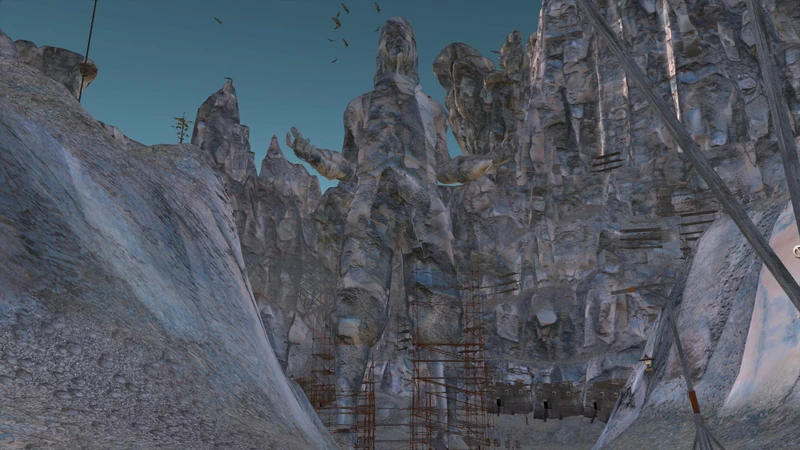
Rebirth sits at the bottom of a pit inside an enormous mountain, where prisoners labour and build a colossal statue of Okran (or Phoenix) until they die — at which point their souls are held to be reborn as children of Okran. There are signs that some sentences are finite, and that prisoners deemed sufficiently cleansed can be let out. Every race except Skeletons can turn up here, because the Holy Nation holds that Skeletons have no soul.
The player can sell characters they feel need "correction" into Rebirth for 500 Cats, or waive the fee for +1 Holy Nation relations. But you cannot buy anyone out: "You cannot buy another for your own selfish desires!"
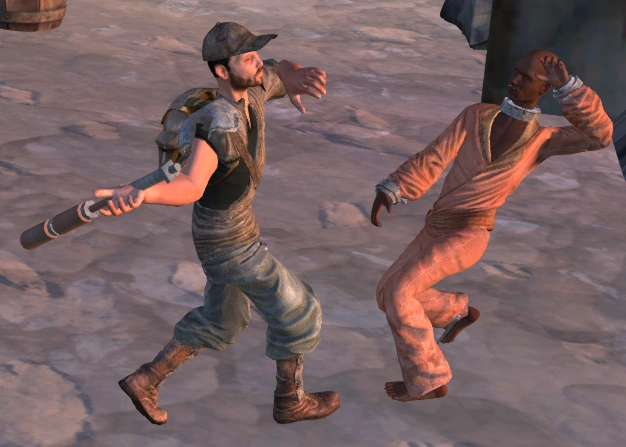
Who does the catching
- Slave Traders — the Empire's slave-holding branch, running the farms and mining camps. They will not attack a neutral player, but the moment one of your characters falls unconscious nearby they will patch them up and take them off to work.
- Manhunters and Slave Hunters — independent factions specialising in recapturing escaped slaves; the former are stronger, better equipped and more numerous. Both will opportunistically package any passer-by who looks weaker than them as an "escaped slave" and sell them on.
- Reavers — a faction of the outer regions, who patrol with armed Reaver Slaves in tow.
- Police — a character arrested in an Imperial or Holy Nation town can be handed straight to the slavers. Bark has no police station, so anyone arrested there goes directly into a cage at the slave shop and is enslaved on the spot.
Two price tags
This industry has a named character at each end of it, and both can be settled with money — set side by side, they say a great deal about how this world prices things.
Headshot stands at the catching end. A Shek woman and a slave hunter by trade, she turns up in a Slaver Bar in either Eyesocket on the Stormgap Coast or the Slave Markets in the South Wetlands. Her melee stats are near zero, but Turrets 54–56 and Crossbows 49–51 make her a rare ready-made ranged specialist for the early game; recruiting her costs 7,500 Cats[V4 0:00:53]. Her personality is flagged as Traitorous.
Ray stands at the caught end. A Hive Soldier Drone slave, he had his tongue cut out by a previous owner for being too disobedient, and his current owner simply wants to offload a bad investment at 1,000 Cats[V5 0:17:27]. He can never speak to any shopkeeper or NPC for the rest of his life. Buying him costs the player 5 relations with the Slave Traders[V4 0:00:53] — the game uses a thousand-cat transaction to force a choice between the cheap option and a position[V5 0:17:27].
Put the two tags side by side: the catcher costs seven and a half times the caught, and buying the hunter offends nobody.
Selling people
The player can capture characters and hand them to a Slave Master for around 400 Cats apiece; the usual stock is Starving Vagrants, Rebel Farmers and desert bandits of every kind. Technically only characters classed as bandits, slaves, adventurers or civilians can be sold; military units (Paladins, Samurai, Shek Warriors) and diplomats cannot — the Black Dragon Ninjas count as military rather than bandits, so they cannot be sold either.
The player cannot own slaves. A purchased slave becomes an ally, and will then either join you or run at the first opportunity. Anyone you sold with your own hands will remember it, and will not be grateful to be bought back or freed later; but if you merely pick up an unconscious character and put them down in front of a slaver rather than kidnapping them, they will have no idea it was you.
After being enslaved
- Disarming — weapons are confiscated first, and some armour is replaced with Prisoner Shackles. Races that cannot wear shoes (Hivers, Skeletons, characters with prosthetic legs) get Hive Prisoner Shackles instead.
- Transport — a conscious character may be allowed to walk along; otherwise a member of the escort carries them. The rest of the gear goes depending on the faction, and may not be taken until you reach a town or camp.
- Caging and labour — into a cage first to heal, then out to work. The entire job list is replaced by a single entry, "Obedient Slave", and the character will obey their master's orders to farm, labour, or even fight on the master's behalf.
- Back to the cage at night — you are returned to a cage after dark, which is your window for picking or breaking the shackles.
The shackles weigh 20 kg and heavily reduce movement speed and Stealth; they come off with Lockpicking (level 20), with tools, or by brute Strength (level 20).
Recorded play has verified this end to end: one player spent an entire stretch deliberately letting the guards knock him out, getting healed, standing up and taking more, farming Toughness and Martial Arts as XP[V6 0:09:21]. The cost was a full set of untreated injuries, and a companion in the same video gave the honest verdict: all the XP in the world does not help if your head is beaten in[V6 0:09:21]. There is a crossover point between training and rehabilitation, and past it the skills you gained get eaten by permanent lost limbs and internal damage.
Escaping
Escape can be simple, or it can take an entire plan. The key skills are Stealth, Assassination and Thievery; Lockpicking matters too, but it is not under time pressure, so you can keep trying.
The standard procedure
- Unlock the shackles first. But keep them on while guards are present, including inside the cage, or you will be attacked immediately. Guards will not re-lock them unless you are caught, so the earlier they come off the better.
- Clear the ground in advance. Knock out lone guards with Assassination, take their weapon and drop it, and strip their gear — they will not pick it up or put it back on. The best moment is while they sleep; night-time, or a spread-out camp such as Rebirth, is easiest.
- Wait for chaos. Smaller camps such as the Holy Mines have plenty of gaps in security, and as soon as bandits attack, most of the guards run off to fight them.
- Disguise. The strongest tool is stolen guard armour, worn as a full set (leave the shackles until the last possible moment). Sneaking does not damage the disguise, but heavy armour will make you very slow.
- Use the side of the gate. Gates usually have one guard in the back row and two to four in front. Knock out the one at the back and slip out along the side. Cause a distraction if you need to: lure in a wild animal, or release the other slaves and let the guards chase them.
After you get out
Getting away is not the end. You will be branded an Ex-Slave for a while, and any character from a pro-slavery faction who recognises you turns hostile.
The check runs off the "Looks like a Slave" percentage in your inventory window. To bring it down you have to change clothes and hair until it reads 1%, and keep a low profile away from other towns for several game days until the heat dies down.
There is exactly one shortcut: if you are not on bad terms with the Anti-Slavers, talking to Grey clears slave status immediately. The problem is that he lives on the other side of the continent, and without decent Toughness and Athletics you usually cannot get there.
Freeing and recruiting
Freed slaves can become fighters. Their reaction depends on personality:
| Personality | Reaction on being freed |
|---|---|
| Brave, Traitorous | Runs off immediately |
| Honourable, Smart | Follows the player, may join |
| Stupid, Fearful | Would rather stay in the cage |
As a rule, a slave whose Strength, Dexterity and Toughness total more than 75 will not join the player; characters the player sold or caged themselves cannot be recruited by freeing them either.
One source that costs nothing at all is the slaves accompanying Noble Hunters: when you take down a noble and their escort, any of those slaves you did not also knock out have a chance to run off, or even to join the player's squad[V7 0:15:10]. One channel reads this mechanic as the prototype of the Reavers' origin story — a group of people who became free the instant their master went down, and whatever they grow into next[V7 0:15:10]. That is a reading rather than a written origin, but it does at least explain why the Reaver narrative is built on "swapping who is the slave" rather than on abolition (see the last section of this page).
Freeing people inside a town carries real risk: slave shops are open all night, freed slaves mostly sprint away or follow you, and town guards will usually flatten them at the gate and drag them back. Being seen releasing them is judged as Terrorism and generates a bounty. If you seriously want to save someone, get them a good distance outside the walls first.
Main locations
| Faction | Locations |
|---|---|
| Slave Traders | Slave Farm, Slave Farm South, Stone Camp, South Stone Camp, Eyesocket, Slave Markets |
| The Holy Nation | Rebirth, Holy Mines |
| Reavers | Ark, Reaver Camp |
Beyond these, every town controlled by the United Cities or the Holy Nation has prisoner cages you can be put into. Most Imperial towns also have a slave shop — Heft, Stoat, Bark, Sho-Battai and Trader's Edge, plus the interiors of the slave camps themselves.
Who opposes it
The Anti-Slavers are the only organisation whose platform is abolition. Led by Tinfist and staffed by elite ninjas, they exist to wreck the slave economy. The Empire classes them as terrorists:
Tinfist... Tinfist and his ninjas. He plagues our guild, sabotages our order, sets our slaves loose. Industry and harvest aside, do you know what happens to these escaped slaves, countryman? — Longen
Longen's argument is that a wild thing ought to be leashed, "for themselves and for others". It is the most honest form of the pro-slavery case — it does not even pretend that slavery is for the good of the enslaved.
Video citations
- The History of Kenshi | DocumentaryCivilizationEx
- History of Kenshi: Minor Powers | Factions (Deadcat, Mega City, Mongrel, Shinobi Thieves...)CivilizationEx
- History of Kenshi: Minor Powers | DocumentaryCivilizationEx
- Kenshi: Unique Companions | Shek, Hivers, SkeletonsCivilizationEx
- Kenshi: All Unique CompanionsCivilizationEx
- Kenshi Co-op is finally here and its AMAZING!HeroInHisHead
- The Origins of the ReaversHeroInHisHead