
Faction RelationsReport
English:Faction Relations · Game Mechanics
Every faction's opinion of you is a single number on a −100 to +100 line: below −30 they attack on sight, above +50 they ally. Relations rise and fall with accumulated behaviour, and nearly every alliance has to be paid for with another relationship.
- A Line from −100 to +100
- How to wreck a relationship
- How to repair one
- Healing the wounded: cheap, capped at +5
- Buying slaves free: +4 each time, expensive but repeatable
- Pacifiers: just pay
- Other gains and losses
- What an alliance gets you
- Knock-on effects: allying means taking sides
- Beating a faction into extinction
- Data and Formulas
- Thresholds and range
- Relation events
- Declaring war and ceasefire
- Buy-outs, Pacifiers and other community numbers
- Research Notes
- See also
Kenshi has no faction menu and no "reputation levels". Between you and each faction there is only one number, built up almost entirely from your behaviour. Understand that number and you understand which gates you can walk through.
A Line from −100 to +100
The rules are simple:
- At −30 or below, the faction turns hostile and attacks you on sight.
- At +50 or above, the faction is allied with you.
- In between is neutral: you can enter towns and trade.
There are two important exceptions.
- Some factions are born to kill you, and no amount of goodwill helps. The Cannibals, Berserkers, Swamp Ninjas, the Fogmen and Slave Hunters attack on sight, and a few others wait until you become "an opponent worth fighting".
- Anyone who sees you commit a crime may attack no matter how high their relation is, even if already allied.
What starting relations reveal
Starting relations between factions are not set casually, and sometimes tell you more about what a faction wants than dialogue does. The Anti-Slavers sit at −100 toward the Cannibals, Dust Bandits, Slave Hunters, United Cities, Traders Guild and Slave Traders, yet at +70 toward Imperial civilians, the Flotsam Ninjas and the Tech Hunters. The Rebel Farmers start out hating almost everyone; only Imperial civilians and the Rebel Swordsmen are explicitly at +100, while a few factions such as the Anti-Slavers are explicitly at 0.
One commentator used the Rebel Farmers' starting relations to infer their motives: bandits in method, but closer to an armed uprising in purpose, with the noble regime itself being the thing truly hated[V1 0:05:08]. That is the commentator's reading, not an explicit game setting.
How to wreck a relationship
This table covers the situations players meet most often.
| Action | Effect |
|---|---|
| Wounding the faction's people | Small drop, growing the more you do it, but no further drop once you reach −20 |
| Knocking someone out | Clear drop, floor of −50 |
| Killing | The heaviest, floor of −100 |
| Putting someone in a cage | Clear drop, floor of −60 |
| Witnessing crimes against allies | When an ally is a victim of your crime, witnesses take off relation again |
| Attacking, imprisoning or skinning someone with a "diplomatic role" | Severe drop |
| Allying with their sworn enemy | May drop dozens of points at once |
| Putting someone in a Skin Machine | Drops in proportion to that character's standing |
The easiest thing to overlook is location. Knocking out the same person costs full points in his own home town, 60% in an allied town, and only one fortieth in the wilds. So brawling with a faction's patrol in the wilderness barely affects relations, while doing it at their gate costs the full amount. Some characters also have importance zero, and hitting them costs nothing.
Theft, lockpicking and kidnapping do not directly dock the victim faction's relation. The consequences of those crimes are wanted status and bounties; see Bounty and Crime.
A "diplomatic role" is usually not a real diplomat but someone of great weight in the faction. They are mostly immune to ranged targeting, and when bodyguards are with them the guards only retaliate one at a time in a defensive posture; even if the faction hates you, you can usually still talk to them.
How to repair one
Healing the wounded: cheap, capped at +5
Bandaging or treating a downed member of the faction scores points, scaled by that person's weight in the faction. Healing a leader-class figure can lift you from −100 to +5 within seconds. Healing ordinary grunts takes a very long time for a tiny gain.
Two key facts: you do not have to be seen to score, and this route is capped at +5. +5 is never enough for an alliance, but it is enough to stop most factions attacking on sight.
Buying slaves free: +4 each time, expensive but repeatable
According to the community, buying someone out of slavery gives that faction +4 relation. The freed person runs off or follows you for a while like an escaped slave; in either case you can pick them up again, sell them to a slave trader, and buy them out again.
The price varies with the person's skills, around 3,000 Cats for a novice and up to 38,000 Cats for an elite, and buying back costs twice as much as selling (see Economy and Trade). Going from −100 to +50 takes about 38 repeats, which is very expensive.
Pacifiers: just pay
Pacifiers are characters scattered in bars across the world who take money to patch up your relationship with their own faction. The fee depends on how bad things currently are; the numbers below come from community records.
| Faction | Below −80 | Below −60 | Below −40 | Below −20 | Below −10 |
|---|---|---|---|---|---|
| Shek Kingdom, Slave Traders, Holy Nation, Traders Guild, United Cities | 100,000 | 75,000 | 55,000 | 35,000 | 15,000 |
| Anti-Slavers, Flotsam Ninjas, Hounds | 50,000 | 40,000 | 30,000 | 20,000 | 10,000 |
A Pacifier only lifts you to the bottom edge of that band; he does not reset you to zero. A player at −90 with the Traders Guild must first pay 100,000 Cats to reach the −10 band, then another 15,000 Cats to reach 0. After each service he says "that's enough for today", and you must wait 2 hours before talking again.
Pacifier locations: Anti-Slavers in Mud Town, Flotsam Ninjas in Squin, Hounds in The Hub, Slave Traders in Stoat, United Cities in Flats Lagoon, Holy Nation in Shark, Shek Kingdom in World's End, Traders Guild in Blister Hill. The last four also have a one-in-four chance of appearing at Waystations.
Other gains and losses
A successful quest adds 10 points with the faction that issued it, and a failed one subtracts 10. Declaring war on a faction pushes relations down to −35, while a ceasefire pulls them back to −25 and does not reconcile you directly.
What an alliance gets you
At +50 relation, all of the faction's holdings turn green on the map, and the practical benefits include:
- Gate guards no longer search you and just let you through.
- Members give you food, and medicine when they see you hurt.
- They help you in fights and bandage you when you are downed.
- They ignore the bounties on you, though crimes they see with their own eyes are not covered.
- Allies may rush to support when a holding is attacked; for example, after allying with the Holy Nation, the Holy Nation sends troops when the Shek Kingdom attacks.
Factions you can ally with include: Anti-Slavers, Crab Raiders, Flotsam Ninjas, Hounds, Rebel Farmers, Shek Kingdom, Ninja Thieves, Skeleton Bandits, Skin Bandits, Holy Nation, Traders Guild and United Cities.
Knock-on effects: allying means taking sides
This is the pit newcomers fall into most often. Allying with A does not automatically make you the enemy of A's enemies, but if the joining procedure itself includes an oath or an action, the cost is settled immediately. The game even lists the bill outright.
| Way of joining | Immediate consequence |
|---|---|
| Joining the Flotsam Ninjas through Moll | Killing Holy Nation people for the oath: Holy Nation −75 |
| Joining the Anti-Slavers through Old Grey | United Cities, Traders Guild and Slave Traders each −30 |
| Joining the Rebel Farmers through Boss Simeon | United Cities and Slave Traders each −25 |
| Talking to Esata and obtaining Seto | Holy Nation −10 |
| Allying with the Skeleton Bandits | Crab Raiders and Skin Bandits get much worse |
| Turning in a bounty on a hostile faction's leader | Directly breaks with that faction |
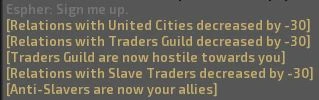
Conversely, some cases do not force a side. Allying with the Holy Nation or the United Cities does not automatically make you the other's enemy; it only locks out most ways of repairing relations. Allying with the Shek Kingdom does not necessarily offend the Holy Nation either, unless you deliberately pick the hostile option when turning in the Bugmaster bounty.
Beating a faction into extinction
Killing or imprisoning a faction leader triggers a World State, which in turn replaces the original towns with new locations.
Other knock-on effects:
- The faction's encounters in the wilds decrease.
- The power vacuum lets other factions invade areas that did not belong to them. The clearest example is killing the Western Hive Queen, after which the Southern Hive begins expanding across the world.
- Large factions do not collapse from losing one leader. A faction on the scale of the Holy Nation or the United Cities must have all its leaders dealt with one by one, and while only secondary leaders are dead they send ever-stronger base attacks that may continue forever.
Imprisoning and killing have the same effect in most cases, but a few conditions distinguish "alive" from "alive and free". If an imprisoned leader is later released, the World State's effects revert, which is believed to be deliberate, to support rescue missions.
Data and Formulas
This is the full set of data for players who want to dig deeper.
The full pairwise relations between factions are on Faction Relations Lookup.
Thresholds and range
The game stores a −100 to +100 number between every pair of factions, and the player-to-faction relation exists only on the NPC faction's side. The starting value is the smaller of the two factions' default relations, then overridden by numbers explicitly listed in each faction's relations list.
| Check | Condition |
|---|---|
| Enemy (attack on sight) | Relation ≤ −30, hard-coded |
| Ally | Relation ≥ 50 |
| Range | Clamped to −100 to +100 |
The game only shows a message when relation crosses −30 or 50. At exactly 50 you are already an ally, but the "became allies" message does not appear. The enemy classification field in the FCS is never read by the game code.
Relation events
| Event | Change | Floor or cap |
|---|---|---|
| Hit once | −0.05 × importance multiplier | floor −20 |
| Knocked out | −2.5 to −10 × importance multiplier | floor −50 |
| Killed | −20 × multiplier (accumulates together with the knockout and kill events) | floor −100 |
| Kill handling | −20 × multiplier, against the killer's faction | floor −75 |
| Healed (when the patient is down) | +0.15 × multiplier per game-speed second | cap +5 |
| Put in a cage | −10 × multiplier | floor −60 |
| Witnessing a crime against an ally | −20 | none |
| Quest failed / succeeded | −10 / +10 | none |
Importance multiplier = location factor × the victim's faction importance. Location factor: 1.0 if the victim is in his own home town, 0.6 in an allied town, 0.025 elsewhere. In the game data, 374 characters have importance 1.0, 142 have 0, and 13 have 100 (leader class). Healing a leader reaches +5 quickly precisely because of that 100x.
Example (victim importance 1.0, starting relation 0):
| Location | Multiplier | Knockout | Kill (three events combined) |
|---|---|---|---|
| His home | 1.0 | −10 | −50 |
| Allied town | 0.6 | −6 | −30 |
| Wilds | 0.025 | −0.25 | −1.25 |
If the victim faction is flagged "not real", none of the relation events apply.
Declaring war and ceasefire
Declaring war only works at relation ≥ −30 and pushes relation down to −35. A ceasefire pulls relation of ≤ −25 back to −25.
Buy-outs, Pacifiers and other community numbers
The +4 for buy-outs, Pacifier fees and locations, and the chain deductions of various alliances come from the community wiki and in-game dialogue. The "change relations" effects in dialogue commonly use −75, −30, +10 and +75, matching the numbers in the table, but Pacifier fees were not found in any inspectable game data field.
Research Notes
- An earlier draft wrote "put in a cage and open dialogue" as −1. The game code's calculation is −10 × multiplier for being caged, with a floor of −60, and the text now says so.
- An earlier draft did not mention location. In the game code, a victim in the wilds scales relation events down to 0.025x, and only in the home town is it the full amount.
- An earlier draft cited a video saying the Rebel Farmers are at −100 toward the United Cities and −50 toward the Slave Traders. In the current game data the Rebel Farmers' default relation is −100, and there is no separate entry for the Slave Traders, so that is also −100; the video's figures do not match the data. The commentator's inference is kept but marked as interpretation.
- An earlier draft said the healing cap is 5. The game code confirms a +5 cap, and points are given only when the patient is down or unconscious.
- The +4 for buy-outs, the Pacifier fee table and the deductions on joining each faction have no complete match in the game data, so the community record is still used.
See also
Video citations
- What If The Rebel Farmers WinHeroInHisHead