
History of KenshiReport
English:History of Kenshi · World & History
From the golden age of the Ancients to the moment the player steps into the wasteland, a timeline full of gaps, contradictions and unreliable testimony.
- Overview of the periods
- The First Empire: the peak of technology
- The Age of Chaos: a gap with no records
- The Second Empire: atonement and corruption
- The interim (about 100 to 1000 years ago)
- The last century
- Events of unknown timing
- Why the dates never line up
- Further reading: forgetting is the theme
- Research Notes
- See also
Kenshi has no official calendar and no history book that all sides accept. Every "date" is an estimate inferred by cross-checking scattered ruins, tattered books and NPC accounts, with errors often measured in thousands of years. The timeline below is layered by reliability, and each section states where its basis comes from.
With no calendar, every narrator has to pick a reference point of their own. Some lore write-ups simply treat the fall of Bast as the zero point, hanging events on it with phrases like "about 937 years before the fall of Bast"[V1 0:00:14]. This is convenient, but the reference point is the narrator's own choice. The game does not provide one.
Overview of the periods
| Period | Rough age | Led by | How it ended |
|---|---|---|---|
| First Empire (the Ancients) | Thousands of years or more, span unknown | Humans and Skeletons (who led and who followed is disputed) | The Great Extinction, causes disputed |
| Age of Chaos | Hundreds to thousands of years | No government | Gradually ended with the founding of the Second Empire |
| Second Empire | At least 1000 years | Skeletons, ruled by Cat-Lon | Rotted from within, not overthrown from outside |
| Interim | About 100 to 1000 years ago | Each people forming on its own | Transition to the modern arrangement |
| The last century | 0 to 100 years ago | Holy Nation, United Cities, Shek Kingdom | The moment the game begins |
The First Empire: the peak of technology
The basis is the ruins themselves and the books left by scientists. This is the oldest and least datable part of the whole timeline.
- Founding of the empire: time unknown, origin unknown. Whether the Ancients were native to this moon or migrated from elsewhere, the game deliberately gives no answer. One book even proposes that "they may have been alien migrants who came in search of resources". As for the moon itself, the most the people of the time could conclude from the night sky was that they lived on one of two moons circling some planet, but knowledge has been lost so thoroughly that none of it can be confirmed[V1 0:00:14].
- Technology reached an almost godlike level: automated factories, orbital satellites (the "Eyes"), genetic engineering, space elevators. The giant plants of the Floodlands are thought to be the Skeleton production lines, and Skeleton NPCs say they were "born here".
- The Behemoth war: the empire fought a war against an enemy whose identity is completely unknown. For it, the Behemoths were built, super-sized Skeleton weapons many times the size of a person.
- Obedience: after the war the Ancients feared the Behemoths' destructive power and ordered them to walk into a giant pit filled with liquid, sealed away permanently.
The irony is that it was that blind obedience and unquestioning loyalty that let them walk down into that pit without resisting.
- The Skeleton uprising and the first Great Extinction: there are many accounts, such as natural disaster, superweapons, biological warfare, civil war, and pollution and mutation from overmining. The Skeleton side's account is always vague, and several Skeleton NPCs are actively covering up this history.
- Mass Skeleton suicide: among the Skeleton remains recovered by Technohunters, a large share are judged to have died by their own hand. The reason is unknown.
The Age of Chaos: a gap with no records
The long dark age after the First Empire collapsed. People argue for a length anywhere from hundreds to thousands of years, and the game gives no firm number. See Age of Chaos for details.
- Sea level dropped by hundreds of metres, land expanded greatly, and former port cities became inland ruins
- Skeleton production lines stopped, no new Skeletons were born afterward, and the race entered irreversible decline
- Humans degenerated into scattered small tribes, and technology fell to zero
- The death of the Behemoth Stobe, presumed to be a sacrifice to stop some doomsday weapon
As for why this period left not one word behind, one theory holds that both sides stopped writing at the same time. The Skeletons have nearly unlimited memory and had no need to write things down, and were busy fighting their own civil war, while the humans forgot everything under the double pressure of survival and technological regression. The motive to write and the ability to write vanished together, and history was cut off[V2 0:16:21]. The inference is persuasive, but the game itself does not confirm it.
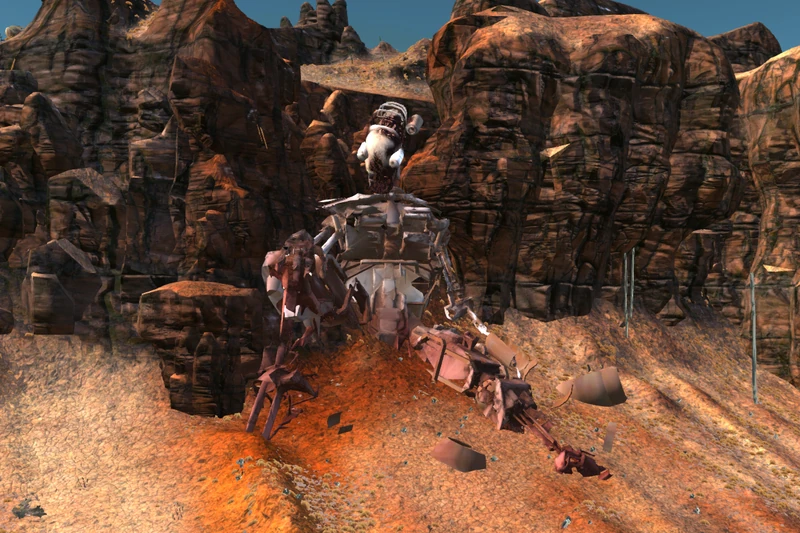
The Second Empire: atonement and corruption
- Founding: Cat-Lon and his Skeleton followers founded the Second Empire to make up for the Skeletons' past crimes, even though humans had long forgotten that history. The capital was built in what is now the Ashlands.
- Hydraulic Knights raised: to fight pirates and the human tribes in the north-west who had turned to cannibalism, the Second Empire formed the Hydraulic Knights, led by General Jang. The legend of the "Uneatable" survives in cannibal tales to this day.
- Enforcers appear: a genetically enhanced human caste, regarded as the predecessors of the modern Shek. They did not yet have horns.
- Rise and suppression of the Okran sect: a sect worshipping the Saviour arose among humans, and Police Chief Hat-12 swept it up with heavy-handed measures, which only made the conflict worse.
- The Phoenix uprising and the founding of the Holy Nation: a sect leader called Phoenix led his followers out of the empire and migrated north-west to found a state. It is the oldest government that survives.
- Rule turned to dictatorship: child prisons, limitless escalation against "pirates", and forced thought-stripping (thrall) of dissenting Skeletons.
- The Great Famine: according to an account by Cat-Lon that was not used in the final game, it began when the Grid exploded. This was the last straw that broke the empire.
- Collapse: no decisive battle and no fall of the capital. The population left in waves, the Skeletons scattered, and Cat-Lon was left alone on his throne.
The interim (about 100 to 1000 years ago)
The events of this period have no clear order among them.
| Event | Notes |
|---|---|
| Appearance of the Hive | Origin entirely unknown. Whether they are mutated humans, arrivals from overseas or an experiment, nothing is settled |
| Kral unites the Shek | The Shek were pulled from scattered tribes into a kingdom, and Kral was deified after dying in battle |
| Modern Shek take shape | The Enforcers' descendants grew horns and developed a culture that honours death in battle |
| Rise of the United Cities and the Traders Guild | Formed on the ruins of an old empire, the two quickly monopolised southern politics and trade |
| Invention of the Springbolt | Invented by anti-government forces to fight heavily armoured samurai |
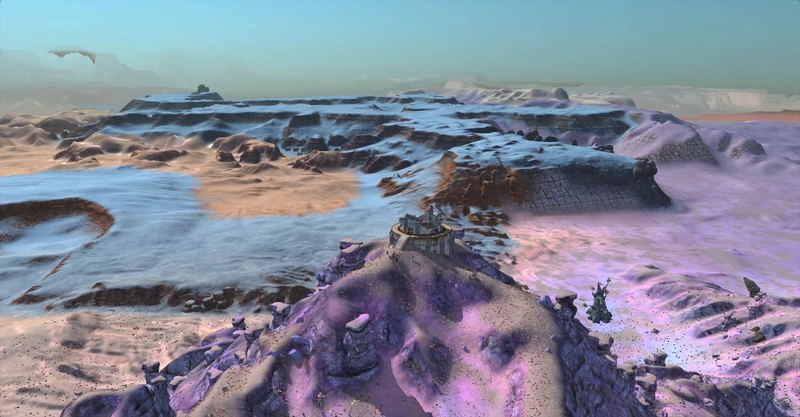
The last century
- The 62nd Phoenix takes the throne: following Holy Nation tradition, separated from his birth parents at birth and raised by the high priests. At 16 he personally tried his own blood relatives and sentenced them to purification by holy fire.
- The Red Rebellion and the rise of the Tengu Emperor: a great drought in the south caused famine, nobles speculated on grain, and the lower classes rioted. Emperor Anzai died in the chaos, and the nobles put forward the Tengu as successor. After that, "poverty" itself was treated as a crime and many commoners were sold into slavery.
- The destruction of Bast: the Holy Nation raided the rich lands that had belonged to the United Cities, burned the city and carried its children off to Rebirth. The place is a permanent battlefield to this day.
- Lu Kun's revenge: Lu Kun, born a slave, was taken in and trained by ninjas, and seven years later returned home and assassinated nobles one after another, until he was caught and imprisoned in the Tengu vault.
- Esata overthrows Shager: Shager planned a suicidal last stand, the warrior Bayan spoke against it, and Esata stepped between the two and fought the king in a duel. After taking power she pulled back from the front, made peace with the United Cities, and opened trade with outsiders.
Events of unknown timing
These events definitely happened, but cannot be placed in any of the slots above.
- The death of Stobe: Stobe's Gamble and Stobe's Garden are both named after him, and his body lies in the latter
- The outbreak of the Fogmen: a related Hive group beside the western Hive collectively lost its mind and became the Fogmen who wander Fog Island
- The fall of the sea level: many dialogues hint that the ancient water level was hundreds of metres higher than now
- The failure of the "Eyes": at least one orbital weapon crashed in the Eyes region, and another in Venge still works, firing a beam at the ground all day
Why the dates never line up
The three main sources fight each other, so they are listed here directly, without reconciliation.
- The wiki's timeline puts the Second Empire at "about 1000 years or more ago", but also puts the founding of the Holy Nation at "5000 years or more ago", even though the Holy Nation split off from the Second Empire
- The Second Empire article separately says the empire collapsed "hundreds of years before the game's events"
- The Skeleton merchant Armour King claims his shop stood in a prosperous market town of the Second Empire called Catch and has traded for 937 years, and afterward he stayed in the same place for a full thousand years, which means the empire was still running normally 937 years ago[V1 0:09:40]
The three cannot all hold at once. A reasonable reading is that the Second Empire lasted a very long time, that the Phoenix uprising happened in mid-empire rather than at its end, and that the empire itself dragged on for hundreds of years before it truly dissolved. But this is still only a reading.
Two anchors in the game that can be checked against each other support this reading. The Armour King's 937 years gives a lower bound for "the empire was still running", and on the Holy Nation side the current leader is the 62nd Holy Lord Phoenix. If the 62 are treated as a father-to-son line, counting back probably goes well beyond 937 years, so the sect uprising is presumed to have happened long before the collapse and not at the same time (the game gives no figure for how long each one reigns, so this is a guess)[V3 0:19:06]. In other words, drawing "the founding of the Holy Nation" and "the fall of the Second Empire" on the same line is probably wrong, and several hundred years are presumed to lie between them.
Another side piece of support comes from outside the game: in a development Q&A, Lo-Fi Games confirmed that Kenshi 2 is set a thousand years before the first game, and explained that because the span is so large, nearly all art assets had to be redone from scratch[V4 0:14:24]. The sequel is placed in the Second Empire period or around its collapse[V5 0:01:06], which gives an official reference for the first game's accounts of the Second Empire falling "about a thousand years ago", although strictly speaking that is the sequel's setting and not a conclusion for the first game.
Further reading: forgetting is the theme
Some commentators argue that the gaps in this timeline are what Kenshi is trying to say, and that forgetting its own history is the core motif of the world. Most inhabitants of the wasteland do not know why the Second Empire collapsed, or even that the sea a thousand years ago stood much higher than now, and precisely because no one remembers, the same crimes are repeated unchanged from generation to generation[V6 0:11:17].
Under this reading the numbers that do not match are part of the design. The player, like the people in the game, can only guess from fragments.
Research Notes
The lengths and order of the periods in the timeline are all player inference, with no matching record in the game data files. This page has had its wording and punctuation proofread and the text tidied, and no numbers were added.
See also
Video citations
- The History of Kenshi | DocumentaryCivilizationEx
- The Age of Chaos: How Cat-Lon Became OkranHeroInHisHead
- The Whole Story of The Second EmpireHeroInHisHead
- Kenshi 2 Just Got a New Update!HeroInHisHead
- Kenshi 2 - What We Know So Far and What We Can ExpectHeroInHisHead
- What If Cat-Lon Tried To Take Back Kenshi?HeroInHisHead