
Rebel FarmersReport
English:Rebel Farmers · Factions
Landless farmers driven to the wall by United Cities slavery and taxation, who raised Fort Simion in Sinkuun to take revenge on the noble class — without ever asking what happens if they win.
"The Empire took my farm, I have nothing to eat and nowhere to live… and you, outsider, you are going to feed me." — Outlaw Farmer
The Rebel Farmers are the largest armed insurgency inside the United Cities. The game tags their faction type as "Bandit", but the label is badly misleading — they rob, yet robbery is not why they exist. They are people their own country pushed out into the desert, biting back with the only means left to them.
In the lore-commentary scene, "the Imperial rebels" is often used as an umbrella term covering the Rebel Farmers themselves along with the factions they later evolve into or ally with, the core membership always being the United Cities' dispossessed farmers and runaway slaves[V1 0:01:47]. One reading holds that the "bandit" classification actually obscures the point: these are not horse thieves raiding for sport but dissidents forced out by the noble system[V1 0:01:47].
Men of Dirt
To understand the faction you have to read its founder. Boss Simion carries a battered journal, Men of Dirt, the only first-hand material on him in the game — and it exists only in his inventory.
The journal records three moments. The first is the day he was driven off his land:
"Eviction day — how am I supposed to compete with the price of free labour! My daughter goes hungry, my woman has started talking nonsense, and despair has backed me into a corner. We are too dried-out to be of use to the Empire; come morning we crawl off into the sand…"
Imperial society has a slur for people squeezed off their land and left to crawl into the sand: drags[V1 0:06:17]. The journal is also the only source on what became of his family — he had worked the farm with his wife and daughter, went bankrupt because he could not compete with a vast slave workforce that amounted to free labour, and once the family was destitute the Empire pushed them out of society altogether[V2 0:16:03].
The second entry has him scavenging a caravan wreck picked clean by Skimmers out in the desert, living off the salvage for a whole season and then building Fort Simion out of the same materials[V1 0:06:17]. The third is his turn:
"Day of plenty — I have come to think of them as my own children, these castoffs of the Empire. I will not let anyone else end up as I did."
From a smallholder who could not compete with slave labour to the master of a fort that shelters the discarded, Simion's authority was not fought for but grown — out of shelter, shared suffering, and revenge with a target. He never declared himself leader. One commentator describes the sequence as inverted: he took in the abandoned first — runaway slaves, evicted labourers, victims of Imperial tyranny — and only slowly did a refuge turn into a resistance[V1 0:07:23].
Their enemy is the nobility, not slavery
The most counter-intuitive thing about the Rebel Farmers: abolition is not on their list of demands.
In a world where slavery is everywhere, and where that same institution is exactly what drove them into the desert, the rebels' anger is aimed with precision at the Noble Circle. Simion voices open impatience with the Anti-Slavers — as he sees it, they have the wrong target; freeing slaves treats the symptom, while the thing that needs dismantling is the noble class in its entirety[V1 0:03:28].
The position has its own internal logic: in the rebels' view slavery is not the disease but the tool — an economic mechanism the nobles use to hold costs down and squeeze free labour dry[V1 0:03:28]. Releasing slaves solves nothing, because tomorrow the nobles will simply take more.
That logic shows up in the faction numbers — they sit at -100 with the United Cities but only -50 with the Slave Traders. Tiered hostility.
Who is in, and who is not
The racial weighting of the roster is itself a slice of society: mostly Greenlanders (around 3,000), then Hive (around 200), with Shek entirely absent. The high Hive share is easy enough to explain, since Hivers already make up a large share of the Imperial underclass; for the missing Shek there is a proposed explanation — their build and combat ability trade too easily for work, so they can simply hire on as mercenaries or samurai for the nobles instead of taking to the wastes[V1 0:02:54]. Nothing in the game text states this directly, but it does not contradict the actual position of the Shek in Imperial cities.
The precedent of the Red Rebellion
Simion's rising was not the first. Decades ago a great drought hit the Empire's southern plains and famine spread nationwide. Traders Guild relief convoys were plundered, and the little that got through was seized by the most powerful. Lady Tanaka, a noble who survived it, gives a chillingly cold account in the book The Red Rebellion:
"The ground ran red with blood, those desperate souls clinging like drowning rats to a sinking ship, dragging us all down into their ruin with them."
That uprising burned cities, dragged nobles into the streets and killed the then Emperor Anzai. The United Cities eventually retook power, sold the survivors en masse into slavery as an example, and hardened its machinery of repression considerably.
The Red Rebellion failed, but it proved something: the Empire's foundation of "rule by wealth and hereditary privilege" is not immovable. Simion's rebellion is its sequel in spirit — smaller, more loosely organised, but running on exactly the same fuel. One commentator argues that this memory is where the rebels' real emotional charge comes from: the whole movement is driven by retribution, aimed specifically at the nobles who hoarded grain during the famine, and not at any new order[V1 0:04:35].
It is worth setting against another line of resistance from the same era. Mourn, in the Bonefields, successfully broke away from the Empire through a slave uprising, and is today a free settlement under Tech Hunter influence[V3 0:07:43]. The difference is instructive: Mourn wanted a concrete, limited, achievable goal — independence for one city; the Rebel Farmers want to dismantle an entire class[V3 0:07:43].
Troops and world states
Their range covers the whole of the Great Desert plus the fringes of Sinkuun, the Hook and Heng; the daily business is ambushing trade routes and hitting outposts, then falling back to Fort Simion[V1 0:02:20].
The rebel order of battle is simple, and deliberately keeps a "farmer" visual vocabulary — straw hats, white vests, ragged halfpants, wooden sandals. The most numerous are Outlaw Farmers with clubs or junkbows; squads are led by Outlaw Swordsmen in heart protectors carrying horse choppers; the closest thing to heavy infantry are Outlaw Heavies in mercenary plate; heavy squads are commanded by an Outlaw Swordsman Captain worth about 3,000 Cats, and come with bonedogs.
What is genuinely interesting is how the world states inflate or shrink this army. Kenshi tells stories through the rise and fall of faction sizes, and the Rebel Farmers are the clearest demonstration:
- Kill or kidnap Lord Inaba — heavy squads are upgraded, the Outlaw Heavy cap rises from 7 to 11, and new patrol areas are added.
- Kill Yabuta — unlocks heavy squad spawns.
- Kill or imprison Emperor Tengu — Rebel Farmer squads across the north-east stop spawning, and in some regions better-equipped Rebel Swordsmen take over instead. In other words, once the Emperor falls this outfit stops being bandits and becomes a paramilitary.
- Kill Simion himself — the rebellion collapses in size: Great Desert -94%, Grey Desert -82%, Sinkuun -76%, Heng -71%, Bast -58%, and Skimsands drops to zero.
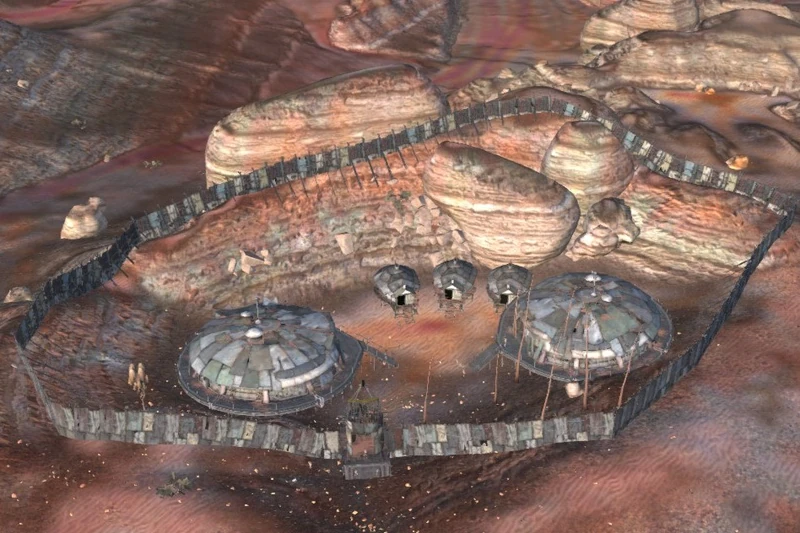
Fort Simion itself is a set of swamp domes and shacks pieced together from caravan wreckage, with three Outlaw Farmers on the gate and a barracks and hideout inside. It has two other world-state rewrites: after Emperor Tengu falls it becomes a ruin occupied by Rebel Swordsmen; or, if the player releases Yabuta of the Sands without allying with the rebels, the whole fort is taken over by the Yabuta Outlaws and becomes "Fort Yabuta".
Nobody feels sorry for them
The rebels are in an awkward moral position. They come from the common folk, yet their robbery does not discriminate — which is why ordinary United Cities citizens and the Empire Peasants are not buying it. Even the AI behaviour reflects this: when fighting breaks out, some civilian NPCs flee and others simply pitch in on the side of the Imperial samurai against the rebels. And in a firefight the rebels furiously curse their Empire Peasant opponents as "traitors".
In other words this is a war of the bottom against the bottom, with the nobles watching from inside the walls.
Allying with the player
The player can join by talking to Simion. His condition is proof that you really are an enemy of the United Cities — his suggested method is "put a boot in some noble's gut". Several routes actually work:
- Already being an enemy of the United Cities
- Killing any noble (or carrying a kidnapped noble on your back)
- Already being allied with the Anti-Slavers
- Asking to join while starving — he says yes, and hands over bread
- Asking while carrying a severed leg, a severed arm, or a badly damaged head
The last two make Simion's real admission criterion clear: he takes in people with nowhere left to go.
Allying shifts relations by +75 with the rebels, +75 with the Rebel Swordsmen, -25 with the United Cities and -25 with the Slave Traders. On top of that, when the player's base is hit by noble-retaliation events, the rebels send a heavy squad to help.
"Got yourself into some real trouble, eh? Us throwaways have to look out for each other… either we bring down the Empire together, or we die together." — Outlaw Swordsman Captain, on arriving as reinforcements
If they won
This is the most discussable part of the Rebel Farmers, and the game's answer is not romantic.
As the nobles are picked off one by one, United Cities towns are not handed to the "Rebel Farmers" — the people who take over are the Empire Peasants. And the way they take over is not conquest but moving in. The rebels tear down the structure of rule, and then peasants walk into the ruins and settle.
The actual world-state rewrites run roughly as follows:
| Town | Trigger | Result |
|---|---|---|
| Sho-Battai | Nagata + Emperor Tengu fall, Simion alive | About 20% damaged, then rebuilt; Free Traders open shops, Rebel Swordsmen guard the gates |
| Port North | The above plus Kana dead | Converted into a fishing port and farming town, supporting the supply line to Heft |
| Bark | Emperor Tengu + Sanda fall | Town functions, inhabitants malnourished |
| Heng | Longen + Emperor Tengu fall | About a third destroyed |
| Heft | Emperor Tengu falls | All seventeen buildings destroyed, heavy loss of life, most survivors malnourished |
| Trader's Edge | Longen, Emperor Tengu and Tinfist all fall | Two of six buildings destroyed; Simion himself moves here |
That last row is the most intriguing ending the faction has: with the conditions met, Simion appears in Trader's Edge no longer as a rebel leader but as an ordinary Empire Peasant. He is out.
As for whether they can govern — the game's answer is close to "no". The inheritors have no leader, no hierarchy and no recognisable law; the Empire Peasant social form is a "non-aggressive collective". They farm, trade and scavenge, but they have no engineers, no caravans and no long-term planning. Towns fall back from prosperity to bare subsistence, and with the defensive line gone, raids by bandits, Skimmers and Cannibals become more frequent.
A narrative video boils the comparison down to a single line: order with oppression, versus freedom with fragility. That video estimates that even with a total rebel victory, only about 44% of the former United Cities settlements end up in Empire Peasant hands, the other 56% reduced to ruins or held by bandits.
Why they are still worth remembering
This faction cannot win a single set-piece battle in the game, but its narrative place does not rest on its record. One commentator's conclusion: the Imperial rebels are worth remembering not because they are strong but because they are recognisable — Kenshi's revolution is not fought with manifestos but with hunger, grief and the desperate hope that somebody has to protect the weak; Simion is no brilliant general and no demagogue, just a man who lost everything and then built a fort in the sand[V1 0:17:34].
Points of disagreement
- Simion has the wrong neighbour. In dialogue he calls "Lord Yoshinaga" of Sho-Battai his nearest neighbour, but Sho-Battai's actual governor is Lord Nagata. This may be a development-stage error, or he may simply have mixed the two up.
- Simion vanishes outright once Emperor Tengu is dead. Unless Longen and Tinfist also fall, he spawns nowhere at all. Many players regard this as a design gap, and there are mods that exist purely to relocate him to Sho-Battai.
- Where the Rebel Swordsmen come from. The wiki describes them as the "better organised, better equipped" militia of this movement, yet they only begin to exist after certain nobles fall; meanwhile Outlaw Heavies and Outlaw Swordsmen stop spawning entirely once Emperor Tengu is dead. The wiki's guess is that they either laid down their swords or were absorbed into the Rebel Swordsmen.
See also
- Empire Peasants — the ones who actually take over if the rebellion succeeds
- United Cities
- Noble Circle
- Anti-Slavers
- Slavery
Video citations
- What If The Rebel Farmers WinHeroInHisHead
- The Real Villain Of KenshiHeroInHisHead
- Kenshi: History of the United CitiesCivilizationEx