
The Holy NationReport
English:The Holy Nation · Factions
The continent's largest theocratic agrarian state in both population and military strength, ruled by the doctrine of the light god Okran as law — with ethnic cleansing and the subjugation of women written into scripture itself.
The Holy Nation is the largest political entity left in Kenshi: a theocracy of Greenlanders with religion as its only source of law. Its population outnumbers other factions many times over, its territory spans more than a quarter of the continent, and it claims five thousand years of continuity. To the faithful it is the one light in a dark world; to Shek, Hivers, Skeletons and women, it is the most dangerous stretch of land on the map.
Origins: a sect that forgot where it came from
The Holy Nation's exact origin is unrecoverable. In-game texts leave only an absurdly wide window: the founding falls somewhere between one thousand and five thousand years ago, and even the Holy Nation cannot say which end[V1 0:02:22]. The Okranite scriptures are among the oldest still-legible texts in the world, and scholars suspect their creation myth reaches back to the collapse of the First Empire — that is, to the First Extinction.
What is certain is that during the Second Empire a sect that would later become Okranism had already taken shape. Its prototype was a cult that worshipped the Behemoth Stobe: they were grateful that this Behemoth had saved humanity, and hated the Skeletons who had nearly wiped humanity out[V2 0:05:17]. As the Second Empire's population recovered, its internal contradictions swelled with it, and this sect was one of the fuses of the rebellion — a body of human believers rising against their Skeleton masters, a thread that simultaneously explains the Holy Nation's almost instinctive hostility towards Skeletons and technology[V3 0:01:29][V4 0:03:58].
Imperial police chief General Hat-12 launched a heavy crackdown on the new sect, and it backfired: the heavy-handed approach "only fanned the blame and the chaos hotter", splitting the already strained relationship between humans and Skeletons inside the Empire wide open. The Empire also had a more covert play in hand: when the artificial soldier caste called the Enforcers was created, it carried two mandates at once — first, to replace the Skeletons expended in the war against the Cannibals (after the fall of the First Empire the Empire had lost the ability to manufacture Skeletons), and second, to infiltrate this Stobe sect[V5 0:08:26]. That move rebounded completely: the Enforcers planted inside eventually went to open war with the sect, and the sect in that great uprising was the Holy Nation later led by the Holy Lord Phoenix. In other words, the blood feud between the Holy Nation and the Shek Kingdom that persists to this day started in that battle[V5 0:09:02].
The rebellion ran for centuries, wearing the Empire down and pushing Cat-Lon towards ever more extreme measures; eventually the sect grew strong enough to secede from the Second Empire outright and found a state in the fertile heart of the continent, while the Empire itself dissolved completely after a great famine[V6 0:04:05]. The secession very likely predates the Second Empire's formal end; that empire did not fall overnight so much as simply rot and come apart.
After its founding the Holy Nation swelled rapidly into a continental superpower, its domain covering Okran's Gulf, Okran's Pride, the Arm of Okran, Okran's Valley, the Border Zone and Rebirth, and building the cities of The Hub, Bad Teeth, Stack and the capital Blister Hill[V6 0:04:43].
Doctrine
The Holy Nation's religion is called Okranism, and its core is the dualism of Okran (Lord of Light) and Narko (the Dark Witch). Faith is not part of life but the whole of it: law, gender order, economic system and foreign policy are all extensions of scripture. The same doctrine narrows the word "person" drastically — only pale-skinned Greenlanders and dark-skinned Scorchlanders count, everything else being a servant of Narko; the church organises itself around the Holy Lord Phoenix as both lawgiver and messenger of Okran, into a thoroughly human-centred religion[V6 0:02:48].
The chief texts are the five volumes of the Scripture of Radiance written by the first Phoenix, plus The Holy Flame, which every citizen is legally required to carry. The doctrine boils down to three articles:
- The dark is a real enemy. The First Extinction was the work of Narko's servants, and the believer's task is to prevent a second. Scripture defines Skeletons outright as "messengers of the dark", equivalent to the darkness that caused the First Extinction itself; Holy Nation identity is built almost entirely on this hatred, so any resurgence of Skeleton power looks to them like the return of Narko[V8 0:09:03].
- Fire is purification. "Smite the enemy with fire, cleanse the world of dark" — burning is not torture but rite.
- Labour is salvation. The unclean need not be destroyed; through hard labour and instruction they may be "reborn" as humans in the next life.
This view of salvation gives Holy Nation cruelty a veneer of tenderness. The current Phoenix describes executing Shek in The Holy Crusade as though it were charity:
When we execute a Hornhead, it is not cruelty, it is mercy.
Government and hierarchy
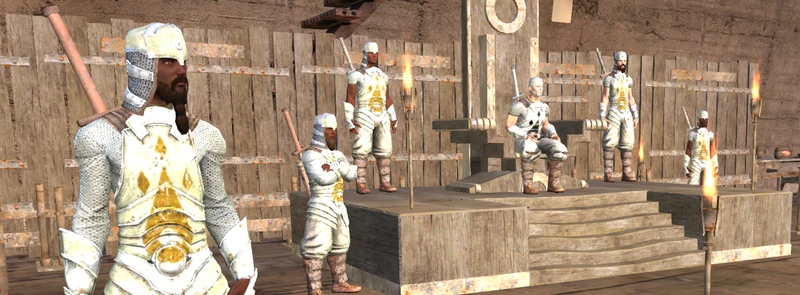
At the apex of the pyramid stands Holy Lord Phoenix, head of state and incarnation of god at once. Below him the priesthood and the army govern jointly, and the two most critical figures are High Inquisitor Seta and High Inquisitor Valtena — each single-handedly running an entire front, with more troops under them than many nations field in total. The literature also mentions a Commander Nix, ranked between High Paladin and Inquisitor. When taking stock of the Holy Nation's top tier, alongside the Phoenix and the two High Inquisitors, one more seat gets listed: the "Guardian of the Holy Flame"[V10 0:00:46]. Seta additionally commands an elite force called the Wrath of God, a unit often treated as the most concrete embodiment of Holy Nation religious fanaticism[V11 0:00:44].
Male citizens are stratified further by skill. Men are expected to volunteer for military or clerical service (frequently both), and bear the duty of "guiding" women and non-humans onto the correct path.
Society
Pure blood and non-humans
The Holy Nation sees itself as a beacon in a dark world and is in fact quite welcoming towards outside humans willing to convert — what they reject is not the outsider but the alien. Joining buys something very concrete: walls, military and police patrols, more food and medicine than you can eat; the price is accepting a racial hierarchy written into scripture[V3 0:02:43]. The Holy Flame sets that hierarchy out with no ambiguity: Greenlander and Scorchlander men are Okran's clean children, firmly on top; human women need to be "tamed" and are legally closer to property[V6 0:05:24]; the Shek, descended from the Enforcers, are degenerate bestial humans who can be purified through enslavement[V4 0:05:06]; Hivers are held to share human origins but to have deformed too far, leaving only enslavement or execution in the name of "mercy"[V12 0:05:07]; Skeletons are beyond redemption, killed on sight.
Rendered into everyday vocabulary the hierarchy gets even blunter:
- The Shek are seen as beasts, violence made flesh.
- Hivers are seen as hollow, selfish creatures born to suffer, living in houses of vomit, eating filth, thieving and swindling by habit.
- Skeletons are Narko's servants, granted no soul, killed on sight. Anyone fitted with robotic limbs is treated as a "Skeleton in disguise".
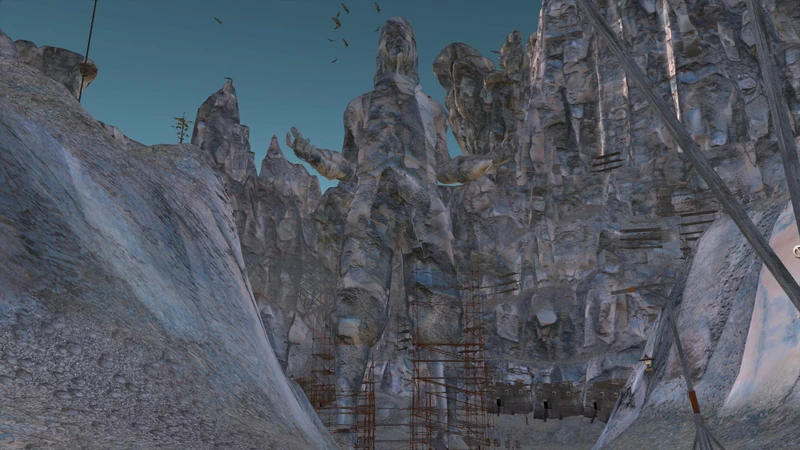
The standard disposal is transportation to Rebirth — a labour camp at the bottom of a mountain pit, where prisoners work themselves to death beneath a colossal statue of Okran so that their souls may be reborn human. The Holy Nation insists this differs fundamentally from slavery in the United Cities: the others enslave for private gain, they instruct for salvation. In practice the difference shows up mainly in the wording.
The position of women
Volume 3 of the Scripture of Radiance writes gender oppression straight into the creation myth: man was made in Okran's image, woman in Narko's. Women are therefore held to be innately susceptible to corruption and in need of "restraint".
An unrestrained woman is a lazy woman; she must be tamed lest she tempt the purity of man down into the dark with her. — Scripture of Radiance, Volume 3, the first Holy Lord Phoenix
Constraint and latitude coexist, and this is where Holy Nation society is most often misread. Women can trade, keep Hiver and Shek servants, turn in bounties and found outposts, and can broadly cross the border freely; but going out at night requires a male escort, wearing jewellery is the sin of vanity, and social norms discourage women from approaching men, so marriages are almost entirely arranged by the man's side. The current Phoenix's own Holy Edict orders that a woman wearing jewellery without a guardian present be flogged until repentant.
The channel that proposed this hypothesis stated explicitly that it is not a defence of the Holy Nation but a way of pointing out the absurd tension in its internal logic: the Holy Nation holds women to be vessels of corruption while being forced to admit that humanity cannot continue without them — so it can neither purge them nor let go, and can only keep them pinned down forever[V13 0:09:23].
Economy
State finances rest on three pillars: the near-unpaid agricultural labour of the Holy Farms, prisoner mining at the Holy Mines, and the output of the Rebirth camp. Most of the mine labour comes from criminals and bandits circulating inside the borders — which makes "cleaning up crime" and "topping up the workforce" institutionally the same activity. The state therefore never runs short of food, water or medicine, a rare luxury in Kenshi[V6 0:06:03].
One commentator argues this makes the Holy Nation the most economically solid of the five major factions: farmers, smiths, traders and bakers each have their place, everyone is required to produce, and so there is almost no visible poverty inside the borders — except that this security is issued only to those who meet the doctrinal standard[V14 0:03:17].
Military
The Holy Nation fields the largest army on the continent, large enough to work several fronts at once, and it genuinely ground the Shek Kingdom's kamikaze troops down to nothing.
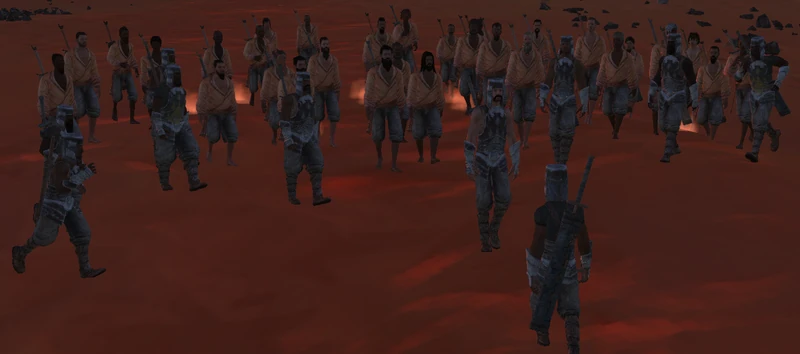
Its main-force characteristic is quantity over quality: a handful of Paladins and Holy Sentinels at the front lead a large mass of Holy Chosen in the charge, and a standard Holy Army detachment easily runs to thirty or forty bodies. They should not be underestimated on that basis, though — the High Paladin and Inquisitor squads in the core regions are individually good enough to stand against other factions' elites, and sometimes better.
The order of battle itself is finely divided: the High Inquisitors command both the police and the Holy Army; High Paladins are captains and also the Phoenix's bodyguard; Paladins form the veteran layer; the Holy Chosen fill out the front line; Holy Servants are slaves unshackled and formed into units; Guardian Paladins garrison high-value locations; and Holy Sentinels watch the mines and towns[V6 0:06:03].
Command is heavily concentrated in three people: the Phoenix holds roughly sixty per cent of the force as a strategic reserve, Valtena holds about thirty per cent and carries the eastern front alone, and Seta holds about ten per cent but is responsible for city defence and reinforcing the south. The structure makes the Holy Nation extremely efficient, and extremely brittle — take those three down and the whole war machine loses its brain.
That machine is in fact braced in four directions at once: Cannibals to the north, Fogmen to the west, the United Cities to the east and the Shek Kingdom to the south. None of the four fronts has yet lost ground, but spreading a force across four bearings is itself a long-term liability[V14 0:04:54].
Foreign relations
The Shek Kingdom: a centuries-old nemesis. For a long time it was only periodic border raiding, until the 62nd Phoenix judged that passive defence would never bring peace and launched the Holy Crusade to eradicate the Shek threat. Shek King Shager answered with an all-out offensive that burned The Hub and several settlements, but that regardless-of-cost assault drove the Shek themselves into population collapse. The Holy Nation ultimately won on sheer numbers, and the Shek were reduced to near-extinction. Today, under Esata, frontal offensives have stopped and treaties are being used to rebuild — she has not given up, she is waiting. One video frames the confrontation in outright mythic terms: children of Okran against children of Narko, the brotherhood of light against the sons of the dark[V10 0:00:46].
The United Cities: after Emperor Tengu took power the two great powers fell into a border war around Bast, now at least fifteen years old. The Holy Nation once shattered the allied force in a single day and burned all of Bast, roasting the local nobles alive and shipping every surviving young person to Rebirth. The Holy Nation despises their materialism and slave trading, but what it objects to is not forced labour as such — only forced labour "for private gain". The Phoenix has always regarded the United Cities as a secondary threat, and keeps only enough force there to hold.
The Flotsam Ninjas: a small resistance movement led by Moll and composed mainly of runaway women and slaves, hiding in the northern Hidden Forest, engaged in smuggling, assassination, spreading heresy and inciting riots — with limited effect but at the cost of harsher purges. In the eyes of the Holy Nation's population, women included, they are terrorists.
Other threats such as the Fogmen, the Cannibals and the Berserkers are all held outside the borders by the defensive line; the moment a line commander dies, the gap tears open at once.
The technological contradiction
The Holy Nation nominally bans ancient technology and anything above tech level four: its towns have no carpets, only chandeliers and torches, no Tech Hunter shops, and it is the only major faction with no Ninja Tower. Yet it simultaneously owns the best medical equipment on the continent — doctors, surgeons and the Phoenix himself all carry advanced first aid kits and splint kits — and its wall fortifications even reach tech level six.
The most flagrant example is Narko's Trap: at the one ancient laboratory inside its borders, the Holy Nation stations a secret guard detail, not to destroy the place but to keep everyone else out. They know what is in there.
One commentator notes that the contradiction has its own internal consistency: Narko's Trap is itself an old-world building, and what the Holy Nation wants has never been to erase ancient technology but to gather it into its own hands where nobody outside can touch it. The same logic extends to player base building — inside the Holy Nation heartland you should match the local image, and rainwater collectors and granaries fit far better than a water well, because they need no power[V15 0:16:21].
Player interaction and consequences
Non-humans and anyone with robotic limbs entering Holy Nation territory are walking into a trap, unless accompanied by a human squadmate (guards will automatically assume servant status). Carrying contraband — AI Cores, Ancient Science Books, hashish, Moll's speeches and the like — means combat the moment it is found. A human male carrying The Holy Flame has the highest pass rate at checkpoints.
Public order in the Holy Nation heartland, meanwhile, is good in a way that hardly feels like Kenshi: some villages have no walls at all, and the residents face essentially no external threat beyond religious oppression. This is also why, when building a base in the core region, putting the farmland outside the wall and covering it only with wall turrets is entirely defensible[V15 0:17:59].
Not every Okranite is a copy of the dogma. Griffin, a veteran who once served the Holy Nation, believes Okran gave him a vision: that a wealthy adventurer would come and help him uncover the truth of the First Extinction. He asks for nine thousand cats, not out of greed but because "able to pay" is his test that you are that person — he is devout without being dogmatic, and stays open about the truth[V16 0:07:58].
The route to friendly relations is direct: as a human male, turn bounties in to an Inquisitor ten times without claiming the reward, or deliver bandits to the Rebirth camp fifty times. Capturing Seto and handing her over is worth +50 relations, handing over Moll +80. Past 75 relations the Phoenix grants the Chalice of Fire and opens the "Holy Nation Route", which requires the player to personally destroy the Flotsam Ninjas and the Shek Kingdom, earning the title "Absolver of the Inferno" on completion.
Unsettled accounts
Kenshi leaves a great deal of lore blank, and the Holy Nation is the faction most aggressively interpreted. The following are channel and community inferences, not settled game canon.
Might the Cannibals be a mutant offshoot of Okranism? One account holds that the Cannibals' faith is in fact a version of Okranism gone astray, on the evidence of several visual and lexical coincidences: the painted emblem on the abdomen of female Cannibals closely resembles the Holy Flame symbol, only with five diamonds instead of three; their leader, the Cannibal Grand Wizard, wears Holy Nation armour; and even their titles follow the Holy Nation's medieval-European naming habits — Paladin, Phoenix, Inquisitor, Sentinel[V17 0:05:00]. If this holds, what the Holy Nation's northern line is holding back is its own reflection.
A design success as an institution. In one commentary that rated the five major factions against six criteria one by one, the only faction that passed almost everything was the Holy Nation — which is also the oldest of the five. The commentator's argument is that, morality aside, an institution that could hold together for another thousand years after the Second Empire's collapse is genuinely effective by design[V14 0:35:10]. This is evaluation rather than statement of fact, but it helps explain why the Holy Nation is so hard to shift in game.
The Holy Nation is the faction most easily labelled "the villain" in Kenshi, and the one that least deserves simplification. Every one of its atrocities can be justified from scripture, and the source of that scripture may well be a rescue mission misremembered for five thousand years.
Books found here
King Shager's Reign, The Holy Flame, The Little Boy That Got Dismembered By Skeletons, A Holy Purpose, Letter Of Farewell, Letter From Bad Teeth, Book Of Grace, Cultural Groupings And Evolution Series, Mission Graeme: Status, Book Of Sacrifice, Holy Edict, The Holy Crusade, Suicide Note, Letter From A Freedom Fighter, Letter To A Priest, Letter To Priest Ton, Moll's Speech, Birth Of The Phoenix, Forbidden Sympathy
Video citations
- What If The Shek And Holy Nation Were Allies? (ft. Muffintop)HeroInHisHead
- Kenshi: History of the SkeletonsCivilizationEx
- Kenshi: History of the United CitiesCivilizationEx
- Kenshi: Major Powers | United Cities and Holy NationCivilizationEx
- The Origins of the ShekHeroInHisHead
- Kenshi: History of the Holy NationCivilizationEx
- The History of Kenshi | DocumentaryCivilizationEx
- What If Cat-Lon Tried To Take Back Kenshi?HeroInHisHead
- The Age of Chaos: How Cat-Lon Became OkranHeroInHisHead
- Kenshi Colosseum: Shek Kingdom Uniques VS Holy Nation UniquesHeroInHisHead
- Kenshi Colosseum: Wrath of God VS Blooded RaidHeroInHisHead
- History of Kenshi: Major Powers | DocumentaryCivilizationEx
- Why Does The Holy Nation Oppress Women?HeroInHisHead
- Which Faction Can Succeed on Kenshi?HeroInHisHead
- Kenshi Base Building - Holy Nation River CityHeroInHisHead
- Kenshi: All Unique CompanionsCivilizationEx
- The Origins of the CannibalsHeroInHisHead