
CannibalsReport
English:Cannibals · Factions
The "Painted Tribe" that holds the north-west, a mass of humanoids degenerated down to nothing but the urge to feed; they cage their captives to fatten them, and they eat their own as well.
The Cannibals are Kenshi's standing disaster in the north-west. They do not negotiate and they do not rob — anything edible gets carried back to the village, put in a cage, and left to wait for the spit. For any squad heading north they are the simplest and the most intractable enemy at once: no politics, no extortion, just numbers.
They are not human
In the game's data structures the Cannibals are a race distinct from humans, split into two branches: the bloated Cannibal, who fill the fighting and leadership roles, and the small, scrawny, green-painted Cannibal Skav, who move in packs and function as ammunition.
Physiologically they have travelled a long way:
- Running speed sits between 16 and 27 mph, so they out-chase ordinary humans by a wide margin
- +20% Cooking learn rate, −20% Farming — the stat line is itself a history of civilisational collapse
- Like the Skeletons and the Hive, they are completely immune to acid rain and acid ground
- They do not eat Skeletons and they do not eat animals, yet they remain hostile to both
The acid immunity is worth noting: a constitution like that can only come from long-term environmental adaptation, and finding it in a "degenerated" population is a contradictory clue in itself. One reading connects that contradiction to the toxin hypothesis discussed below — prolonged exposure to chemical contamination destroyed their brains while simultaneously letting their descendants evolve immunity to acid[V1 0:14:29]. That is inference only; the game never explains where the acid immunity came from.
Origins: three hypotheses, no verdict
The most formal surviving investigation is The Cannibal Plains: De-evolution Of Man?, written by Finch, leader of the Machinists; copies can be found at the science headquarters in World's End and in the great library at Black Scratch. What Finch really seizes on is a contrast: this land is full of advanced ancient laboratories, and yet it has grown the most primitive tribe on the continent[V2 0:03:18]. He confirms that the Painted Tribe's existence can be traced back thousands of years, but on the cause he can only list coexisting possibilities:
- Environmental poisoning — heavy metals and chemicals leaking from the ancient laboratories, chronic toxins they could not adapt to
- Experimental accident — derangement caused by the laboratories' own "products"
- Extreme famine — simply starved down to eating their own kind
The real fork in the book is chronological: are the Cannibals the direct descendants of the ancient labs' inhabitants (degenerating in place), or invaders from elsewhere who ate the labs' original occupants? The damage inside the ruins supports both readings. Finch leaves a third, more uncomfortable possibility open too — that they are neither the operators' descendants nor invaders, but the descendants of the human test subjects dragged into those laboratories to be experimented on[V2 0:03:18]. Finch himself reaches no conclusion.
The game's own inhabitants have no consensus either. A Skeleton character entering the Cannibal Plains will say outright that they do not know why the people of the north turned out this way, and Finch in dialogue still lists the same three possibilities[V1 0:10:01] — when a machine that has lived a thousand years cannot answer, that fact is part of the answer.
One of those hypotheses can be weakened, though. A channel that went through the game files points out that soil fertility on the Cannibal Plains is in fact quite high, which makes the "simply starved into it" route hard to sustain[V3 0:07:45]; the same review also worked through environmental toxins, lab-produced drugs and experiment-induced madness one by one, and still ended without a verdict.
On a land of such advanced science there exist prehistoric, uncivilised tribes, which is plainly a regression — are the inhabitants of the Cannibal Plains de-evolving?
There is a reading that the key is the Floodlands — that belt once underwater and packed with Skeleton manufacturing facilities. If the Second Empire settled humans to farm the only fertile land to its north while the groundwater had long since been permeated by heavy metals from the factories, several generations of poisoning would be enough to explain rising aggression, declining reason and acid immunity. That is player research, and the game offers no direct evidence.
The Hydraulic Knights and "the Inedible One"
The Cannibals' existence goes back at least to the Second Empire, and they were a problem the Empire genuinely committed resources to.
Cat-Lon's empire raised a military order for it — the Hydraulic Knights, commanded by General Jang, tasked with the Empire's external threats: pirates, and Cannibals. It is one of the few military units in imperial history whose formal designation survives.
And in the Cannibals' own legends there circulates a story about a Skeleton warrior they call the Inedible One. The name almost certainly points at a member of the Hydraulic Knights, very likely General Jang himself — for a tribe that sorts the world by nothing but edibility, a thing that cannot be eaten and yet keeps cutting them down is raw material for myth.
That history is still running. Northern tribes still pass down stories about Skeletons by word of mouth and remain hostile to and afraid of robots, and the source is precisely their ancestors' memory of fighting the Hydraulic Knights[V4 0:06:16]; a thousand-odd years on, the fear of that beating is still in the legend[V5 0:09:02]. The practical consequence is that Cannibals do not distinguish between individual Skeletons: any mechanical body that walks onto the Cannibal Plains is taken for that same crew, accompanied by shouts that the Inedible One has returned[V3 0:07:45].
General Jang and five Hydraulic Knights are still in Ashland Dome III in the Ashlands to this day, wearing Ancient Samurai Armour and carrying Nodachi, waiting for an order that ceased to exist long ago.
Hierarchy: from the scrawny to the Grand Wizard
Cannibal social structure is unexpectedly clear — a top-down patriarchal hierarchy, and simultaneously a feeding order[V6 0:25:03]:
| Rank | Notes |
|---|---|
| Cannibal Grand Wizard | Leader of all Cannibals, seated in the Cannibal Capital |
| Meat Lord | Ruler of "First Village" at the northern end of Darkfinger |
| Mighty Canhead | A "Magi" wearing an iron can on his head, who personally leads raids of sixty-plus |
| Cannibal Chief | Petty chief of an individual village |
| Cannibal | The main body |
| Scrawny Cannibal | The bottom rung, the most numerous, and the most often eaten by their own |
The hierarchy is written into their bodies too: small, hunched individuals serve as battlefield medics and expendable infantry, while larger, more bloated upright individuals occupy the upper ranks[V1 0:03:17]. The division of labour at the top is equally plain — the Grand Wizard holds power from the capital, the Meat Lord is the strongest warrior in the tribe, and chiefs each command a village[V2 0:04:34]. Beyond that this society has no functions at all: the entire structure turns on finding meat, obtaining meat and eating meat, with their own kind counted inside the "obtainable" category[V1 0:03:17].
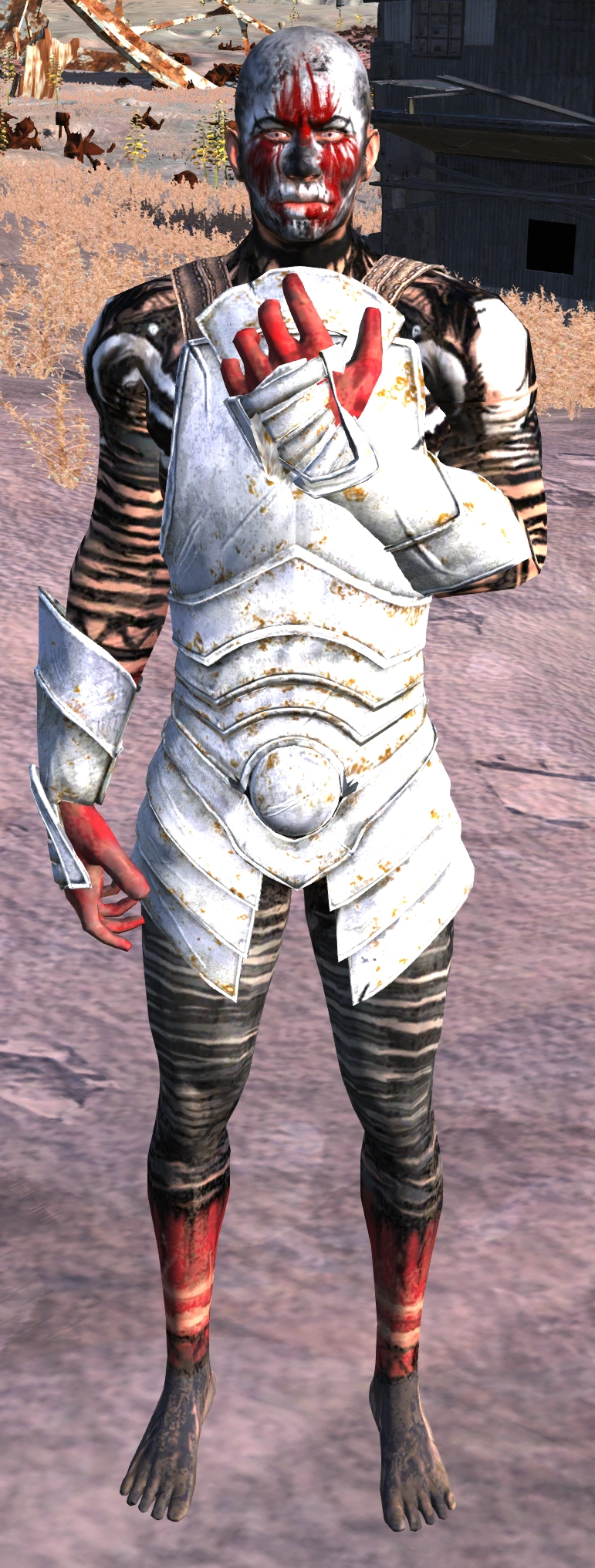
The Cannibal Grand Wizard is the most intriguing part of the system. The Holy Nation, the Shek Kingdom and the United Cities all put a 40,000-cat bounty on him at once — three powers who otherwise cannot stand each other, agreeing on this one thing. The notice reads:
Leader of all known cannibal population. Actual magic ability unknown. Location unknown.
His gear is stranger still: a Holy Chest Plate, and a Moon Cleaver. Add the fact that the body paint on female Cannibals' abdomens bears "a suspicious resemblance to the Holy Nation's symbol", and these details point toward Cannibal belief possibly being a deformed offshoot of some shared religious source. The title "Grand Wizard", with its medieval European flavour, also belongs to the same vocabulary as the Holy Nation's Phoenix, Paladins and Inquisitors.
Cages, cooking pits and totems
The mode of operation is fixed: swarm with overwhelming numbers, then carry the unconscious organic target back to camp or village and lock it in an iron cage. Once the cages are full, they periodically beat the captives to death and throw them into the central cooking pit.
There is also a form of hunting on the plains that requires no fighting at all. The whole region is scattered with settlements abandoned all at the same moment — food still on the tables, lamps still lit, valuables untouched, no sign of a struggle[V1 0:01:06]. To a wanderer on the road that reads as a gift of supplies; in fact it is the most efficient trap in the game. Whoever lies down to sleep there wakes the next day in a cage, watching their companions go onto the spit one at a time[V1 0:01:06].
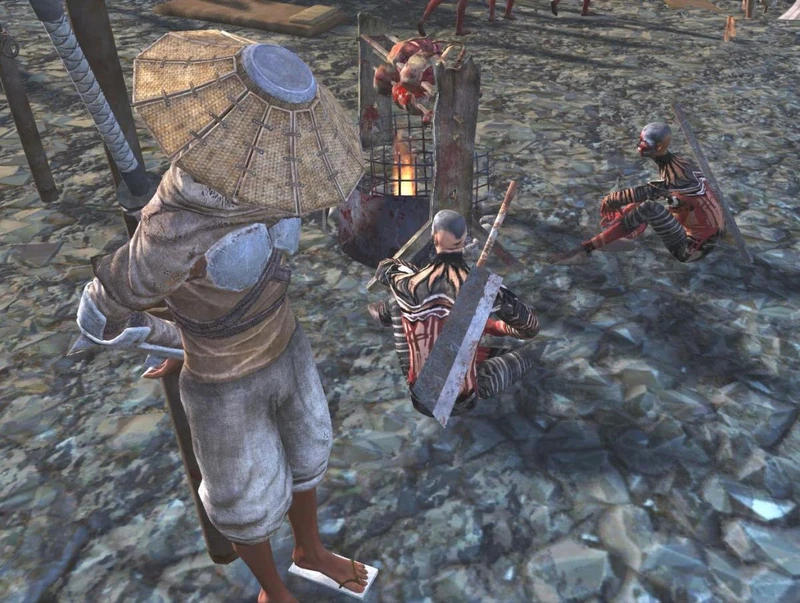
Even the lowest-ranking Scrawny Cannibal carries a Basic First Aid Kit. They will bandage their captives — not out of pity, but to keep the meat fresh.
The Captive's Journal series (found in a chest in the Grand Wizard's hut) records the whole process. The author writes from the horror of day one to the incoherence of day twenty-one: an uncle carved away piece by piece, wounds staunched, the corpse finished off around breakfast, the rest eating the leftovers to "fatten up the food stores". The journal's last line is addressed to his brother:
Time to get you out of here now, Robun.
Territory and expansion
The tribe has held the north-west since the era of Cat-Lon's rule, and its position has not moved in over a thousand years[V7 0:00:44]. The Cannibal core is the Cannibal Plains and Darkfinger, which are also the formal extent of their power in Finch's writing[V2 0:04:34]; patrols push out into the Northern Coast, Berserker Country, Bast, Okran's Valley, Dreg, the Purple Sands and the Hidden Forest.
The strongholds they control include the Cannibal Capital (originally Deadcat, still displayed on the map as a neutral town in order to lure the player in), three Cannibal Camps, First Village in Darkfinger, and the occupied "Suspicious Lab" in the Floodlands.
Cannibal expansion is dynamic. If Emperor Tengu dies, Cannibal Infestations begin appearing in the Great Desert; Okran's Fist, Sho-Battai and Flotsam Village can all fall under particular world states as well.
On the Cannibal Plains their most reliable food source is not travellers but the Shrieking Bandits — the two groups have been brawling for a long time, and Cannibal cages are frequently full of shriekers. Why the two are packed onto the same stretch of ground is covered in the inference in this article's final section.
Two empty towns in the north
The traces Cannibal expansion has left are not only patrols but two settlements that no longer have anyone in them, one large and one small, with the same story.
Deadcat was once a nation taking shape in the north. It survived the collapse of the Second Empire and the wars that followed, but it did not survive the Cannibals — bitten at year after year, it never managed to grow, and eventually broke apart into scattered fragments[V2 0:05:09][V6 0:25:03]. The Painted Tribe swallowed large tracts of the north, took the city of Deadcat and made it their own capital, while survivors were forced south-east and dispersed into a few remote fishing villages, universally wary of outsiders[V8 0:01:28]. The "Cannibal Capital" the player sees on the map today is that city.
There is a smaller, more complete case on the border between the Northern Coast and the Cannibal Plains: a settlement known as the Ghost Village. It was founded by migrants fleeing the Holy Nation and the United Cities, and the site was well chosen — sheltered terrain, good fishing near water. They built walls, built houses, mounted turrets, and reckoned that would be enough against a pack of mindless cannibals[V8 0:02:06]. Then people started disappearing one by one, until the whole village emptied in a very short span, supplies still lying where they were left[V9 0:02:06].
Put those two side by side and you see why "a pack of mindless monsters" is a bad summary: it is not that the Cannibals cannot take a walled settlement, it is that they have the patience to drain one dry.
The Cannibal Hunters
The one organisation that exists to contain the Cannibals is the Cannibal Hunters, headquartered at the Bastion on the border of Darkfinger and Sinkuun, and led by Robun — these are the people who have spent the long haul out in the north-west wilderness dealing with the Grand Wizard and the Meat Lord[V7 0:00:44].
The name is not a coincidence: Robun is the brother of the Captive's Journal author, and very probably the only survivor of that captivity. The faction's motive needs no further explanation.
They are one of the few groups who will treat wounded strangers, and they operate alongside their distinctive Mountain Dogs; they are friendly with the Tech Hunters and can be hired for roughly 3,000 Cats a day.
The nightmares never end. We keep killing, and they never end.
Someone has measured the two sides against each other in a sandbox experiment: 172 Cannibals (including 50 rank-and-file and 10 chiefs) attacking 41 Cannibal Hunters backed by a camp and Mark II crossbow turrets, and the hunters held every wave[V7 0:04:02]. An arena test like that is of course not canon, but it lays out the difference in the two sides' nature very clearly — the Cannibal threat comes purely from numbers and an endless willingness to charge, while the hunters run on equipment, training and fortification. One commentator concludes that this is exactly why a handful of hunters in the wilderness can keep an entire tribe suppressed over the long term[V7 0:06:48].
Further readings and unsettled claims
The Cannibals are one of the most heavily blank factions in Kenshi, which is why a good deal of brilliant but unverifiable inference has accumulated. Everything below is a lore channel's reading, with no corresponding statement in the game.
They may be "the demonised other" written into reality. One commentator offers a literary reading: the Roman Empire used accusations of cannibalism, incest and blood sacrifice to smear Christians and Germanic peoples, and Kenshi's Cannibals happen to live north of the Second Empire, Rome's counterpart — they may be the literal embodiment of that northern barbarian other from official propaganda[V1 0:08:54]. That is an analogy at the level of narrative structure, not in-game evidence.
The Shrieking Bandits may be descendants of "the ones who refused to eat people". The same toxin hypothesis is extended to explain the Shrieking Bandits' origin: they descend from those who refused cannibalism back then, and while fleeing inland they were stopped by General Jang's troops — because outsiders could not tell who was a Cannibal — and so were stranded on the fringes of the Cannibal Plains[V1 0:17:51]. They are equally degraded mentally and can only shriek, yet they do not eat people, and a Tech Hunter journal describes them as simply misunderstood nomads[V1 0:17:51]. The inference explains rather well why two groups sharing one region and looking so alike have been killing each other for so long, but the game has never given any direct account.
See also
Video citations
- The Origins of the CannibalsHeroInHisHead
- Kenshi: Major Powers | Tech Hunters and CannibalsCivilizationEx
- The Whole Story of The Second EmpireHeroInHisHead
- Kenshi: Major Powers | SkeletonsCivilizationEx
- Kenshi: History of the SkeletonsCivilizationEx
- History of Kenshi: Major Powers | DocumentaryCivilizationEx
- Kenshi Colosseum: Cannibal Horde VS Cannibal HuntersHeroInHisHead
- History of Kenshi: Minor Powers | Factions (Deadcat, Mega City, Mongrel, Shinobi Thieves...)CivilizationEx
- History of Kenshi: Minor Powers | DocumentaryCivilizationEx