
HiveReport
English:Hive · Races
An insectoid humanoid race mass-produced by a Queen through parthenogenesis, born into its caste and bound into a group mind by pheromones; cut the link and most individuals either go mad or die.
The Hive — also called Hivers — is the least understood and most widely despised sapient race in Kenshi. They are spindly, twig-like insectoid humanoids, meant to act in concert under a group mind, ruled by a Hive Queen and her Princes. For the vast majority of Hivers, the survival and satisfaction of the Hive is the entire meaning of life, and dying for it is simply the obvious thing to do.
"In the hive nothing matters, nothing exists, nothing is desired… except loyalty to the Queen."
Biology: eggs, pheromones and the dispenser
Hivers are not born live; they hatch from eggs. The only individual in the entire race capable of reproduction is the Queen, who produces all offspring single-handedly by parthenogenesis; should her eggs be fertilised by another Hiver, a new Queen may be born. In official lore, Hivers emerge from a "dispenser unit" on the Queen's body — a metal canister attached to her torso.
What holds an entire Hive together is pheromones. The chemical signal the Queen emits forms an invisible net that gathers the will of every individual into one. A Hiver on that net does not question orders, and needs no name. Every Hive is essentially just an extension of the same all-capable Queen, the individual no more than a part of that larger whole[V1 0:03:34].
Hiver anatomy has a string of vivid mechanical consequences:
- Acid immunity — acid ground, acid rain and acid water do nothing to them. The red acid river in Vain will dissolve Humans and Shek, but Hivers wade through it unharmed; in the acid rain of the Deadlands they will even remark that the rain feels nice
- No feet — no Hiver can wear footwear. When imprisoned they get dedicated shackles that hang in the armour slot instead
- Extremely fragile limbs — losing one is routine, and the instant it happens they dump 6–30 blood and keep bleeding heavily; two lost limbs in quick succession is enough to bleed out. A lost part can only be replaced with a robotic prosthesis, maintained thereafter with Skeleton Repair Kits
- Cannot wear ordinary shirts — Hiver-only clothing leaves the arms uncovered, so their protection is innately poor
- No biological sex — the gender field is locked to "-" in character creation. Most races still refer to them as male by habit, and Hivers themselves barely grasp the concept of "sex"
Even caste differences are written into the digestion: all Hivers are acid-immune and all can stomach raw meat, but only Workers and Soldiers can digest foul raw meat — Princes cannot[V1 0:05:30]. Another trait easily dismissed as trivia is that Hivers can regurgitate ingested organic matter and, once hardened, use it as building material[V2 0:07:14] — a detail that later became a recurring exhibit in various origin hypotheses.
That same body dictates their combat model: their strength is the swarm, not the individual. A pack of Hivers closing in is genuinely dangerous, but one on its own is at a serious disadvantage — their frames cannot support a full set of armour, and their fragile structure makes dismemberment far likelier than for other races[V1 0:06:06].
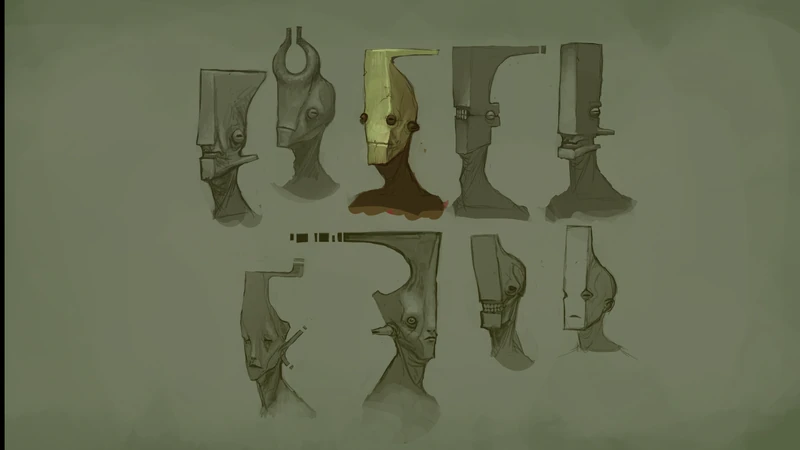
Castes: three bodies, three destinies
Hive castes are not a social division of labour but fixed at birth. Working from the spawn weights in the game files, there is one Prince for every 20 Workers and 20 Soldiers.
| Caste | Role | Traits |
|---|---|---|
| Hive Worker Drone | Labour and production | The race description calls them "expendable" outright; excellent at farming, labouring, engineering and thievery, with one of the shortest sight ranges in the game |
| Hive Soldier Drone | Defend the Hive, control the Workers | 200 HP in the head, yet the least intelligent of all Hivers; cannot wear any headgear, leaving them wholly unprotected against sandstorms and toxic gas |
| Hive Prince | The Queen's mouthpiece and actual administrator | The most intelligent and most independent; serves as envoy and merchant abroad; skilled at lockpicking, stealth and science |
| Hive Queen | Source of reproduction and of will | The only fertile member of the race; extremely slow, and internally classed as a robot |
The Prince's official description points at a key fact:
The highest ranking Hiver, the right hand of the Queen. Nobody has ever really seen the Queen, it is always the Princes who run things.
A Free Prince is usually the product of losing a power struggle to a rival, or of exile for some dereliction of duty. Because their intelligence and survivability far exceed the other subraces, Hive Princes appear in the wastes at a frequency far above their share of the population — the Cloud Ninjas, Swamp Ninjas, Grayflayers and Stone Rats are composed entirely of Princes.
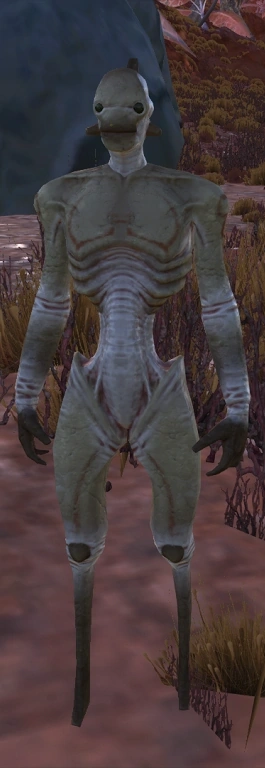
Leaving: the freedom and the void of the Hiveless
A Hiver belongs to a particular Hive society from birth; that belonging is not a choice but a condition[V3 0:01:28]. An individual on the network receives a powerful sense of belonging and purpose, and the link between Hiver and Hive decays with distance and time: the longer the separation, the stronger the individual will and the weaker the sense of purpose — but most individuals never get that far. The Worker's race description is blunt: once removed from the controlling influence of the hive, they "usually die". After the link breaks there are only two roads — grow a self, or slowly despair to death under the mental strain of being cut off[V2 0:03:21].
Once the connection is severed for good, that Hiver can never go back. They are called the Hiveless, or Lost Ones, because the Queen's pheromones no longer work on them.
The Hiveless possess complete free will and individuality, and are consumed by emptiness and depression at the same time. Paradoxically, those who make it through often become more independent and live richer lives than their kin inside the Hive, while still suffering for years from a purposeless melancholy — losing the Hive means losing purpose[V1 0:04:53][V4 0:13:04]. One reading works backwards from the fact that disconnected Hivers so often take their own lives: while the link held they really were in a state of satisfaction, and the actual pain comes from being forced to bear the weight of individual consciousness alone[V5 0:27:55]. That is also why the overwhelming majority go looking for a new "master" to house their meaning — which explains why the Hiveless exist in bulk in only two forms out in the world: the Empire Peasants of the United Cities, and slaves in the labour camp at Rebirth. On the mercenary market, Hivers also ask about a third less than other races.
The Hiveless are also the only Hivers with names. They are said to "name themselves after the first thing they see", or more precisely after the first significant thing they encountered on gaining self-awareness: Beep is named for the sound he himself made, while the smuggler in the swamp called Green took his from the greenery around him[V6 0:07:19]. The same logic produced names like Eyegore, Finch, Ray and Silvershade.
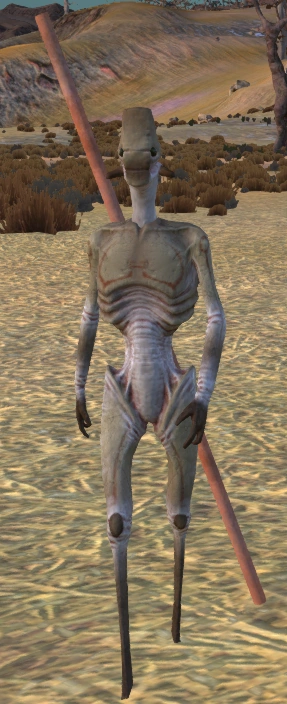
Three branches
Historically the Hive split into at least three cultures, two of which still function. All three can be told apart by skin colour alone:
- Western Hive — beige to light brown skin; the most populous and most open to outsiders, living off caravans and external trade, based in Vain and Dreg; over 99% of the Hivers you meet in the wastes come from here[V7 0:06:06]
- Southern Hive — pink-purple skin with white markings; extreme isolationists and frenzied carnivore-cultists holding Royal Valley and Greyshelf, who offer intruders to a huge machine called the King[V1 0:03:34]
- Deadhive (commonly the Fogmen) — blue, insane, queenless, with nothing left but the urge to eat people, penned into the Fog Islands
The relationship between the three is not symmetrical: the Southern Hive is hostile towards the Western Hive (relations −100), but the Western Hive does not return the sentiment. And the moment either Queen dies, that Hive's settlements are swamped by the Deadhive within a very short time — the single most important clue to understanding the Hive.
As for what would happen if the two active Hives actually fought, the game itself gives no answer. One channel simulated a sandbox battle and the Southern Hive beat the Western Hive decisively; that is a player-made experiment rather than official lore, but it illustrates the gap in their roles rather neatly — a fanatical war cult against a trading and farming collective[V8 0:03:16].
Cultural profile
Through a mass of dialogue and incidental detail, the game assembles a picture of Hive society that is not especially dignified but is unusually vivid:
- Diet: Western Hivers live mainly on plants such as cactus, are poor hunters and excellent farmers. They use their own excrement as fertiliser and fermentation additive to grow an extremely potent "super hemp"; bug juice (which Hivers call "nourishment") is a globally notorious addictive substance
- Fish: Hivers are fanatical about fish. Hive traders' crates hold an abnormal quantity of it, and a Hiver in your squad will chime in unprompted at a fish seller: "we really do love fish"
- The broken: dialogue during treatment reveals that kin who lose limbs or are badly hurt get thrown into the incinerator; the same goes for those judged "mentally faulty"
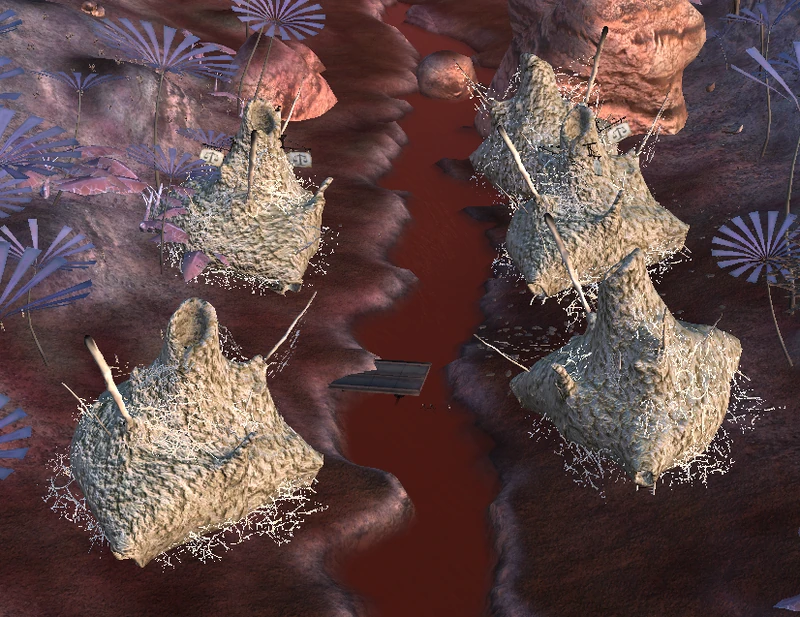
- Childishness: outsiders walking into a Hive Village get followed by giggling Workers, because the visitor is "all squishy"; tavern chatter hints that some of the huts in a Hive Village are built out of Hiver vomit
That last point is not purely a joke. Following the hints in the in-game dialogue, some have concluded that Hive construction consists of vomiting up a substance that hardens and then using local trees as rebar to hold the structure up — if so, the walls of a Hive settlement were never meant to be straight and even, being closer to rammed earth than to masonry[V9 0:06:44]. This is one player's reading, put forward while building a Hive-style base; take it as a way of understanding how Hive villages look, not as an official construction manual.
How the world sees Hivers
Contempt for Hivers is cross-factional consensus in Kenshi, only the reasons differ: the Holy Nation places them at the very bottom of its racial hierarchy, the Traders Guild treats the Western Hive as commercial competition, the Shek find them irritating weaklings, and in the United Cities there are those who smear them as animals driving up poverty and crime[V1 0:08:05].
The Holy Nation regards them as unclean. Volume 6 of the doctrinal handbook The Guiding Light calls Hivers "insect demons":
There is not a trace of soul in those hollow, obsidian eyes… This wretched heresy has corroded their flesh into a hollow and most base form, near akin to the beginnings of a skeleton.
The policy follows: Hivers are deemed former humans fallen far enough that they deserve only enslavement or a "mercy" execution, only Hivers accompanied by a Human are permitted passage, and any found alone in holy land are arrested and sent to Rebirth for life.
The Shek Kingdom despises them for their feeble frames and lack of martial courage. Proud Shek warriors refuse to be recruited by a Hiver, and Shek towns will not sell them houses — but Hive caravans are still allowed in to pay tribute.
The United Cities, and above all the Noble Circle, loathes Hive immigrants for their poverty and low station while welcoming them enthusiastically: Workers make the best slaves and servants, are four times as likely as Humans to become Empire Peasants, forty times as likely as other Hive subraces to end up enslaved — and command the highest price of any organic race. The city's xenophobic gang, the United Heroes League, simply beats Hivers as competitors in the labour market.
As for the cross-factional stereotype that Hivers are greedy thieves and swindlers — regrettably, it is partly true. Hive caravans will inflate the price of a Glowing Lantern to absurd levels under the banner of a "discount"; Workers and Princes get an innate +20% to Thievery; 18% of the Shinobi Thieves and 66% of the Scavengers are Hivers; and the pearl jars and ceramic bowls that occasionally turn up on their shelves are sold by no shop anywhere. The Hive trader's own repeated sales pitch rather gives the game away:
"Don't believe the liars who say we are thieves! They are the thieves!"
Origins: a question with no answer
Where the Hive came from is one of Kenshi's greatest mysteries, and the game never settles it. The most glaring point is that no trace of Hivers appears in any historical record from before the late Second Empire — this insectoid race looks as though it appeared on the planet out of nowhere[V10 0:08:27][V2 0:01:43]. In-game scholars asked about it have no answer either, and a detail often cited in support is that even Skeletons who have lived for a thousand years mostly hold no ancient memory of Hivers[V11 0:17:45].
Four accounts are in circulation, and nothing in the game gives any of them decisive evidence[V1 0:04:12]:
- A product of the Second Empire — the mainstream guess. With the Skeleton population collapsing and famine and rebellion closing in, the Empire poured resources into genetic engineering, and the Hive was designed as a labour class that needed little food, would not question orders, and could replenish manpower at speed. That specification matches Hiver behaviour — superb at physical labour, entirely uncomplaining towards the Queen's orders while connected — very closely[V12 0:02:36]
- The work of renegade Skeletons — engineered from Humans by a Skeleton faction that had broken away from Imperial control, possibly with the intent of replacing Humans with a Worker caste
- A native species — indigenous to the planet, simply growing larger and evolving intelligence over time
- Arrivals from elsewhere — come across the sea from another continent, or from another world entirely[V7 0:05:31]
Further reading: was the Hive designed?
The loudest camp among lore researchers holds that the Hive was deliberately engineered by the Second Empire as a labour class, and the most common version of the hypothesis is laid out like this: in his later years Cat-Lon was driven to paranoia by mass rebellion and by the famine that followed the destruction of the power grid, and he needed a workforce that ate little, endured acid and radiation, and was obedient by nature — so he followed the same genetic-engineering road that had produced the Enforcers, and reworked Humans into Hivers[V13 0:08:13]. The same commentator further infers that the explosion which destroyed the grid was nuclear in character — on the evidence of the surviving crater and the titanium ore scattered around the grid — which, if true, would also explain why a designed Hive absolutely had to be radiation- and acid-resistant[V13 0:08:47].
The hypothesis draws its force from matching symptom to symptom. Hivers first appear around a thousand years ago, at the end of the Second Empire — exactly when Cat-Lon faced the triple crisis of famine, unfarmable land and a north overrun by Cannibals[V14 0:04:19]. Hunger resistance (Hiver hunger drains extremely slowly in game), the pheromone link (easy to control, insurance against revolt), tolerance of acid rain and radiation (able to labour where Humans cannot go), and a Queen doubling as genetic template and built-in incubator (manpower replenished fast) — the proponent argues that this entire specification lines up item by item with the Empire's terminal problems, which is hard to write off as coincidence[V14 0:07:04]. Read on along the same line, and the purpose of the pheromone network is not merely efficient division of labour but Cat-Lon replicating the control system that once bound his own Skeleton kin, the real aim being to stop the Hive from breaking away from the Second Empire[V15 0:06:33].
This camp also has a "thematic" argument on its side. One commentator holds that Kenshi's central theme simply is that every race is manufactured — Humans made Humans, the Shek were engineered from Humans, the Skeletons were built by Humans — and that making the Hive a native species of the planet would let the whole theme fall apart; on that basis he would rather believe the Hive is a Second Empire genetic creation[V16 0:07:06].
There are bolder extensions too. One holds that the Second Empire, in the middle of the famine, tried to engineer an organism that could rebuild civilisation once the famine passed; the successes became the Hive, the failures became today's Skin Spiders, and the Enforcers were sent to clean the failures up — the proponent admits this inference has no in-game support, but uses it to explain where the Shek's thousand-year obsession with the Bugmaster comes from[V17 0:09:34]. Another variant writes Cat-Lon and the Bugmaster as collaborators, the two of them jointly reworking Humans to be "more like Skeletons". Worth noting: the channel that proposed this hypothesis pointedly declined to use it in later videos, for a very practical reason — a thousand years have passed, and the origin makes no difference to how the Western Hive behaves today[V18 0:14:31].
Another widely circulated reading in the player community ties the Hive directly to the Bugmaster: the Bugmaster is the very geneticist who built the Enforcers (later the Shek) for Cat-Lon, and the Hive and the Skin Spiders are the successes and failures of one batch of experiments; the three Queens he cultivated scattered when the Empire fell, each breeding on different organic feedstock and thereby producing three colours and three temperaments. The regurgitated-building-material trait mentioned above is also frequently cited in support of the claim that this species was designed to rebuild itself unaided on a resource-poor world.
Development and the sequel
Official comment on the Hive mystery is scarce. One of the few exceptions is producer Chris Hunt stating clearly, while discussing the sequel, that Kenshi 2 will reveal more history and lore, the Hive included[V19 0:11:31]. There is a technical difference worth mentioning too: in the first game all Hive subraces actually share one body mesh, differing only in the head, whereas the second will give each subrace its own complete model[V20 0:04:28].
See also
Video citations
- Kenshi: History of the HiversCivilizationEx
- The Origins of the HiversHeroInHisHead
- Kenshi: Unique Companions | ScorchlandersCivilizationEx
- History of Kenshi: Major Powers | DocumentaryCivilizationEx
- Which Faction Can Succeed on Kenshi?HeroInHisHead
- The Origins of the Preacher CultHeroInHisHead
- Kenshi: Major Powers | Shek Kingdom and HiversCivilizationEx
- Kenshi Colosseum: Southern Hive VS Western HiveHeroInHisHead
- Kenshi Base Building - Mountain HiveHeroInHisHead
- The Complete Known History of KenshiHeroInHisHead
- The History of Kenshi | DocumentaryCivilizationEx
- Kenshi: Major Powers | SkeletonsCivilizationEx
- Kenshi Lore Master AMAHeroInHisHead
- All Life Came From Humans (Sort of)HeroInHisHead
- Was There a Skeleton Mainframe?HeroInHisHead
- Kenshi 2 - What is the [Redacted] Feature?HeroInHisHead
- The Origins of the ShekHeroInHisHead
- What If Cat-Lon Tried To Take Back Kenshi?HeroInHisHead
- Kenshi 2 - What We Know So Far and What We Can ExpectHeroInHisHead
- Kenshi 2 Just Got a New Update!HeroInHisHead