
BastReport
English:Bast · Locations
A once-prosperous frontier city levelled by the Holy Nation in a single day — the head noble roasted alive, the young marched off to Rebirth. Fifteen years on it is still a frozen battlefield.
I've heard of this place. A whole city, wiped out by the Holy Nation in a single day. They roasted the head noble alive in Okran's name and marched all the young ones off to Rebirth... Ah. I mean, I hate nobles as much as anyone, but... But... Actually, he probably deserved it. — Player character line on entering Bast
Bast is a ruined city on the United Cities' north-eastern frontier, and the namesake of the surrounding zone. It is one of the few historical event sites in Kenshi's world with a named perpetrator, a date and consequences.
Before the destruction
According to the History of Kenshi, the Bast zone was originally an area the United Cities were developing: 9 small villages and 3 settlements, dotted with farmland and trading towns[V1 0:12:43], the empire's north-eastern breadbasket and trade hub[V2 0:14:08]. Dialogue from the poet Bard implies this period of prosperity was quite short.
The game data bears this out — the Bast zone's Fertility is 100%, an anomaly anywhere in the northern desert. The surface was burned to scorched earth, but the land itself still remembers that it could once grow things.
The destruction
The Holy Nation's army punched straight through the United Cities' lines and took the city of Bast in a single day, burning the head noble alive in Okran's name and torching the villages and farms of the entire region[V1 0:12:43][V2 0:14:08]. The young were marched off to the Rebirth labour camp under the name of "purification"[V2 0:14:08]. That invasion also ended the long-standing peace between the Holy Nation and the United Cities[V3 0:08:22]. The order to use the holy flame came from Holy Lord Phoenix himself — even player-made versus videos label him simply as "the man who ordered Bast burned with holy fire" when introducing him[V4 0:00:44].
Then the Holy Army withdrew.
The front line was thereby pushed from the border of Okran's Valley all the way to here. The conflict has now lasted at least 15 years — the basis being Luquin's dialogue: he knew of this place before he was thrown into Tengu's Vault 15 years ago. Today the zone holds nothing but Holy Nation crusaders and imperial troops exchanging fire over and over[V1 0:12:43][V3 0:08:22].
They're still getting hammered by the Holy Nation up there... Doesn't look like the years have been any kinder to Bast. — Luquin
What was the Holy Nation trying to do
This is a question players have argued over for years. Several things can be ruled out from in-game evidence:
- Not conquest. The Holy Army withdrew immediately after levelling the area, leaving no occupation force behind.
- Not total massacre. The text mentions only the execution of the head noble, and civilians survive.
- Not mass enslavement. Only "the young" were sent to Rebirth, not the entire able-bodied population. Large numbers of children lost their families in the chaos, and taking them away had both religious legitimacy and practical utility for the Holy Nation.
The more defensible reading is: intimidation, retaliation, and the creation of a buffer zone. The trigger was very likely the empire enslaving some frontier farming village — and the world-state branch in which "slave traders take over the Holy Farms" happens to require Emperor Tengu to be alive.
Lore videos put together two other accounts, neither of which has direct textual support: one is that Emperor Tengu's tyranny itself enraged the Holy Nation; the other is that the United Cities' grandees had long been nibbling away at Holy Nation territory and this stroke was the reckoning[V2 0:14:08]. Neither is incompatible with "retaliation for enslaving a frontier village"; the difference lies only in whether responsibility is pushed onto the emperor personally or onto the noble class as a whole.
As for why the Holy Nation did not press its advantage: Holy Lord Phoenix has never listed Emperor Tengu or any imperial noble as a target that must be removed, and he never sends elite Inquisitor squads to this front.
There are greater threats than the United Cities closing in on our holy lands. For the sake of the people, we must concentrate our strength on those matters. — Holy Lord Phoenix
The empire's side is even more naked about it:
Just let the Holy Nation stay where they are; they make a rather good peaceful buffer between us and those bone lunatics. — Emperor Tengu
In other words, a large part of why Bast has never been retaken is that the empire's leadership simply does not want to retake it[V1 0:13:48]. The noble Koin's calculation is even franker: if the balance in the west tips too far toward the Shek, the desert will soon be swept by barbarian warlords, and the Holy Nation makes a convenient target to keep the Shek occupied[V1 0:13:48].
Both sides think the other makes a useful shield. Bast is the scorched earth that understanding left behind.
That said, the empire cares considerably more than the Holy Nation does: the diplomat Koin and Emperor Tengu will ask the player to capture High Inquisitor Valtena, and only once that is done will the Holy Nation genuinely be pushed back out of this place.
A blade to the breadbasket
Some commentators point out a consequence that is often overlooked: Bast was the United Cities' agricultural heartland, producing most of the empire's food, so the Holy Nation flattening Bast amounted to cutting the empire's granary out from under it — on that reading, this is the key reason the United Cities' economy continues to decline[V5 0:15:15]. That is the commentator's causal inference; the game does not directly connect "imperial economic decline" with Bast. But the zone figures argue for it: Bast's Fertility is 100%, and there is no second patch like it anywhere in the northern desert. The price of Tengu's "rather good buffer" is that the empire has handed over the single most cultivable piece of land it had to be a battlefield.
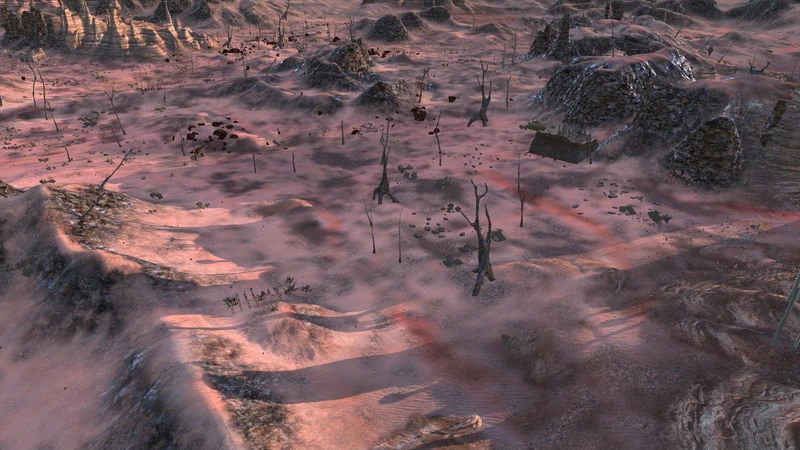
Bast today
Almost nothing is left of the city itself: two intact houses, one occupied by imperial squatters and the other empty; the loot is junk and common materials, with a chance of finding a backpack or a camp bed indoors.
Prisoner Cages are scattered around the city, and they have two practical uses: an excellent place to train Lockpicking; and one absurd mechanic — lock a character and a pet in a cage and hunger refills to 200.
The "Guy with a Dog" game start begins here: a malnourished drifter with 13 Cats, an iron stick, and a bonedog pup he has just picked up. The city can also be found by exploration or with the Map of the United Cities (Central Territories).
The Bast zone: a frozen war
| Environment | Value |
|---|---|
| Water | 50% |
| Fertility | 100% |
| Arid | 100% |
| Green | 10% |
| Stone / Iron / Copper | 100 / 100 / 80 |
The season is "Border Zone", with frequent sandstorms.
Settlements in the zone
- Drin — a half-ruined barracks settlement, the empire's largest military outpost in the area. It was probably a trading town originally and has since been converted into a garrison; the old bar is still open. Its state is tied to Lord Inaba and Emperor Tengu, and directly determines patrol strength across the zone.
- Endin — a ruined city which, like Bast, has no samurai garrison, leaving only farmers, exiles and outlaws. The only intact structure is a Storm House containing a free camp bed.
- Guard Outpost, and the Ravaged Hamlet (pure scenery)
Worth noting: all three settlements are included in the Map of the United Cities (Central Territories), imperial tax collectors' routes cover this area, and the Holy Nation's "prayer day" explicitly excludes it. On paper, this scorched earth is still core imperial territory — even if actual control probably ends somewhere east of Drin.
Who is fighting here
| Side | Typical composition |
|---|---|
| United Cities | Weak imperial force (3–6 samurai, 1–3 scouts, 10–20 conscripts) |
| The Holy Nation | Holy Army unit (3–5 Paladins, 6–8 Holy Sentinels, 30–45 Holy Chosen) |
| Rebel Farmers | Spilling over from Sinkuun |
| Cannibals | Spilling over from the Northern Coast |
| Escaped slaves, wanderers, bonedogs | Scattered |
The point is that the combined appearance frequency of the miscellaneous factions is roughly equal to that of either great power on its own. This is not total war; it is a low-intensity, long-running stalemate.
What it actually means for the player
Bast is one of the most efficient corpse-farming grounds of the mid game:
- Gear: Holy Sentinel armour and samurai armour are everywhere, and first aid kits are plentiful. Faction armour makes a usable disguise, but its market value is heavily suppressed and it will not sell well.
- Materials: throwing salvaged weapons and armour into an Item Furnace is a cheap route to raw iron.
- Skills: an environment strewn with bodies is a top-tier place to train Field Medic.
Key points for dealing with both sides' patrols:
- Against the Holy Nation: bring a human male character, preferably carrying The Holy Flame to placate them. But if there is a Skeleton or a character with prosthetics in the squad, they attack on sight regardless.
- Against the United Cities: do not let your characters be malnourished — in the empire's eyes hunger is itself suspicious. If you are stopped, you can usually buy your way out with cats.
Building a base here
The channel's verdict: Recommended with caveats
- Copper The one primary resource Bast lacks is copper: some areas have no copper at all within a 1,000 m radius, so building in a particular spot may mean giving copper up.[V6 0:00:32]
- Copper The one primary resource Bast lacks is copper: some areas have no copper at all within a 1,000 m radius, so building in a particular spot may mean giving copper up.[V6 0:00:32]
- Copper The one primary resource Bast lacks is copper: some areas have no copper at all within a 1,000 m radius, so building in a particular spot may mean giving copper up.[V6 0:00:32]
- Copper The one primary resource Bast lacks is copper: some areas have no copper at all within a 1,000 m radius, so building in a particular spot may mean giving copper up.[V6 0:00:32]
- Copper The one primary resource Bast lacks is copper: some areas have no copper at all within a 1,000 m radius, so building in a particular spot may mean giving copper up.[V6 0:00:32]
- Defensible terrain Paul Rogers gives no fixed recommended coordinates; he only says that if you do not care about copper, "just look for a plot of flat land with some iron nearby and you'll be ready to go".[V6 0:03:16]
- Raids Within his first couple of days on site Paul Rogers triggered four separate attacks — the Holy Nation, the Cannibals, the Slave Traders and the Sand Ninjas — on top of frequent harassment from Holy Nation patrols.[V6 0:04:22]
- Raids The Cannibals originate in the north-west, so settling in the south or east means you will hardly meet them; settle in the west and you will run into the Holy Nation constantly, settle in the east and you will see Samurai patrols everywhere.[V6 0:02:43]
- Raids As strong as the Holy Nation and the United Cities are, they will not skin you or eat you; the only faction that keeps a character from ever coming back is the Cannibals.[V6 0:05:29]
- Tax The Holy Nation has a weekly demand of its own (the captions garble it, so the figure is unclear), and bans anything robotic as well as hemp.[V6 0:02:11]
- Tax The Holy Nation has a weekly demand of its own (the captions garble it, so the figure is unclear), and bans anything robotic as well as hemp.[V6 0:02:11]
- Other Paul Rogers positions Bast as a mid-game settle: do not touch it until you have more than 10 well-trained characters.[V6 0:06:35]
- Distance to supplies Caravans from the Western Hive and the Traders Guild come to the base of their own accord, so you have trade and resupply without leaving home.[V6 0:04:55]
- Other Paul Rogers positions Bast as a mid-game settle: do not touch it until you have more than 10 well-trained characters.[V6 0:06:35]
Video citations
- The Real Villain Of KenshiHeroInHisHead
- The Complete Known History of KenshiHeroInHisHead
- Kenshi: History of the United CitiesCivilizationEx
- Kenshi Colosseum: United Cities VS Holy NationHeroInHisHead
- Which Faction Can Succeed on Kenshi?HeroInHisHead
- Should You Settle Bast? | Kenshi Location GuidePaul Rogers Gaming