
Economy and TradeReport
English:Economy and Trade · Game Mechanics
Kenshi has no global market, only a price map drawn by "trade cultures" — the same brick of hashish is worth 75% in the Swamp and 1200% in the United Cities, with gate guards searching your bags in between.
Kenshi's economy has no central bank and nobody watching inflation. It has exactly one feature: the same object is worth different money in different places, and that spread is hard-coded by factional ideology, prohibitions and points of origin. Once you can read that price map, hauling cargo stops being transport and becomes arbitrage.
Cats: named after a dictator
The universal currency is the Cat, base value 1 Cat. It also exists physically — you fish it out of barrels in ruins and out of nobles' pockets — but the moment it is picked up it merges into your total and the item disappears. There is also the String of Cats, worth 10 Cats.
The origin of the name was retconned once. Early material said Cats was short for "Catan Credits", after the town of Catan (later Catun); once the southeastern part of the map shipped, it was changed to derive from Cat-Lon, the last emperor of the Second Empire. The old version was never fully cleaned out — vanilla Dust Bandits still demand that the player hand over "Catan Credits".
Love, health... all freedoms in life depend on money. Want love? Lovers crave money. Want health? Doctors crave money. — Money is Freedom, held in the bank at the Traders Guild headquarters
Trade goods are the only things bought and sold at par
- Trade goods — bought and sold at full value. Practically everything that is not a weapon or a piece of equipment counts as a trade good.
- Weapons and equipment — sell for far less than they cost. Reselling gear does not work mathematically; offloading scavenged equipment is recycling, not business.
- Stolen trade goods — sell for half price unless laundered first.
Laundering means putting the stolen item into a specialised container (an armour locker, a crossbow locker, an item furnace and so on); once you take it out, the "stolen" tag is gone and it sells at full value, even back to the faction you took it from.
Ordinary trade goods land randomly within ±30% of base value from town to town. That is not a wide band, and it barely moves over short distances — the markup from Stack to Bad Teeth is nearly identical, and you have to travel far (Stack to Heng, say) to open a real gap. A handful of high-value trophies (Beak Thing Egg 4,200 Cats, Leviathan Pearl 12,000 Cats, Fog Prince Head 6,000 Cats) are fixed price instead.
The real spread comes from "trade cultures"
Every faction and location carries a trade culture profile that determines three things: which items never spawn locally, which are contraband, and the price multipliers on specific goods. All the money that can actually be made lives here.
| Trade culture | Applies to | Key multipliers | Contraband |
|---|---|---|---|
| Empire | United Cities, Traders Guild, Empire Peasants | Hashish 1200%, Bloodrum 400%, Hemp 400%, Sake 150% | Hashish, Bloodrum, Hemp |
| Free Traders | Free Trader territory; depending on world state can include Drifter's Last and the southern slave farms | As above (Hashish 1200%) | As above |
| Empire Southwest (overlay) | Catun, Clownsteady, Mourn, Flats Lagoon, the slave markets, Tengu's Vault, etc. | Hashish 500%, Hemp 300% | Depends on the controlling faction |
| Empire Lawless | Tech Hunters, Anti-Slavers, Machinists, Scavengers | None | None |
| Shek Kingdom | Shek territory | Hashish 350% | Hashish |
| The Holy Nation | All Holy Nation land | Hashish 400% (shops never stock it) | Hashish, Ancient Science Books, AI Cores |
| Swamper | Swamp villages, Reavers, Stone Rats | Hashish 75%, Sake 75%, Bloodrum 125% | None |
| Slavers | Slave camps and slave markets | Hashish 600%, Bloodrum 400%, Hemp 400%, Sake 150%; raw materials all pushed down to 40–50% | Hashish, Bloodrum, Hemp |
The logic of a trade route
Read that table backwards and the routes draw themselves: buy where the multiplier is lowest, sell where it is highest and the item is also illegal.
The Swamp is the source of hashish and sake (75%); the United Cities towns of Heft, Heng and Sho-Battai list hashish as contraband and pay 1200% for it — a theoretical spread of 16x.
The wiki documents one full circuit that strings hashish and alcohol together, running anticlockwise around central Kenshi: start at Blister Hill and buy up Bloodrum across the Holy Nation cities → head to Squin and the Stenn Desert Waystation for Cactus Rum → sell the Cactus Rum in the Swamp towns and load up on Hashish and Sake → unload the Hashish at Flats Lagoon and buy more Sake → north to the Grey Desert Waystation for still more Sake → into Heng, where the Bloodrum goes to the Shinobi Thieves and the Sake to the bars, and you buy Cactus Rum again → west through Okran's Shield back to Blister Hill to start over. Grog gets no trade culture multiplier at all, so it is strictly a buy-cheap-sell-dear filler for spare capacity.
There are two channels:
- The Shinobi Thieves — pay 10,000 Cats to join and you can use their black market traders. Ninja traders always buy and sell at half the local price, so a town at 1200% still settles at an effective 600%, far better than the point of origin. Membership also gets you 50% off their own stock.
- Getting past the gate search — guards will demand to see your backpack. Stuffing the contraband into a backpack that is in your inventory rather than worn avoids the check entirely. Refusing the search or fighting carries a 4,000-Cat bounty in the United Cities (see Bounty and Crime).
Gate searches exist in the first place because the United Cities treat the law itself as a business. They arrest not only foreigners but their own citizens under statute, and profit from their forced labour; drugs are a serious crime locally, most shops flatly refuse hashish, and guards search people entering the city at random[V1 0:03:55]. In other words, the 1200% price tag and the pat-down at the gate are two faces of the same institution: it is the prohibition that manufactures the spread.
Trader cash is finite
How much you can sell depends on how many Cats are in the other party's pocket, not on how much cargo you are carrying.
- Town-resident NPCs are handed a fixed sum of cash the first time they load and are never topped up again. Over the long run, the volume a single town can absorb has a ceiling.
- Roaming caravans repeatedly despawn and respawn, drawing fresh funds every time — those are your genuinely renewable customers. Caravan leaders run 2,000–8,000 Cats; slaver caravan guards are a fixed 10,000 Cats.
- Shops have restock and cash-refresh cycles. Traders in Western Hive villages cycle every 6 hours and come with both a robotics shop and a trade goods trader, which makes them a popular dumping ground.
The practical conclusion: when planning a run, decide which shops you are selling to first, not what you are buying.
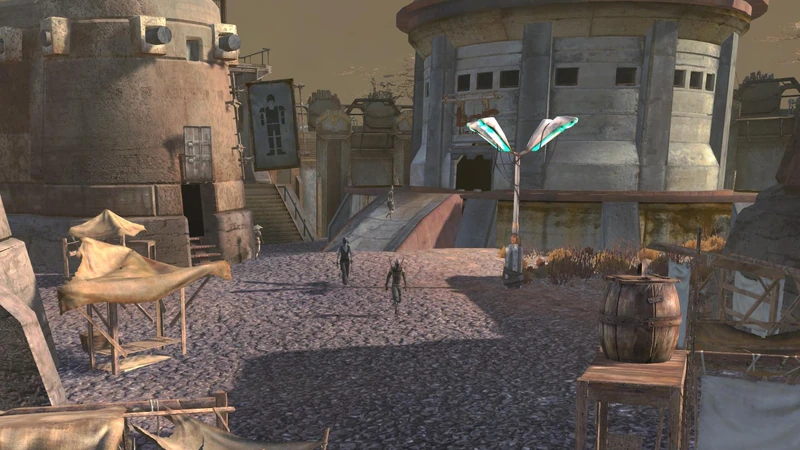
Buying relations: the admission fees
Kenshi lets you buy institutional privilege outright.
| Party | Fee | What you get |
|---|---|---|
| Shinobi Thieves | 10,000 Cats | Black market traders, lockpicking training chests, assassination dummies, beds, 50% member discount |
| Traders Guild (Yamdu, at Trader's Edge) | 100,000 Cats (75,000 Cats if you own an outpost) | Tax exemption, exemption from Slavery-related raids, +75 relations with the Guild and the slavers |
| Guild Pacifier (Blister Hill) | Variable | Wipes out past offences against the Guild |
Concretely, the Guild alliance means no taxes on a base built near them and no attention from hunter squads or slavers, at the cost of −30 relations with the Anti-Slavers.
The value of that "no taxes" line only becomes clear once you have seen the bill. Players who build a base inside United Cities territory get regular visits from a tax collector: the first demand is usually 3,000 Cats with three days to pay, and failing to pay pushes the next figure higher. Persistent refusal does not end in a growing fine — it ends in an entire army arriving to pull down your walls[V2 0:06:34].
Some commentators push this line one level further and end up pointing at the player: if Longen really is the hand behind the Empire, then the slave markets, the trade routes and the factional politics — all the systems we use in every single playthrough — are a world he designed. Every purchase feeds his empire, and every sale strengthens his grip on continental commerce[V3 0:19:52]. That is a reading of the game's themes rather than a description of its mechanics; but it does make one thing clear: Kenshi's economy was never a neutral backdrop.
Common misconceptions
- "Trading is buy low, sell high" — the ±30% band on ordinary trade goods leaves almost nothing once you subtract legwork and risk. The real profit is in trade culture multipliers, which means contraband.
- "Selling gear pays better than selling trade goods" — backwards. Gear has a huge buy/sell spread; trade goods are the ones traded at par.
- "Stolen goods can be sold as they are" — at half price. Run them through a specialised container first.
- "Find one big shop and dump everything" — there is no such shop. Trader cash is a hard ceiling.
See also
Video citations
- Kenshi: History of the United CitiesCivilizationEx
- Kenshi | The Nugget Mafia (Ep. 2)HeroInHisHead
- The Real Villain Of KenshiHeroInHisHead