
Faction RelationsReport
English:Faction Relations · Game Mechanics
Every faction's opinion of you is a single number on a −100 to +100 line: below −30 they attack on sight, above +50 they ally. And nearly every alliance has to be paid for with another relationship.
- A Line from −100 to +100
- How to Wreck a Relationship
- How to Repair One
- Healing the Wounded: Cheap, but Capped at +5
- Buying Slaves Free: +4 Each, Expensive but Infinitely Repeatable
- Pacifiers: Just Pay
- What an Alliance Gets You
- Knock-on Effects: Allying Means Taking Sides
- Beating a Faction Into Extinction
- See Also
Kenshi has no faction-select screen and no "reputation ranks". Between you and each faction there is only one number, accumulated almost entirely from your own behaviour. Understand it and you understand which gates will open for you.
A Line from −100 to +100
The rule itself is simple:
- Below −30: the faction turns hostile and attacks on sight
- Above +50: the faction allies with you
- In between: neutral — you can enter towns and trade
There are two important exceptions:
- Some factions are built to kill you and no amount of goodwill changes that. Cannibals, Berserkers, Swamp Ninjas, Fogmen and Slave Hunters attack anything they see; others wait until you count as an opponent worth fighting before they come for you.
- Witnessed crime overrides relations. Anyone who sees you commit a crime against them or their allies may attack, even if you are already allied.
The Relations Table Reads as a Design Document
The starting relation values between factions are not filled in at random, and sometimes they explain a faction's intentions better than its dialogue does. The Rebel Farmers are the clearest example: they sit at −100 toward the United Cities but only −50 toward the Slave Traders[V1 0:05:08].
One commentator infers from this that the tiering of hostility corroborates the rebels' motives — in practice they are bandits, but in purpose they are closer to an armed uprising: what is really hated is the aristocratic regime itself, and the slave trade is merely one of its by-products[V1 0:05:08]. That is a reading of the numbers rather than anything the game states outright, but numbers are the hardest kind of text in this game to fake.
How to Wreck a Relationship
| Action | Effect |
|---|---|
| Attacking members of the faction | Drops; drops faster for high-ranking members |
| Prolonged fighting against large numbers of members | Even neutral factions eventually turn hostile |
| Locking someone in a cage and opening dialogue | −1 |
| Putting someone in a Peeler Machine | Drops in proportion to that character's standing |
| Attacking, imprisoning or skinning a character with Diplomatic Status | Severe drop |
| Allying with their sworn enemy | Can cost dozens of points at once |
Diplomatic Status usually does not mean an actual diplomat but a person of consequence within the faction. It comes with hidden mechanics: most are immune to ranged targeting; when escorted by bodyguards, those guards will only retaliate one at a time and in self-defence; and you can often still talk to them even when the faction hates you.
How to Repair One
Healing the Wounded: Cheap, but Capped at +5
Bandaging or repairing a faction's wounded gains points, scaled by how much that individual matters within the faction. Healing a faction leader can drag you from −100 to +5 in seconds; healing a mook is worth roughly 0.01 points per 100 points of healing.
Two key facts:
- You do not need to be seen to get credit
- This route caps at +5 — never enough for an alliance, but enough to stop most factions attacking you on sight
Buying Slaves Free: +4 Each, Expensive but Infinitely Repeatable
Freeing someone from slavery is worth +4 with that faction. The freed character runs off like an escaped slave or follows you for a while; either way you can pick them up again, sell them back to the Slave Traders, and buy them free again.
The price scales with the target's overall skill level: a total blank slate runs about 1,000 Cats, and most non-elite units cost several thousand. Grinding from −100 to +50 takes roughly 38 repetitions, for a total of about 38,000 to 760,000 Cats.
Pacifiers: Just Pay
Pacifiers are characters scattered around bars who take money to patch up your relations with their own faction. The fee depends on how bad things currently are:
| Faction | <−80 | <−60 | <−40 | <−20 | <−10 |
|---|---|---|---|---|---|
| Shek Kingdom, Slave Traders, The Holy Nation, Traders Guild, United Cities | 100,000 | 75,000 | 55,000 | 35,000 | 15,000 |
| Anti-Slavers, Flotsam Ninjas, Hounds | 50,000 | 40,000 | 30,000 | 20,000 | 10,000 |
A Pacifier only lifts you to the bottom of the next band, not straight to zero. A player at −90 with the Guild must first pay 100,000 Cats to reach the −10 band, then another 15,000 Cats to get to 0. After each service he calls it a day, and you must wait 2 hours before talking again.
Pacifier locations: Anti-Slavers in Mud Town, Flotsam Ninjas in Squin, Hounds in The Hub, Slave Traders in Stoat, United Cities in Flats Lagoon, Holy Nation in Shark, Shek Kingdom in World's End, Traders Guild in Blister Hill. The last four also have a 25% chance of appearing at Waystations.
What an Alliance Gets You
Past +50, all of that faction's holdings turn green on the map. The practical benefits include:
- Gate guards stop searching you and wave you through
- Members hand out food, and give you medicine when they see you injured
- They assist you in combat and will bandage you when you go down
- Your bounty is ignored (not counting crimes they witness themselves)
- Allies may come to your aid when your holdings are attacked — for example, ally with the Holy Nation and they will send troops when the Shek Kingdom attacks
Factions that can be allied include: Anti-Slavers, Crab Raiders, Flotsam Ninjas, Hounds, Rebel Farmers, Shek Kingdom, Shinobi Thieves, Skeleton Bandits, Skin Bandits, Holy Nation, Traders Guild and United Cities.
Knock-on Effects: Allying Means Taking Sides
This is the trap new players fall into most often. Allying with A does not automatically make you an enemy of A's enemies — but if the joining procedure itself involves an oath or an action, the bill is settled immediately.
| Method of joining | Immediate consequence |
|---|---|
| Joining the Flotsam Ninjas through Moll | Oath to kill Holy Nation people: Holy Nation −75 |
| Joining the Anti-Slavers through Grey | United Cities, Traders Guild and Slave Traders −30 each |
| Joining the Rebel Farmers through Boss Simion | United Cities and Slave Traders −25 each |
| Talking to Esata the Stone Golem and taking Seto | Holy Nation −10 |
| Allying with the Skeleton Bandits | Severe damage with Crab Raiders and Skin Bandits |
| Turning in a bounty on a hostile faction's leader | As a rule: an outright break with that faction |
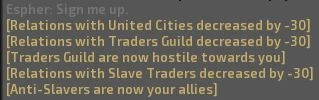
Conversely, there are cases where you do not have to pick a side. Allying with the Holy Nation or the United Cities does not automatically make you an enemy of the other; it merely locks you out of most repair options. Allying with the Shek Kingdom does not necessarily offend the Holy Nation either, unless you deliberately pick the hostile option when turning in the Bugmaster bounty.
Beating a Faction Into Extinction
Killing or imprisoning a faction's leaders triggers World States, which in turn trigger Town Overrides — the original town is wholesale replaced with a new location.
Other knock-on effects:
- The faction's wilderness encounters (Homeless Spawns) decrease in number
- The power vacuum lets other factions move in, producing "invasion"-type encounters in regions that were never theirs. The clearest example: kill the Western Hive Queen and the Southern Hive begins expanding across the world
- Large factions do not collapse over one dead leader. The Holy Nation and United Cities are big enough that you must work through every leader; in the stage where you have only killed the minor ones, they send base attacks that escalate indefinitely, potentially forever
Imprisonment and death have the same effect in most cases; a few conditions distinguish "alive" from "alive and free". If an imprisoned leader is later released, the world-state effects revert — widely considered deliberate design, meant to support rescue-mission narratives.
See Also
Video citations
- What If The Rebel Farmers WinHeroInHisHead