
Traders GuildReport
English:Traders Guild · Factions
A merchant organisation that calls itself neutral, and is in practice the economic backbone of the United Cities and the real management of its slave camps — even the enemy Holy Nation does business with them.
- What "neutral" actually means
- Longen and Trader's Edge
- The empire's circulatory system, and the one time it broke
- Is this a commercial organisation, or something else
- The real management of the slave camps
- Joining the Guild: a transaction with a price tag
- A pacifier in the enemy capital
- Armed force
- Collapse and world states
- Trivia
- See also
The food eaten every day in the cities of the United Cities, the armour worn there, the stone in its roads — nearly all of it passes through the same pair of hands. The Traders Guild is the empire's actual circulatory system, and it calls itself neutral.
What "neutral" actually means
The Guild claims it only does business and stays out of politics. The position is not entirely false: it is precisely because they operate under a merchant's name that they can deal with everyone, including the empire's enemy the Holy Nation.
The wiki collects several pieces of indirect evidence pointing at trade between the two nations behind the scenes:
- Greenfruit appears in noble inventories and in imperial bars, and only the Holy Nation grows it at scale
- High Inquisitor Seta carries a Catun-grade Paladin's Cross
- The Holy Nation does not sell cactus rum itself, yet sells bloodrum, which is made from it
The greenfruit thread is especially hard to argue with: it is grown mainly in Holy Nation territory yet turns up in quantity in United Cities markets as an ingredient in local food; and inside Blister Hill, the seat of Holy Nation power, a Guild pacifier is permanently stationed[V1 0:03:58]. Two nations fifteen years into a war, and the Guild trades with both sides.
The same inference applies to the Swamp and the Shek Kingdom: the sake in imperial bars, the hashish and bloodrum in noble collections, none of it can be local produce; and Yamdu himself mentions bluntly that the Guild is selling weapons to the Shek Kingdom[V1 0:05:03] — meaning that a commercial organisation inside the United Cities is arming a military power that has threatened the United Cities for generations.
In other words, two states that each declare they will destroy the other have a guild between them that needs to keep both accounts open. It is Kenshi's most direct treatment of ideology meeting cash flow.
Buried in this is a harder contradiction: the Shek under Shager raided Guild supply lines while the Guild sold weapons to the Shek. The answer some commentators propose is that "chaos is profit" — being raided is a fine excuse for raising prices and letting nobles bid each other up, while an armed Shek keeps Holy Nation and United Cities military spending high and ensures no side gains an overwhelming advantage[V1 0:07:13]. This is a reading rather than stated game canon, but it at least gives those weapon shipments an explanation that does not contradict itself.
Longen and Trader's Edge
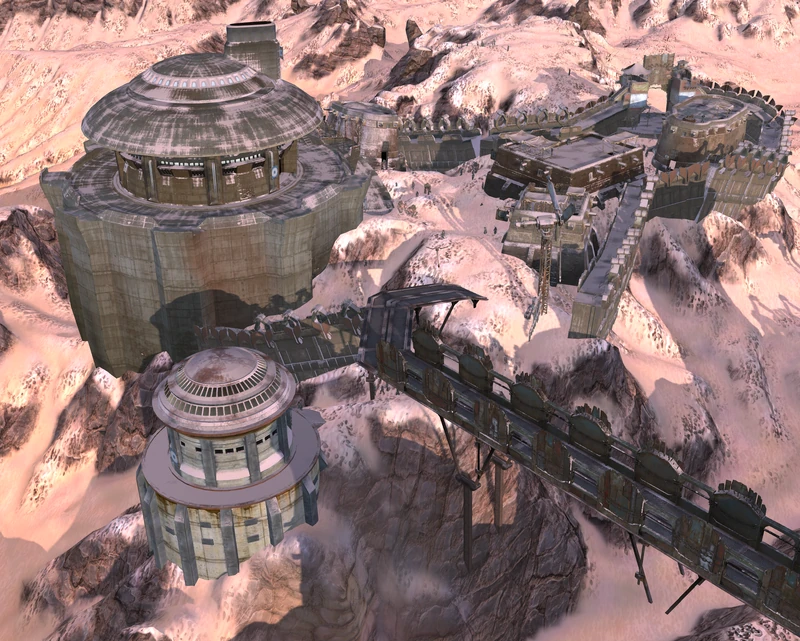
The Guild's headquarters sits at Trader's Edge — a plateau settlement beside Heng, connected by metal bridges, effectively a special economic zone inside the empire: the Guild governs itself, and the United Cities guards the door.
Sitting in the throne room at headquarters is Longen, leader of the Guild, who holds Diplomatic Status. He has his own noble squire supreme, plus a set of nobles holding large numbers of slaves — and those nobles are sworn directly to Longen rather than to Emperor Tengu[V1 0:02:21]. Aside from the limited competition offered by the Free Traders, Longen is the undisputed king of commerce in the empire.
Worth noting is the political implication of that sentence: the Guild has effectively grown a power base inside the empire that does not answer to the emperor[V1 0:02:21]. This thread is the starting point of all the later arguments that "the Guild is the empire's real master"; for the most aggressive version of it, see the Emperor Tengu article.
The empire's circulatory system, and the one time it broke
Based in Heng, the Guild is the practical pillar of both imperial government and economy: it carries day-to-day logistics, and in lean years it is also what moves grain into the cities[V2 0:01:32][V3 0:04:34]. In the empire's history there has been exactly one fatal exception — during the great southern famine, bandits blockaded the roads and stripped the shipments, while whatever did arrive was hoarded by southern nobles and auctioned among themselves. The Guild's supply network had effectively failed altogether[V3 0:04:34]. What happened next was the Red Rebellion (see Emperor Tengu and United Cities).
Incidentally, the empire strictly bans drugs, most shops refuse to take hashish, and guards randomly search people entering cities[V2 0:01:32] — a ban that coexists with nobles keeping private hashish stashes, which is one way of seeing where the boundary of the Guild's "legitimate business" actually lies.
Is this a commercial organisation, or something else
Some commentators consider the Guild's actual operating style closer to the mafia than to a business: deals are driven by threats, intimidation and under-the-table methods; and given that the imperial economy is built almost entirely on slave labour, in an age of peasant revolts that is a rather dangerous structure[V4 0:15:47].
That impression holds up on the practical level too. Guild escorts belong to the United Cities system and vastly outclass an early player squad — one streamer attacked a Guild caravan at the gate of their own base, had the entire squad flattened instantly, and had to reload[V5 0:02:11]. An organisation that "only does business" travels with that grade of firepower.
The real management of the slave camps
The Guild's relationship with slavery is not "connected to"; the two are two names for the same thing.
The wiki puts it plainly: the Guild manages the empire's slave camps through the Noble Circle, and every character bearing the title Slaver or Slave Mistress holds Guild membership. From that angle, the Slave Traders are just one department of the Guild. One layer further out, small factions like the Manhunters and Slave Hunters exist to keep that supply chain stocked.
Longen has a full argument prepared for all of this — about how escaped slaves become new threats out in the wild, about how "wild things must be kept on a leash". He describes Tinfist as a madman letting beasts loose to prey on people.
"Tinfist… Tinfist and his ninjas. He harasses our guild, undermines our order, frees our slaves." — Longen
Joining the Guild: a transaction with a price tag
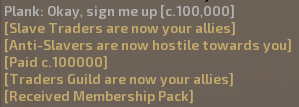
The Guild is one of the few factions whose alliance can be bought outright with money. Find Yamdu at the Trader's Edge headquarters — Longen's "noble squire supreme", a timid nest-less Hive Prince — and pay 100,000 Cats to join; if the player already owns a base, the price drops to 75,000 Cats[V6 0:06:01][V7 0:20:01].
"Free trade, protection, slavery exemption, and of course 'class'. To be a distinguished member of the Guild is the lifelong dream of every man in the desert!" — Yamdu, on the benefits of joining the Guild
Translated into practical effects:
| Item | What it actually means |
|---|---|
| Free trade | Bases built near Guild territory are not taxed |
| Protection | Manhunters and Slave Hunters stop targeting you |
| Slavery exemption | Slave Traders will not pick you when they go hunting |
| Class | A privilege other people do not have |
The cost is written in the relations table: +75 Guild, +75 Slave Traders, −30 Anti-Slavers. There is no middle ground in this deal — the moment you pay, you have picked your side.
A pacifier in the enemy capital
The Guild's pacifier is stationed in Blister Hill — the Holy Nation's capital. Whatever you have previously done to the Guild, as long as you have not touched Longen or Lady Kana, a sum of money will make the whole guild pretend it never happened.
Armed force
The Guild has no army but plenty of money to hire one. Shop guards, caravan escorts and privately contracted Samurai all work for the Guild, with the Samurai mainly deployed around Trader's Edge. When things really turn to fighting, they will also hire muscle such as the United Heroes League to raid the player's base.
Members are predominantly Scorchlanders (relative weight 100), followed by Greenlanders (70) and Shek (50), with even a few Hive Soldier Drones (10) — an organisation bound purely by profit has little interest in bloodline.
Collapse and world states
The Guild's survival is tied to two men: Longen and Emperor Tengu.
- If both die while Tinfist is still alive and free, Trader's Edge falls into Anti-Slaver hands, and the Free Settlement becomes "The Free City"
- If both die but Tinfist has already been eliminated, Trader's Edge goes to the Empire Peasants instead
- Conversely, if the player eliminates Tinfist and reports back to Longen, the reward is +70 Guild and +70 Slave Trader relations, two Leviathan Pearls, and Yamdu himself joining the squad — that Longen is willing to hand over his own squire supreme as a bounty payment says everything about where the Anti-Slavers sit on his list of priorities[V6 0:06:01][V7 0:20:01]
Trivia
- The Guild and the Western Hive are commercial competitors — a rare case of hostility involving neither religion nor race
- The design on the Guild's banner is taken from the real-world Ban Liang coin, matching the game's currency, "cats"
- Players who take the Wandering Trader start begin with +75 Guild relations
- If the player sets a shop to public and it sits near a trade route, Guild members will come by to buy in person
- Longen is the subject of a long-running community joke: one arena video series casts him as the event's sponsor in every episode and signs off with "no refunds on tickets, take it up with Longen" — a joke that points at the Guild functioning as the wasteland's court of last resort[V8 0:05:41][V9 0:04:08]
See also
Video citations
- The Real Villain Of KenshiHeroInHisHead
- Kenshi: Major Powers | United Cities and Holy NationCivilizationEx
- Kenshi: History of the United CitiesCivilizationEx
- Which Faction Can Succeed on Kenshi?HeroInHisHead
- Kenshi | MOVING DAY....AGAIN!! | Let's Play Kenshi Genesis (Ep. 4)HeroInHisHead
- Kenshi: Unique Companions | Shek, Hivers, SkeletonsCivilizationEx
- Kenshi: All Unique CompanionsCivilizationEx
- Kenshi Colosseum: United Cities VS Holy NationHeroInHisHead
- Kenshi Colosseum: Wrath of God VS Blooded RaidHeroInHisHead