
History of KenshiReport
English:History of Kenshi · World & History
From the golden age of the Ancients to the moment the player walks out into the wasteland — a timeline full of gaps, contradictions and unreliable testimony.
- The periods at a glance
- The First Empire: the peak of technology
- The Age of Chaos: a blank with no records
- The Second Empire: atonement and corruption
- The interregnum (roughly 100–1,000 years ago)
- The last century
- Events of uncertain date
- Why the dates never line up
- Further reading: forgetting is itself the theme
- See also
Kenshi has no official calendar and no history book that anybody agrees on. Every "date" is an estimate derived by cross-referencing scattered ruins, damaged books and NPC testimony, with error bars measured in thousands of years. The timeline below is presented in layers by reliability, and each section states where its evidence comes from.
Because there is no calendar, a narrator has to pick a reference point of their own. Some lore summaries simply take the fall of Bast as their zero hour and hang events off it with phrasings like "about 937 years before the fall of Bast"[V1 0:00:14] — convenient, but also a reminder of something: the reference point is chosen by the narrator, not given by the world.
The periods at a glance
| Period | Roughly how long ago | Dominant power | How it ended |
|---|---|---|---|
| The First Empire / Old Empire (the Ancients) | Several thousand years or more, span unknown | Humans and Skeleton (which served which is disputed) | Mass extinction, cause disputed |
| The Age of Chaos | Centuries to millennia | No polity | Tapered off with the founding of the Second Empire |
| The Second Empire | At least 1,000 years | Skeletons, ruled by Cat-Lon | Rotted from within; it was not overthrown from outside |
| Interregnum | Roughly 100–1,000 years ago | Each people formed on its own | Transition into the modern arrangement |
| The last century | 0–100 years ago | Holy Nation, United Cities, Shek Kingdom | The present, where the game begins |
The First Empire: the peak of technology
The evidence is the ruins themselves plus books left by scientists. This is the oldest and least datable stretch of the whole timeline.
- Founding of the empire — time unknown, origin unknown. Whether the Ancients were native to this moon or migrated from elsewhere is deliberately left unanswered. Books even float the hypothesis that they were extraterrestrial colonists who came looking for resources. As for the moon itself, what people of the time could work out by looking up at the night sky was roughly this: they lived on one of two moons orbiting some planet — but knowledge was lost so completely that none of it can be confirmed[V1 0:00:14].
- Technology reaching near-divine levels — automated factories, orbital satellites (the "Eyes"), genetic engineering, space elevators. The vast factory halls of the Floodlands are believed to be the Skeleton production lines; Skeleton NPCs will tell you they were "born here".
- The Behemoth war — the empire went to war with some enemy whose identity is entirely unknown. For that war it built the Behemoths, enormous Skeleton weapons many times the size of a person.
- Obedience — after the war, the Ancients feared the Behemoths' destructive power and ordered them to walk into a vast pit filled with liquid, sealing them away permanently.
The irony is that it was precisely that blind obedience, that unquestioning loyalty, which made them walk down into the pit without resistance.
- The Skeleton uprising and the first mass extinction — accounts vary wildly: natural disaster, superweapon, biological warfare, civil war, pollution and mutation from over-extraction. The Skeleton side's accounts are consistently vague, and several Skeleton NPCs are actively covering up this stretch of history.
- Mass Skeleton suicide — among the Skeleton remains recovered by Tech Hunters, a large share are judged to have ended themselves. The reason is unknown.
The Age of Chaos: a blank with no records
The long dark age after the First Empire collapsed. Its length has been argued as anything from centuries to millennia, and the game gives no firm number. See The Age of Chaos.
- Sea levels fell by hundreds of metres, land expanded enormously, and former port cities became inland ruins
- Skeleton production lines stopped; no new Skeleton has been born since, and the race entered irreversible decline
- Humans regressed into scattered small tribes, with technology reduced to nothing
- The death of the Behemoth Stobe, presumed to be a sacrifice made to stop some doomsday weapon
As for why not one word of this period survives, one reading holds that both sides stopped writing at the same time: Skeleton memory is close to unlimited, so they had no need to write anything down in the first place, and they were busy with a civil war of their own; humans, meanwhile, forgot everything under the double pressure of survival and technological regression. The motive to write and the ability to write disappeared simultaneously, and history went dark[V2 0:16:21]. It is a rather elegant inference, but the game itself does not endorse it.
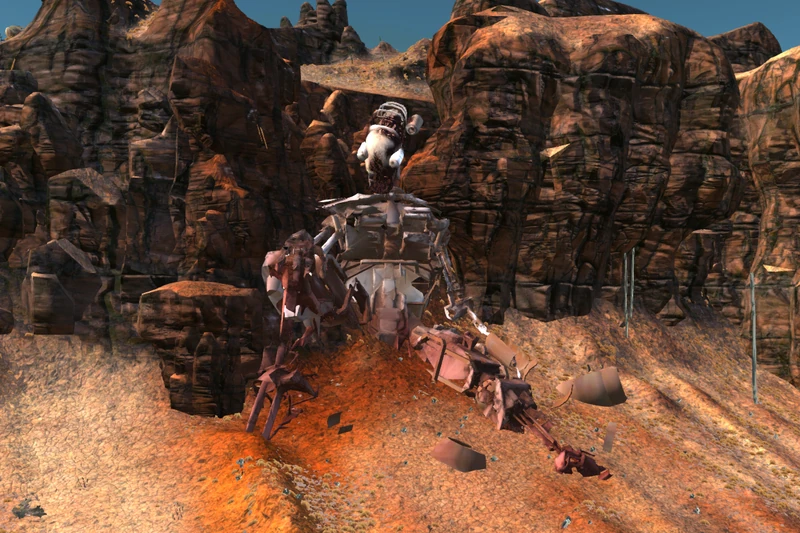
The Second Empire: atonement and corruption
- Founding — Cat-Lon and his Skeleton followers founded the Second Empire to make amends for the Skeletons' past crimes, even though humans had long since forgotten that history. The capital was built in what is now the Ashlands.
- The Hydraulic Knights are formed — to fight pirates and the human tribes of the north-west who had turned to cannibalism, the Second Empire assembled the Hydraulic Knights under General Jang. Cannibal legend still carries the figure of the "uneatable one".
- The Enforcers appear — a genetically enhanced human class, regarded as the forerunners of the modern Shek. They had no horns yet at that point.
- The rise and suppression of the Okranite cult — a cult worshipping a saviour emerged among humans, and Hat-12, the chief of police, moved against it with heavy-handed methods that only sharpened the conflict.
- The Phoenix uprising and the founding of the Holy Nation — a leader called the "Phoenix" arose within the cult and led followers out of the empire, migrating north-west to found a state. It is the oldest polity still standing.
- The turn to autocracy — children's prisons, unlimited application of the charge of "piracy", and forced thralling of dissenting Skeletons.
- The Great Famine — according to unused dialogue from Cat-Lon's CPU, it began with an explosion in "the Grid". This was the last straw that broke the empire.
- The empire dissolves — no decisive battle, no fall of the capital. The population left in waves, the Skeletons dispersed, and Cat-Lon stayed alone on the throne.
The interregnum (roughly 100–1,000 years ago)
The events of this period have no clear order relative to one another.
| Event | Notes |
|---|---|
| The Hive appear | Origin entirely unknown. Human mutation, migration from overseas, or the product of experiments — no verdict |
| Kral unites the Shek | The Shek were consolidated from scattered tribes into a kingdom; Kral was deified after dying in battle |
| The modern Shek take shape | Descendants of the Enforcers grew horns and developed a culture that honours death in battle |
| The United Cities and the Traders Guild rise | Formed on the ruins of some old empire, the two quickly monopolised politics and trade in the south |
| The Spring Bat is invented | Devised by anti-government forces to counter heavily armoured samurai |
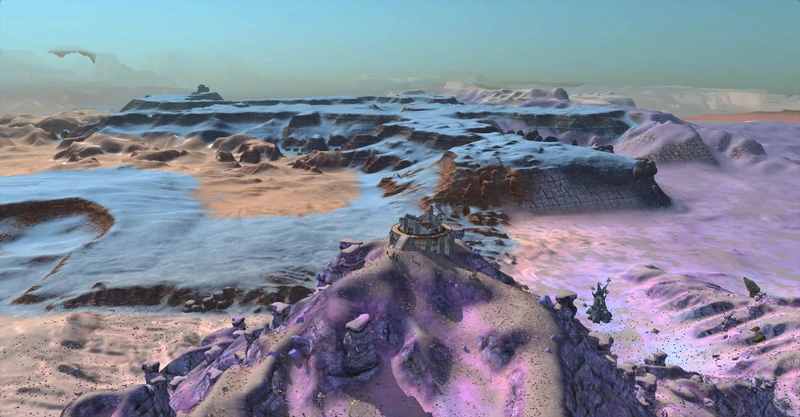
The last century
- The 62nd Phoenix takes the throne — by Holy Nation tradition he was separated from his birth parents immediately after birth and raised by high priests. At sixteen he personally judged his own blood relatives and sentenced them to purification by holy fire.
- The Red Rebellion and Emperor Tengu's rise — a great drought in the south caused famine, nobles speculated on food, and the underclass revolted. Emperor Anzai died in the chaos, the noble circle installed Tengu as his successor, and afterwards "poverty" itself was treated as a crime, with vast numbers of commoners sold into slavery.
- The destruction of Bast — the Holy Nation launched a surprise attack on a prosperous region belonging to the United Cities, burning the city and carrying its children off to Rebirth. The area remains a permanent battlefield today.
- Luquin's revenge — Luquin, born a slave, was taken in and trained by ninjas, and returned home seven years later to assassinate nobles one after another before being captured and imprisoned in Tengu's Vault.
- Esata overthrows King Shager — Shager intended to launch a suicidal final war; the warrior Bayan spoke against it, and Esata stepped between the two and duelled the king. Once in power she pulled back from the front, made peace with the United Cities, and opened up trade.
Events of uncertain date
The following definitely happened, but cannot be placed in any of the slots above:
- The death of Stobe — Stobe's Gamble and Stobe's Garden are both named after him; the body is in the latter
- The Fogmen outbreak — a Hive branch beside the Western Hive collectively lost its mind and became the Fogmen roaming the Fog Islands
- Falling sea levels — several dialogues imply ancient water levels were hundreds of metres higher than today's
- The failure of the "Eyes" — at least one orbital weapon crashed in The Eye region, while another still functions over Venge, firing a beam at the ground throughout the day
Why the dates never line up
The three main sources contradict each other, and they are simply listed here without reconciliation:
- The wiki's timeline puts the Second Empire at "roughly 1,000+ years ago" but the founding of the Holy Nation at "5,000+ years ago" — even though the Holy Nation split off from the Second Empire
- The Second Empire page elsewhere says the empire collapsed "several centuries before the events of the game"
- The Skeleton merchant Armour King says his shop was in Catch, a thriving market town of the Second Empire, and that he has been in business for 937 years, after which he stayed in the same spot for a full thousand more — which implies the empire was still operating normally 937 years ago[V1 0:09:40]
The three cannot all be true at once. The reasonable reading is that the Second Empire lasted a very long time, that the Phoenix uprising happened in the middle of the empire rather than at its end, and that the empire itself took several more centuries to actually come apart. But that is still just a reading.
Supporting it are two anchors in the game that can be checked against each other. Armour King's 937 years gives a lower bound for "the empire was still running"; and on the Holy Nation side, the current incumbent is the 62nd Phoenix. Sixty-two generations reaches back far more than 937 years, so the cult's uprising must have happened long before the empire's collapse rather than at the same time[V3 0:19:06]. In other words, drawing "the founding of the Holy Nation" and "the fall of the Second Empire" on the same line is wrong; there are at least several centuries between them.
One further piece of indirect corroboration comes from outside the game: Lo-Fi Games have confirmed in development Q&As that Kenshi 2 is set a thousand years before the first game, and explained that precisely because the gap is so large, nearly all art assets have to be rebuilt from scratch[V4 0:14:24]. The sequel is positioned during the Second Empire or around its collapse[V5 0:01:06], which gives the first game's "the Second Empire fell about a thousand years ago" statements an official point of reference — though strictly speaking that is the sequel's setting, not a ruling on the first game.
Further reading: forgetting is itself the theme
One line of commentary argues that the blanks in this timeline are not a defect caused by missing data but the very thing Kenshi is about: forgetting your own history is the core motif of this world. The overwhelming majority of wasteland residents do not know why the Second Empire fell, or even that sea levels a thousand years ago were far higher than now; and precisely because nobody remembers, the same crimes get re-enacted generation after generation, unchanged[V6 0:11:17].
On that reading, the numbers in the timeline that fail to add up are part of the design — they force the player into exactly the position of the world's inhabitants, guessing from fragments.
See also
Video citations
- The History of Kenshi | DocumentaryCivilizationEx
- The Age of Chaos: How Cat-Lon Became OkranHeroInHisHead
- The Whole Story of The Second EmpireHeroInHisHead
- Kenshi 2 Just Got a New Update!HeroInHisHead
- Kenshi 2 - What We Know So Far and What We Can ExpectHeroInHisHead
- What If Cat-Lon Tried To Take Back Kenshi?HeroInHisHead