
Empire PeasantsReport
English:Empire Peasants · Factions
The underclass of the United Cities — heavy taxes, poverty laws and slave labour squeeze them outside the city walls. About three quarters are Hive immigrants, and they are the only ones still standing after the Empire falls.
The Empire Peasants are not an army and not an organisation — they are the underclass of the United Cities itself, written up as a faction. They are tenant farmers crushed by taxation, servants in shacks against the city walls, and people too poor even to get through the gates, left to camp in the desert.
Poverty as a crime
To understand the Empire Peasants' position you first have to understand one of the core logics of the United Cities: money is the primary measure of a person. In Imperial culture, extreme poverty is not merely misfortune but is regarded as a latent criminal tendency — which is why the destitute are frequently sold straight into slavery.
The other side of that logic is that the Empire imposes almost no limits on race or religion. What you believe and what you look like are nobody's business as long as you obey the law — the real dividing line is money[V1 0:00:58][V2 0:00:58]. The nobles legislated poverty directly into criminality, low earners were squeezed outside the walls, and the only protection out there is the occasional passing Samurai patrol[V3 0:03:55][V1 0:00:58]. The Empire also abuses its own laws to arrest its own citizens and profit from their forced labour[V2 0:00:58].
The material conditions themselves are tighter than one would guess. Compared to the Holy Nation, the United Cities lack arable land, and food, water and medicine are all scarcer — the class gap was opened up on exactly this foundation[V3 0:03:55]. One commentator notes that the Empire effectively has no middle class: only destitute commoners and nobles, with soldiers and Samurai wedged in between at most; wealth flows into foreign trade and into each city's lord, and almost none of it returns to the people[V4 0:16:22].
This is not a player inference — the ruling class wrote it down themselves. The United Cities, A United Power puts it this way:
"Money finds it's way to the worthy, a tool for the powerful. But it will find it's escape from the fool… The beggar's place is in the mines, a destiny fit for the lowly and the weak links that would sully our perfect nation."
The headline of issue three of the Empire's official tabloid, United Weekly, is blunter still — "Cleaning up the Dregs. How to fix the 'poor' problem in the outer cities" — and the article criticises the Empire's poverty laws for not being harsh enough. The word "dregs" turns up in nobles' private accounts too: during the Red Rebellion, the nobility "sealed themselves off from the dregs of the periphery".
What were the other issues of the same tabloid about? The Emperor's new hat, and this season's fashionable gold trousers. The juxtaposition needs no further comment.
Why most of them are Hivers
The spawn weights for Empire Peasants are: Hive Worker Drone 400, Hive Soldier Drone 200, Greenlander 100, Shek 100, Hive Prince 20, Scorchlander 10. That works out to the Hive making up about three quarters — a worker drone is roughly four times as likely to become an Empire Peasant as a Greenlander is.
Behind that ratio sits an immigration chain: most Hiver commoners inside the Empire come out of the Western Hive to the north. The wiki's own definition of this class is "Hiver-dominated immigrant peasants and serfs that make up the lower working class of the Empire". The reception on the United Cities side is what you would expect: nobles remark on the Hive races with open disgust, and the newspapers pin the rising crime rate on them.
Issue one of United Weekly is headlined "Twig men bring yet MORE crime into the United Cities". Issue five accuses "animal-like" native Hivers of abusing visiting Empire merchants. This is a newspaper written for people inside the walls.
To make things worse, the cities also contain a xenophobic outfit of self-proclaimed "city heroes", the United Heroes League. Made up of Greenlanders, they accuse foreign races of stealing their jobs and wrecking farms, technology and businesses, and their patrols will follow and harass a player's non-human characters — and may attack once you leave the city with them in tow. (Their NPC class is set to bandit, so hitting them inside a town brings the guards over to your side; the Traders Guild, however, does hire them as expendable troops.)
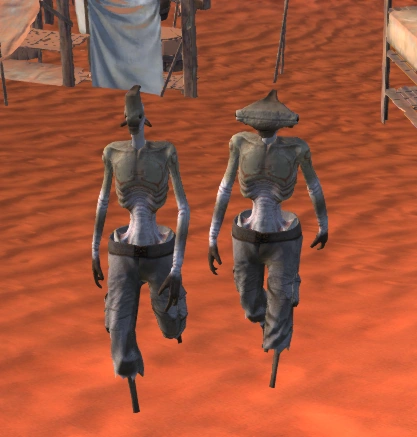
How they survive
Empire Peasant living conditions are made concrete in the game in several ways:
- Housing: some live in shacks on the edge of towns, farming or serving for barely enough money to eat; others are too poor to get through the city gates at all and can only settle in Vagrant Camps out in the wilds. These camps are found in the Great Desert and around Heng.
- Equipment: sticks in hand, straw hats on head, wooden clogs on foot. Peasant traders stock only [Prototype] and [Shoddy] quality — half and half, with nothing better on offer.
- Food: the wiki describes them as subsisting "on minimal food", including Foul Raw Meat scavenged off Skimmer corpses.
- Membership: besides peasants and tenant farmers, the faction also shelters Escaped Slaves. They carry a 2,000-Cat bounty from the United Cities and wander around Heng, the Howler Maze, the Skimsands, the Great Desert and the Hook; encountered alone, they can be talked to and recruited.
Why they hate the Holy Nation
The Empire Peasants' faction relations contain only two exceptions: +100 to the United Cities, -100 to the Holy Nation.
Why would a class so destitute that its own nation swept it out the door hold maximum hostility toward a distant theocracy? The wiki offers two accounts without settling on either:
- The destruction of Bast — what the Holy Nation did there left substantive hatred behind.
- United Cities propaganda — the Empire manufactures an external enemy, and the effect lands on the class easiest to mobilise.
Worth noting: the Empire Peasants have no negative value at all toward the Noble Circle that abuses them. The +100 loyalty is unconditional.
An awkward relationship with the Rebel Farmers
The Rebel Farmers come from the same class — they are Empire Peasants driven off their land who picked up weapons. But relations between the two are not warm.
Numerically, the Rebel Farmers list Empire Peasants at +100 "coexistence": they will not attack neutrals unprompted, but fighting can still break out. When it does, the rebels furiously curse the Empire Peasants opposite them as traitors.
From the rebels' angle, anyone who stays inside the system farming for nobles is an accomplice; from the peasants' angle, rebels who rob caravans and travellers on the roads are a threat — and rebel robbery is not aimed only at the upper class. This is also why ordinary citizens are generally unsympathetic to the rebellion: in AI behaviour, caravans and shop guards will side directly with the Imperial Samurai.
After the Empire falls
The Empire Peasants' real weight only becomes visible when the United Cities collapses. When the Noble Circle is cleared out one by one, the ones who take over the towns are not the Rebel Farmers but the peasants — and not by storming them, but by moving in: the peasants do not besiege the cities, they simply take up residence in the abandoned buildings[V5 0:10:10].
Depending on the world state, settlements that may fall under Empire Peasant control include Sho-Battai, Heng ×2, Heft, Bark ×2, Clownsteady, Trader's Edge, Port North and Port South.
The coverage of that takeover is a good deal uglier than "the peasants won" makes it sound, though. The United Cities originally had 16 settlements, and the Empire Peasants actually inherit only about 44%; the remaining 56% are either derelict or fall into bandit hands[V5 0:10:10]. And in the places they do take, the entire apparatus of Empire function disappears along with the nobles: Samurai patrols, Traders Guild caravans and slave markets all stop, and the economy falls back to farming, barter and scavenging at subsistence level[V5 0:11:53].
Post-takeover conditions vary enormously:
- Sho-Battai takes about 20% damage but is genuinely rebuilt — Free Traders open shops, rebel swordsmen and bonedogs guard the gates, and the bar's beds are swapped for camp beds.
- Port North is half-repaired from a destroyed slave camp into a fishing port and farming town, propping up the supply line that runs through Sho-Battai to Heft.
- Heft is the other extreme: all seventeen buildings destroyed, the capital command post smashed, most survivors malnourished, and the default resident type is outright "squatter".
- Clownsteady keeps its police station and thieves' tower; the United Cities and the Empire Peasants share the same legal system, but the town's Empire Southwest trade culture is stripped out by the override and replaced with the Empire Peasants' own Empire trade culture, so the local price bonus on hashish actually jumps from 500% to 1,200%.
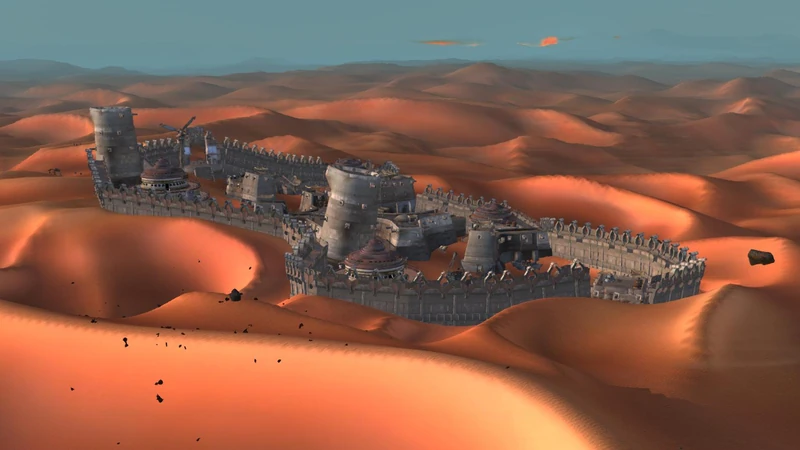
Can they run a country?
The answer leans toward no, and the reasoning is quite specific: the Empire Peasants have no leader, no hierarchy and no identifiable law, and show no sign of any central leadership[V5 0:11:53]. Their social form is a non-aggressive aggregate that forms mutual-aid networks with refugees, traders and even drifters, but has no administration, no garrison and no long-term planning. Translated into the actual state of the towns, this means many settlements sit indefinitely at malnourished or half-ruined levels[V5 0:11:53].
Economically they sustain farming, trade and scavenging, but lack engineers, caravans and any coordination of labour — holding on to what they inherited is already a stretch, let alone expanding. On security they present a paradox: systemic violence is gone, with no more noble executions, slave sweeps or arbitrary arrests; but there is no defensive line either, and raids by bandits, Skimmers and Cannibals land far more easily.
One commentator sets the two orders side by side: the United Cities are "ordered but oppressive", the Empire Peasants "free but fragile", and what the latter obtained is freedom from oppression, not freedom from danger[V5 0:13:36]. The same analysis concludes more bluntly that the Empire Peasants are not a government but a "commoner takeover faction", close to a placeholder in game logic — no leader (not a single named character apart from Boss Simion), no council, no administration, and their method of controlling a town is simply "being there". What they manage is survival, not governance, and they are waiting for a stronger power to replace them[V5 0:14:42]. This is the channel's assessment rather than a verdict handed down by the game, but it aligns closely with the values and behaviour the game gives this faction.
See also
- Rebel Farmers — the ones who picked up weapons
- United Cities
- Noble Circle
- Slavery
- Hive
Video citations
- Kenshi: Major Powers | United Cities and Holy NationCivilizationEx
- History of Kenshi: Major Powers | DocumentaryCivilizationEx
- Kenshi: History of the United CitiesCivilizationEx
- Which Faction Can Succeed on Kenshi?HeroInHisHead
- What If The Rebel Farmers WinHeroInHisHead