
SkimmerReport
English:Skimmer · Creatures
A giant insectoid of the northeastern desert that sleeps buried in the sand by day and comes out in packs at night, attacking anyone on sight. Killing them is no crime, the Desert Sabre is especially effective against them, and a lone adult is the toughest.
- What It Is
- Where You Will Meet Them
- How Dangerous
- How to Deal With Them
- After They Fall
- Data and Formulas
- Faction and Relations
- Basic Data
- Mechanics
- Routine: 17 Hours Lying Down, 7 Hours Awake
- How Age Is Drawn: Patrols Are Half-Grown, Singles Are Adults
- Its Strike: Seventy Percent Pierce
- Hit Weights and Attack Slots
- Speed and Escape
- Countering Them
- Distribution and Spawning
- Drops and Cashing In
- Trivia
- Research Notes
- See Also
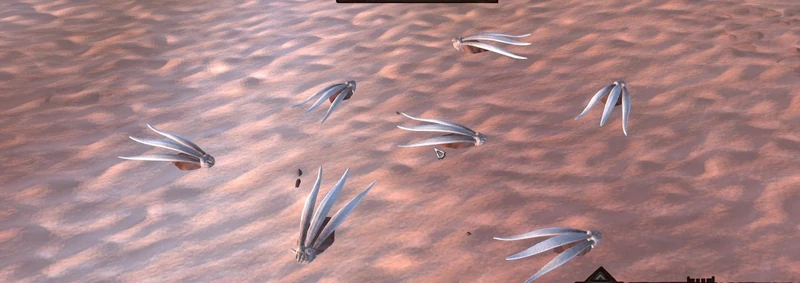
The Skimmer is a large insectoid found across the dry northeast of the continent. It looks like an antlion larva scaled up dozens of times, with a low-slung body, two long antenniform forelimbs held high over its back, and a ring of white fangs around its mouth meant for gnawing corpses. It is hostile to almost every living thing and attacks on sight, and it is the first lesson for players who start near United Cities.
Killing a Skimmer is no crime: nobody will come after you for it and no bounty will follow. They are at peace only with herbivores. Everyone else and every other beast is prey.
What It Is
Skimmers form a group of their own and belong to no human faction. Spiders, Cannibals, Fogmen, the Skeleton Legion, Scavengers, Fishmen and a long list of bandits and armies are sworn enemies of theirs, and the Southern Hive hates them most of all. United Cities, the Traders Guild and the Western Hive have no old grudge with them, but that does not help: when they come out on patrol they leap on neutral passers-by all the same.
They have two kinds of nest, the large Skimmer Nest and the Small Skimmer Nest. The remains of a caravan picked clean by Skimmers is a recurring scene in the game's background, and some characters got their start by scavenging supplies from such wreckage[V1 0:06:17]. Port South is harassed by them often, and while the guards are busy with the bugs, attention inside the walls slackens.
Routine: Sleep by Day, Out at Night
By day the whole pack sleeps buried in the sand, lying down 17 hours of the day and waking only from 11 PM to 6 AM, 7 hours in all. A sleeping Skimmer springs up and attacks the moment anyone comes near, so do not assume you can walk past just because they are asleep. Lone individuals do not sleep and wander the desert in daylight.
Where You Will Meet Them
Skimmers have no fixed base that you can avoid; they are bands roaming the desert. Most places you meet a lone adult, while night patrols of three to six appear only in Skimsands, the Great Desert and Heng.
| Region | What you will meet | How common |
|---|---|---|
| Skimsands | Patrols and lone individuals | Most roaming bands are them; highest density |
| The Great Desert | Patrols and lone individuals, plus nests | Fairly common |
| The Eye | Lone individuals only | Fairly common |
| Heng | Patrols and lone individuals, plus small nests | Occasional |
| Grey Desert, Sinkuun | Lone individuals only | Occasional |
| Bast | Almost never | Extremely rare |
Skimsands lies between the Holy Nation and United Cities, where the patrol routes of both sides overlap, but the true permanent residents are these bugs. Nests house guards in groups of one to three, each a little smaller than a lone adult. A cleared nest slowly refills, in about a day for a large nest and about half a day for a small one. There is no loot inside nests.
How Dangerous
A single adult Skimmer has about two and a half times an ordinary person's health in each part. An unarmoured character loses more than half their health to one hit, is knocked out by two, and dies in about four. The real danger is when they come in packs. A squad with no fighting strength that ran into six Skimmers in the Great Desert saw its line collapse at once, its members carried off one by one[V2 0:02:19].
A few things worth remembering:
- The older they are, the tougher. Lone individuals are fully grown adults and the hardest to beat. Night patrol members have only sixty to ninety percent of an adult's health, and nest guards are smaller still, about fifty to ninety percent.
- They hurt mainly by piercing, so cloth is nearly the same as nothing, light armour stops only about thirty percent, and only heavy armour holds.
- Characters with high Toughness are far sturdier. Unarmoured, a high-Toughness character loses only a little over half the health a low-Toughness one does from the same hit.
- At most two can bite the same target at once, so when six surround one person, the bugs on the outer ring can only circle and wait for an opening.
They run no faster than people. An adult manages about 14 to 16 mph, younger ones slower, and an ordinary humanoid without load is faster, so fleeing almost always works. But the gap is only a mph or two, and with a wounded companion, a heavy load, an injured leg or an empty stomach, the advantage quickly disappears.
How to Deal With Them
The most effective answer is to bring a Desert Sabre. It hurts Skimmers especially, dealing double damage and roughly halving the number of hits needed; only two weapons in the whole game carry a bonus against specific creatures like this. For the sabre itself see Desert Sabre.
Without a sabre, workable approaches are:
- Scatter at once in different directions so the pursuers are split up.
- Stall for time until passing Slave Hunters take over and draw the swarm away[V2 0:02:19].
- Lead them all the way to a city gate and leave them to the gate guards, then collect the corpses afterwards; even at the no-equipment stage this reliably yields food and cash.
After They Fall
An adult Skimmer's corpse holds 6 Animal Claws, 2 Raw Meat and 8 Foul Raw Meat. The claws are the main income, the meat is worth little, and all three together come to about 600 Cats.
| Item | Count | Sell price | Notes |
|---|---|---|---|
| Animal Claw | 6 | About 90 Cats each | Trade good, sells at full price |
| Raw Meat | 2 | About 30 Cats each | Sells at only half price |
| Foul Raw Meat | 8 | Under 1 Cat each | Nearly worthless |
Neither Raw Meat nor Foul Raw Meat is meant for ordinary people to eat. Only Scorchlanders and the Hive can eat Raw Meat, and only Hive Workers and Soldiers can eat Foul Raw Meat. Raw Meat can be roasted into Dried Meat over a campfire, and Foul Raw Meat can be made into Crunchy Bone Jerky.
Data and Formulas
The following is the full data for players who want to dig deeper.
The Skimmer uses the spider's animation skeleton (attack category ATTACK_SPIDER, the same sound IDs as the spider), three times the spider's per-part health, and a sleep routine of its own.
Faction and Relations
The faction is named Skimmers and is flagged "not real", so attacking them is no crime and lowers no faction's relation with the player. In the faction table, Skimmers are at -100 with Spiders, Cannibals, Fogmen, Bloodraiders, Rebel Farmers, the Skeleton Legion, Scavengers, Grass Pirates, Gurillo Bandits, Fishmen, Thrall Masters, Yabuta's Fugitives, the Second Empire, and the background factions Old Empire, Old Machines, Ancient Ruins and Gutters; -50 with the Southern Hive; and -10 with Starving Bandits, Dust Bandits and Vagrants. Most of this table comes from the other factions' data listing Skimmers as hostile, and whether it is fully symmetric has not been confirmed item by item in the reverse-engineered data. The game's hostility threshold is -30, so those three at -10 are still neutral in relation terms.
United Cities, the Traders Guild and the Western Hive have a relation of 0 with Skimmers. But their patrol package carries the "attack enemies and neutrals" task (task 21), so neutral does not mean they will spare you. The coexistence list holds only the herbivore faction, and the coexistence flag keeps the two sides from fighting each other.
Basic Data
The numbers in the table below come from the Skimmer's character record and race record; the source of derived formulas is marked in parentheses.
| Item | Value | Notes |
|---|---|---|
| Combat stats | 35, random +-10 | Characters with no separate STATS record start every combat-related skill from this number, so Strength, Dexterity, Toughness, Athletics and so on fall between 25 and 45. |
| Martial Arts, Dodge | 3.5, random +-10 | These two take only a tenth of the base value and can go negative after randomisation. Animals use Martial Arts as their weapon skill, so their striking power rests mainly on Dexterity, not skill. |
| Fixed Strength (animal strength) | 20 | The field description says "animals have fixed strength", but no place was found in the reverse-engineered data where it is used directly as a Strength level; only that effective Strength is multiplied by age is confirmed. |
| Lifespan | 8 | The field description says days to reach adulthood (default 20), so Skimmers mature faster than ordinary animals. No write point for age growing over time has been found in the reverse-engineered data, and how this number acts is unconfirmed. |
| Body size | 0.2 (juvenile) to 0.8 (adult) | scale min / max, default 1.0. Blood pool and per-part health are both multiplied by this size. |
| Per-part health | Base 300 per part, seven parts | Chest, head and stomach are vital; the left and right forelimbs and left and right legs are limbs. Base total 2,100, vital parts 900. |
| Blood pool | Min 20, max 200 | Animal blood = 20 + 180 x size (medical). Adult 164, juvenile 56. |
| Run speed | Speed floor 50, cap 100 | S0 = 50 + 50 x Athletics / 100, then multiplied by (0.5 + 0.5 x age). |
| Walk speed | 25 | The RACE walk speed, about 5.6 mph. |
| Combat movement multiplier | 2.0 | The speed vector in the combat movement branch is multiplied by 2.0; humanoid races are 1.0, spiders are also 2.0. |
| Extra attack slots | 1 | The number of attackers on one target is 1 + 1 = 2 (cap 5). |
| Weapon | _skimmer (natural weapon) | Cut multiplier 0.8, blunt 1.0, pierce 1.0, cannot block, manufacturer "Unknown". |
| Smell | Blood threshold 0, egg threshold 5 | In the reverse-engineered data these two fields mean how strong a scent must be to trigger tracking; for the actual effect of blood 0 and egg 5, see the Research Notes. |
| Vampiric | Yes | The field description says "drains nutrition while eating, does not chew limbs", consistent with the drain-style feeding in the creatures overview. The point of use has not been found in the reverse-engineered data. |
| Carriable | Yes | Can be picked up after being knocked down; the point of use is likewise unconfirmed in the reverse-engineered data. |
| Self healing | Yes | Wounds slowly recover on their own; healing rate and bleed rate multipliers are both 1.0. |
| Blood colour | 11447848 (0xAEAE28) | A yellowish green; the colour byte order is unconfirmed. |
Health That Grows With Age
An animal's health, size, effective Strength and run speed are all multiplied by age (0 to 1). Max per-part health = base 300 x size x HP mult (1.0), and size = 0.2 + 0.6 x age.
| Age | Health per part | Total, seven parts | Total, three vital parts | Blood pool |
|---|---|---|---|---|
| 0.5 | 150 | 1,050 | 450 | 110 |
| 0.6 | 168 | 1,176 | 504 | 121 |
| 0.75 | 195 | 1,365 | 585 | 137 |
| 0.9 | 222 | 1,554 | 666 | 153 |
| 1.0 | 240 | 1,680 | 720 | 164 |
In other words, the game has no such thing as a "level" here; its age is its level. How age is drawn is covered in the spawn table in the next section.
Mechanics
Routine: 17 Hours Lying Down, 7 Hours Awake
The AI packages of night patrols and nest squads all inherit the same "animal sleep nocturnal" add-on (addon- animal sleep nocturnal). This package has only one leader goal: the task Animal Sleep, start 6, end 23. By the game's scoring rule, the slot is active when 6 <= hour < 23, so from 6:00 to 22:59, 17 hours, they want to sleep, and they are awake only from 23:00 to 5:59 the next day, 7 hours.
This sleep goal is attached only to the leader; the other members act on the goals "follow leader" and "protect squad". Whether members lie down with the leader is not directly confirmed in the reverse-engineered data; that is inferred.
The three spawn squads use different packages:
| Squad | AI package | Sleeps? | Other goals |
|---|---|---|---|
| Night patrol (skimmer patrol group nocturnal) | animal agressive patrol nocturnal | Sleeps (6 to 23) | Inherits "animal patrol": patrol, protect squad, attack enemies and neutrals |
| 24-hour single (skimmer hunter solo 24hr) | animal patrol aggressive | Does not sleep | Same as above |
| Nest squad (skimmer nest) | Creature nest agressive nocturnal -eat corpses | Sleeps (6 to 23) | Patrol home, protect companions, self-preservation, attack, eat corpses |
"Sleep" itself is the task SLEEP_ON_FLOOR. The reverse-engineered data lists its start conditions as including "no enemies nearby", "not on alert" and "not in the home town". So whenever an enemy appears nearby, the sleep task's preconditions fail and the higher-priority attack task (classification 3; sleep is 2) takes over. That is what players feel as "get too close and they jump up".
For animation, sleeping uses the sleeponfloor action, which carries a "disable movement" flag; only two ANIMAL_ANIMATION entries in the base game have this flag. The data has no description of "burrowing into sand"; being buried appears only in the visuals, and all the game data shows is sleeping on the ground.
How Age Is Drawn: Patrols Are Half-Grown, Singles Are Adults
When the world generates a squad, each animal's age = max(0, random x animal age random - 0.1 + age base x 0.01) (reverse analysis, world generation). The parameters for the three Skimmer squads:
| Squad | Count | Age base (%) | Age random range | Age range | Per-part health range |
|---|---|---|---|---|---|
| 24-hour single | 1 | 100 | 0.1 | 0.9 to 1.0 | 222 to 240 |
| Night patrol | 3 to 6 | 70 | 0.3 | 0.6 to 0.9 | 168 to 222 |
| Nest squad | 1 to 3 | 60 | 0.4 | 0.5 to 0.9 | 150 to 222 |
The conclusion is a little counterintuitive: in the largest group, the night patrol, each member's health is actually twenty to thirty percent lower than a single's, and they run slower too (see the next section). The single is the full-health adult, and the hardest to fight.
Its Strike: Seventy Percent Pierce
Animal damage reuses the melee weapon formula (reverse analysis, combat damage), with Martial Arts as the skill (3.5 +- 10) and an attribute multiplier k equal to age, applied only to Dexterity. The Skimmer's weapon _skimmer has cut multiplier 0.8, blunt 1.0, pierce 1.0, and manufacturer Unknown has two models, grade 5 Rusted Junk and grade 10 Rusting Blade, each at half.
For an adult (k = 1), Martial Arts 3.5, Dexterity 35, Strength 35 and Rusting Blade:
- Cut: the cut coefficient at grade 0.1 is lerp(0.1, 0.3, 2.0) = 0.47, times the weapon's 0.8 = 0.376. Cut = lerp((3.5 + 35) x 0.376 / 200, 13, 52) = 13 + 39 x 0.0724, about 15.8.
- Blunt: blunt coefficient lerp(0.1, 0, 2.0) = 0.2, blunt = lerp((0.5 x 3.5 + 1.5 x 35) x 0.2 / 200, 0, 52), about 2.8.
- Pierce: 0.78 x (3.5 + 35) x 1.0 + 10 x 1.0 = 40.0.
- Total about 58.7, of which pierce is 68%. The Rusted Junk model totals about 56.8, only about 2 points apart.
Dexterity runs 25 to 45 and Martial Arts -6.5 to 13.5, so pierce falls between 24.4 (weak) and 55.6 (strong), and an adult's total damage per hit is roughly 39 to 76. Younger individuals shrink only in the Dexterity term: an age 0.5 individual does about 42 total, and 0.75 about 51.
##### How Armour Blocks
Armour reduces cut damage by a percentage and pierce by a flat deduction (Harpoon resistance, reverse analysis). Most Skimmer damage is pierce, so clothing with high cut resistance but a low pierce deduction does not block much. The table below assumes Toughness 50 (damage multiplier 1.0) and the piece worn on the part hit. Health lost per hit = cut x (1 - cut resistance) + max(0, pierce - deduction), without counting knockout or coverage rolls:
| Wearing (standard grade) | Cut resistance | Pierce deduction | Health lost per hit |
|---|---|---|---|
| Nothing | 0 | 0 | 55.9 |
| Trader's Leathers | 0.176 | 14 | 39.1 |
| Trader's Leathers + Leather Shirt | 0.292 | 21 | 30.2 |
| Samurai Armour | 0.400 | 36 | 13.5 |
| Samurai Armour + Chainmail | 0.525 | 48 | 7.5 |
Toughness matters a great deal too. Damage multiplier = 1 - lerp(Toughness / 100, -0.65, 0.65): 1.65 at Toughness 0, 1.52 at 10, 1.0 at 50 and 0.35 at 100. For the same unarmoured character hit once by an adult Skimmer, Toughness 50 loses 55.9, Toughness 10 loses 84.9 and Toughness 0 loses 92.2.
The immediate blood loss of each hit is (cut + pierce) x 0.2 (reverse analysis, hit resolution), typically about 11 points, and the wound keeps bleeding afterwards.
Hit Weights and Attack Slots
A Skimmer's seven body parts all have base health 300, and the weights for being hit are chest 300, head 300, stomach 300 and each of the four limbs 100, totalling 1,300. As base probabilities, chest, head and stomach are 23.1% each and each limb 7.7%, meaning 69.2% of hits land on a vital part. After a hit, that part's weight rises further (up to 4 times), so repeated attacks on the same part focus more and more (reverse analysis, hit resolution).
For attack slots, the extra attack slot of 1 plus the global value of 1 means at most 2 Skimmers attack the same target at once (attacker count = clamp(1 + extra slots, 1, 5)). While the target is itself attacking, the count is fixed down to 1. This explains why, when six surround one person, the outer bugs seem to circle waiting for a spot.
Speed and Escape
The run speed formula is S0 = lerp(50, 100, Athletics / 100) x (0.5 + 0.5 x age), and mph is converted by multiplying by 0.22369 (reverse analysis, movement speed). A Skimmer's Athletics is 25 to 45:
| Age | Athletics 25 | Athletics 35 | Athletics 45 |
|---|---|---|---|
| 0.6 (patrol minimum) | 11.2 | 12.1 | 13.0 |
| 0.9 | 13.3 | 14.3 | 15.4 |
| 1.0 (adult single) | 14.0 | 15.1 | 16.2 |
A humanoid Greenlander's run speed is lerp(70, 120, Athletics / 100): 15.7 mph at Athletics 0, 16.8 mph at 10 and 18.5 mph at 25. So a character with Athletics above about 5 is faster than even the fastest adult Skimmer when bare-handed and unencumbered, and fleeing really is almost always feasible. The gap is only 1 to 2 mph, and with load, a leg wound, hunger or a wounded companion the advantage quickly vanishes.
The combat movement multiplier of 2.0 acts on the combat movement branch (circling, sidestepping); humanoids have 1.0. Whether this lets them catch players in close-quarters pursuit has not been verified item by item in the reverse-engineered data, and in gameplay videos fleeing usually still succeeds.
Countering Them
The Desert Sabre's race damage table lists Skimmers at 200%, along with Spiders at 200%, Small Spiders at 150% and Bone Dogs at 125%. Only the Desert Sabre and Falling Sun have such multipliers in the whole game, and 200% is the highest. The sabre itself has cut multiplier 1.1, blunt 0.25, pierce 0 and a defense bonus of +2; for item details see Desert Sabre.
Calculation: damage formula as above, taking weapon skill = Dexterity = Strength = X (no move multiplier), then multiplying by race damage 2.0 and the Skimmer's damage multiplier (Toughness 35, adult 1.195). To bring one vital part of an adult single (240 health per part) below 0:
| Weapon, skill | Per hit without sabre bonus | Per hit with sabre bonus | Hits with bonus | Hits without bonus |
|---|---|---|---|---|
| Edge Type 3 (grade 80), skill 25 | 45.2 | 90.3 | 3 | 6 |
| Edge Type 3, skill 50 | 74.8 | 149.5 | 2 | 4 |
| Edge Type 3, skill 75 | 104.4 | 208.8 | 2 | 3 |
| Catun No.2 (grade 35), skill 25 | 30.3 | 60.5 | 4 | 8 |
| Catun No.2, skill 50 | 45.0 | 90.0 | 3 | 6 |
The sabre's bonus roughly halves the hits needed, one of the most direct counters in the whole game. Half-grown patrol members (age 0.75, 195 health per part) need about one hit fewer.
Distribution and Spawning
Skimmers are not fixed-placement enemies but squads drawn from the roaming spawn tables of biome groups (BIOME_GROUP). They appear in the tables of seven biome groups, with weights and shares as follows (share = the sum of the weights of the two Skimmer squads divided by the total roaming weight of that region):
| Region | Night patrol weight | 24-hour single weight | Share of region's roaming spawns | Region density multiplier |
|---|---|---|---|---|
| Skimsands | 100 | 50 | 71.4% | 2.2 |
| The Great Desert | 40 | 40 | 18.3% | 1.25 |
| The Eye | None | 100 | 19.1% | 1.0 |
| Heng | 25 | 30 | 11.7% | 1.0 |
| Grey Desert | None | 11 | 11.8% | 0.65 |
| Sinkuun | None | 10 | 8.8% | 1.0 |
| Bast | None | 1 | 1.4% | 1.6 |
Night patrols (3 to 6) appear only in Skimsands, the Great Desert and Heng. The tables for The Eye, Sinkuun, Grey Desert and Bast hold only 24-hour singles, so Skimmers met in those outer regions are almost all alone.
Nests
Nests are towns of type TOWN_NEST. The two kinds differ as follows:
| Nest | Nest population | Roaming squads (weight) | Biome groups where it appears |
|---|---|---|---|
| Skimmer Nest | 18 | 24-hour single 6, nest squad 4 | The Great Desert (29.9% of that region's nest weight) |
| Small Skimmer Nest | 8 | Nest squad 4 | The Great Desert (3.0%), Heng (55.6%) |
A cleared nest slowly refills. The game's rule is that a nest's roaming population cap drops to 70% after being cleared and then recovers 0.218 per world-clock hour. At that rate, a Skimmer Nest takes about 24.8 hours to refill from 12.6 to 18, and a small nest about 11 hours from 5.6 to 8. The nest itself drops no equipment or items (stash base value 0).
Nest squads have age 0.5 to 0.9, younger than patrols, so clearing a nest means facing half-grown individuals, each easier than a single, though there are 1 to 3 of them and they carry the "eat corpses" goal.
Drops and Cashing In
A Skimmer's death items are placed in its inventory at spawn (an animal's main inventory is locked after spawning and holds only these). If a non-player-faction living animal has its death items taken wholesale, it is judged dead.
| Item | Count | Unit price (base) | Player sell | Notes |
|---|---|---|---|---|
| Animal Claw | 6 | 90 Cats (value 150 x 0.6) | 90 Cats, 63 to 117 across cities | Trade good, sells at full price. |
| Raw Meat | 2 | 60 Cats (value 100 x 0.6) | 30 Cats, 21 to 39 across cities | Not a trade good, sold at x0.5. |
| Foul Raw Meat | 8 | 1 Cat | 0.5 Cats | Nearly worthless. |
Its inventory is 4x8, and the field description requires a size that fits all the death items. You can only see a corpse's inventory once it is downed or dead.
Trivia
- Skimmers are among the few animals that use an "Unknown" manufacturer weapon, so there are only two weapon models (Rusted Junk and Rusting Blade), which differ by only about 2 points of total damage.
- Their animation skeleton is shared with the spider, and per-part health is three times the spider's (300 against 100 per part).
- "Skimmers" does not appear on the faction page because the data marks it "not real".
- The Desert Sabre's encyclopedia entry calls it a "Skimmer-runner"; that is another translation, and this site's official name is Skimmer.
Research Notes
- An earlier draft said they "attack on sight"; the data basis is the patrol package's "attack enemies and neutrals" goal, not faction hostility. The relation table is 0 with United Cities, the Holy Nation, the Traders Guild and others.
- An earlier draft said "does not attack the Western Hive" and that was wrong: the coexistence list holds only the herbivore faction, the Western Hive is neutral and the Southern Hive is -50.
- The earlier draft's upper bounds of "per-part health 60 to 258, blood pool 56 to 174" were wrong; the adult maximums are 240 and 164.
- The earlier draft's "weapon fixed at 23 cut damage" was wrong: in the data the cut multiplier is 0.8 and pierce 1.0, pierce is seventy percent, and it depends on Dexterity and age.
- The earlier draft's "poses no threat to lightly armoured squads" was wrong; a leather jacket cuts only about thirty percent.
- The earlier draft's "Raw Meat averages about 60" holds only for buying; selling is 30. "Rotten Raw Meat is edible" was wrong, being limited to the Hive.
- Three earlier claims, "Bast spawns reliably", "all three regions can randomly spawn nests" and "go back to sleep after 140 minutes", have no support in the data and were rewritten or removed.
- The earlier draft's "extra attack slots 1" is correct; this time its effect (an attacker count of 2) has been added.
- The start conditions of the sleep task come from the kb task table; whether members lie down with the leader and whether sleeping has a "buried in sand" appearance check are inferences, currently unconfirmed.
- Lifespan 8 and age growth: kb has not found a write point for age increasing over time, and whether juvenile Skimmers grow up in game is unconfirmed.
- The actual effect of the combat movement multiplier 2.0 on close-range pursuit speed is unconfirmed.
- The smell, vampiric and carriable fields have values in the data, but kb confirms only their load location or field description; the point of use is unconfirmed.
- The earlier draft's "gate guards habitually use polearms" and "the number one cause of death for beginners" are community claims not confirmed by game data.
See Also
- Animal Nests
- Creatures
- Beak Thing
- United Cities
- Gorillo
- Desert Sabre
- Skimsands
- Combat System
- Medical System
- Armour
Video citations
- What If The Rebel Farmers WinHeroInHisHead
- Kenshi | The Nugget Mafia (Ep. 1)HeroInHisHead