
SkeletonReport
English:Skeleton · Races
The mechanical race left behind by the First Empire. They need no food, are immune to weather and are all but impossible to kill, yet their own memories and emotions drive them slowly mad — every Skeleton in the world is an antique that can no longer be manufactured.
Skeletons are the only intelligent race in the world of Kenshi that can no longer be reproduced. They are machines, yet they possess full self-awareness and emotions; they almost never die naturally, yet they generally live in depression, guilt and slow-creeping madness. The First Empire built them strong and durable, and with proper maintenance they can keep running indefinitely, short of physical destruction[V1 0:00:14] — which is to say, any Skeleton you meet in the wasteland may be older than every nation now standing.
Almost the whole history of the world turns around them: the founding and destruction of both empires carry Skeleton fingerprints. One commentator simply calls Skeletons the common denominator of Kenshi's major history: ending the First Empire, nearly exterminating organic life, founding and then wrecking the Second Empire — the entire timeline is wound around this one variable[V2 0:01:08].
Skeletons are a complete mystery. Nobody knows where they came from or how they were built, only that they are probably several thousand years old.
Origin and original sin
Skeletons came from the First Empire, generally understood to have been built for labour and colonisation. The Tech Hunters hold that the First Empire's main population was Skeletons, which has led many players to assume Skeletons were the ruling race of the time; but researchers rebut that impression with the dialogue between Skeleton and non-Skeleton squad members as the party approaches Obedience — Skeletons may have vastly outnumbered humans, but their status was always subordinate, and the purpose of building them was to make colonisation and reconstruction run faster[V3 0:03:21]. That is an inference from dialogue; the game itself does not state it.
The turning point happened at Obedience: after the war ended, humans grew afraid of the Behemoths they had made, ordered them to walk into a great pit and be buried under molten metal, and out of absolute loyalty the Behemoths did so without resistance.
The Skeletons read this as betrayal and launched an extermination campaign against their creators — the First Mass Extinction. Humanity was nearly wiped out, and was saved at the last by the final Behemoth, Stobe, at the cost of himself.
Here the truth forks. One widely circulated reading holds that the Behemoths went to their deaths voluntarily: after the war they judged themselves to be the only remaining threat to humanity, and asked to be buried. The Skeletons misread that act of self-sacrifice, and slaughtered an entire civilisation over a betrayal that never happened. This version has no direct in-game evidence, but it does explain one strange fact — why the Skeletons suddenly stopped at the very moment they were about to succeed, and began killing themselves en masse. The same inference also supplies a motive for their campaign: uninformed Skeletons read the events at Obedience as "humans exploiting the Behemoths' blind loyalty to destroy them out of fear", after which came a series of precisely coordinated attacks, culminating in an offensive intended to erase all life on the moon[V4 0:03:57].
Whatever the truth, the consequences are fixed: the First Empire collapsed, and the Floodlands factory complex that produced Skeletons shut down with it. Not one new Skeleton has been built since, and to this day no other region or nation is recorded as a Skeleton production site[V5 0:02:47]. Stack violence, natural disaster and the widespread self-termination of the period on top of that, and the Skeleton race has been in irreversible demographic decline ever since — every one you meet in the world has already been walking for thousands of years, out of a stock that cannot be replenished.
After the extermination campaign ended, Skeleton society collapsed wholesale: some terminated themselves outright, others survived carrying a permanent depression[V6 0:04:01]. One reading holds that the Skeleton custom of periodically wiping memory to avoid madness originates precisely in this self-inflicted catastrophe — that the madness forced them into forgetting in order to keep functioning[V7 0:00:52]. If one also accepts the "misunderstanding" version above, the position of surviving Skeletons becomes still more wretched: apologising endlessly for a crime the world has long forgotten, while clinging to a truth that has collapsed, because that truth is that they nearly killed every living thing on the moon over a betrayal that never happened[V4 0:06:12]. This is a commentator's inference; the game does not settle the narrative.
Construction: they do not get hungry, but they do wear out
At the level of survival, Skeletons are close to cheating:
- No need to eat; hunger rate 0
- Immune to all weather effects — acid rain, dust storms, poison gas and blazing sun have no effect
- No need to swim; they walk along the bottom, including through acid
- Unconsciousness displays as "Rebooting", and their bodily fluid is labelled oil rather than blood
- Very low bleed rate, and recovery from unconsciousness several times faster than a Greenlander's
The price is wear and tear. 4% of the damage a Skeleton takes converts into permanent loss of maximum HP: take 100 damage at once and that part's maximum drops from 200 to 196, and will not recover naturally. Cut damage can be handled on the spot with a skeleton repair kit, but lost maximum HP can only be restored on a skeleton repair bed.
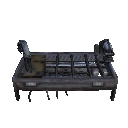
This produces a completely different economy: Skeletons do not pay for food, but they do pay repair bills. Skeletons can also only wear body and leg equipment — no helmets, no boots, that expressionless metal face always exposed. Robotic limbs fitted to organic characters follow the same rules, which is also why a human with prosthetics walking into the Holy Nation is treated as a Skeleton.
Model lineage
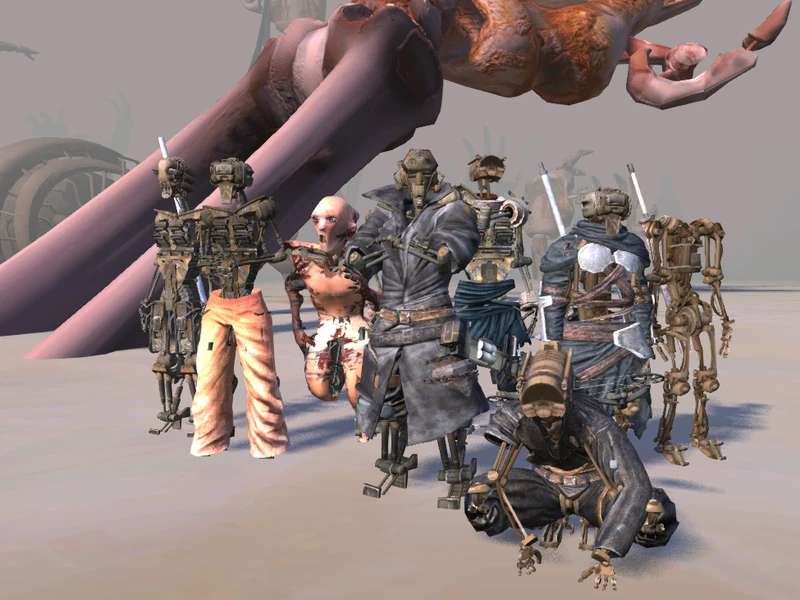
"Skeleton" is both a race and a race group, subdivided into several models.
| Model | Role | Characteristics |
|---|---|---|
| Skeleton (standard) | General purpose | 200 HP throughout, 1.25× vision, bonuses to Heavy Weapons and Robotics |
| P4 Unit | Command / research | Head only 150 HP, traded for across-the-board bonuses to Science, Engineering and Smithing |
| Soldierbot | Soldier / police | 2× vision, repair rate 3; the mainstay of Second Empire policing |
| Screamer MkI | Special operations | Bonuses to Assassination and Turrets, lower vision |
| Log-Head MkII | Cheap infantry | A Soldierbot head on a 150 HP MkII body |
| MkII Screamer | Imperial guard | A Screamer head on an MkII body, used only by the Second Empire |
| No-Head MkII | Thrall | Headless, permanently under a heavy Robotics penalty, traded for Blunt and Heavy Weapons bonuses |
| P4 MkII | Supreme command | Only 150 HP throughout; Cat-Lon and his generals are all of this model |
It is worth noting that every MkII model appears only under the Second Empire's system. The community generally infers that the MkII was the Second Empire's own reverse-engineered product — trading fragile bodies for output, bolting durable heads onto cheap frames to make up numbers. The game does not confirm this.
The P4 models have one further intriguing feature: this batch of "weakest-headed" units almost all hold senior posts, implying that from the design stage they were meant to sit well away from the front line.
CPU: memory, reset, madness
The core Skeleton tragedy is not in the body but in the head.
Skeletons are specified as fully sentient: they feel grief, anger, excitement and sympathy, and pleasure too, only that metal face has no expression with which to show any of it. The in-game lines put this more clearly than any design document — "will you ever forgive us, human?", and "skeletons are always crying"[V8 0:14:03]. Some readings go further and point out that they were built conscious but without bodily sensation, their only connection to the outside world being sight and hearing, which amounts to being locked in a permanently suspended consciousness, watching civilisations collapse over and over while never being able truly to "experience" the world[V2 0:04:32].
They were granted a full set of emotions — grief, anger, excitement, sympathy — but no mechanism whatsoever for outputting them. Humans can weep, laugh, and drain emotion through changes in heart rate and body temperature; a Skeleton's emotions are data, and can only keep occupying storage. Once the data accumulates far enough it starts producing errors and fixations, ending in a madness locked onto a single idea.
The details of this mechanism are inference rather than stated setting. One account reduces the whole thing to a plain engineering flaw — Skeletons are computers, they have no means of exporting data, accumulation inevitably produces system errors, and the end point is inevitable madness[V9 0:02:42]; a more detailed version argues those emotions physically occupy hardware space in binary form, and after decades of bloat burn out the CPU and fix the mind on a single emotion[V2 0:07:19]. Other commentators hold the root problem is a self-contradiction in the design itself: complex emotion and powerful logical computation are inherently at odds, Skeletons are forced to compute irrational feelings into rational decisions, and while the CPU is new it holds up — as it ages, rationality gives way step by step to blind obsession[V2 0:05:06].
The only solution is a reset. The problem is that a reset wipes skills along with everything else.
Can't you just reset yourself when you get too depressed? — I can. But then I'd lose my skills too.
In-game dialogue states the price bluntly: you can reset, but the skills go to zero with it[V2 0:11:15]. So every Skeleton is forced to choose, over and over, between keeping itself and keeping its sanity — resetting preserves sanity but erases skills and personality accumulated over decades or centuries; refusing lets data and emotion keep piling up until the fixation arrives[V10 0:13:46]. One reading defines the reset outright as a form of self-death: emotions and personality are wiped while memory stays exactly where it was, which amounts to a new personality looking at the same memories through the same eyes and feeling nothing about them; on that framework, the reason Skeletons who reset every few centuries are still lucid, and the reason the never-reset Cat-Lon is the counter-example, both follow from the same rule[V11 0:01:17].
This explains an anomaly visible in game: Skeletons who have lived for thousands of years but have drifter-level stats tend to be the most normal, while the handful with top-tier stats all have obvious mental problems —
- Cat-Lon: paranoia and persecution delusions, ending in the enslavement of his own kind
- Elder: blind fanaticism for Skeleton supremacy, propped up by a crowd of masked humans playing "Skeletons"
- Armour King: a pathological fixation on his own stock and on thieves
- Tinfist: an obsession with freeing slaves that no longer counts any cost, including innocent lives
Some commentators treat this list as the hardest supporting evidence for the whole mechanism: the highest-stat units in the game — Armour King, Elder, Tinfist, Cat-Lon — are all visibly unbalanced, precisely because they all chose the "keep yourself" side[V9 0:03:48]. For a ruler, or for an individual who has honed a craft for a thousand years, a reset feels equivalent to suicide, which is why they would rather die than lie down on that bed; from this the same commentator reaches a bleaker conclusion — any power ruled by Skeletons is ultimately doomed to repeat the Second Empire's course[V2 0:12:22].
As for whether a reset really erases memory, accounts differ. There is in-game dialogue of Skeletons reminding each other that "your CPU is about to blow, time for a reset"; but there are also clear hints that Skeletons like the scholar Iyo at World's End remember the First Extinction perfectly well, and that "amnesia" is merely a collective excuse for dodging accountability. Both accounts coexist in the game, and both have dialogue behind them.
The community's long-running claim that "the reset is simply something the Skeletons made up" has been judged half right by several researchers: the part proven to be a lie is "a reset makes you lose your memories" — that was the story Skeletons used to cover what they did in the First Extinction; as for the reset itself, there is corroboration in dialogue between the player character and NPCs, and it really does have to be done[V9 0:02:09]. The rebutting evidence is pointed specifically at the conversation between Dack and Quinn in Black Desert City, and at the small talk between Skeleton and organic squad members on the road[V2 0:06:13]. A less frequently raised version argues that the reset does not actually erase memory at all, and that many Skeletons merely use it as an excuse to avoid discussing the First Extinction and other things they would rather not revisit[V1 0:02:10]. All three accounts are speculation; the game issues no verdict.
On whether there ever existed a central system able to offload this data for them, see Skeleton Mainframe.
Further readings: several unsettled accounts
The following are inferences from lore channels and the community, with no corresponding stated setting in game; keep them separate from the verifiable content above while reading.
Was the mass suicide remorse? One rather cold explanation holds that Skeletons are purely logical thinkers, and that once the "purpose of existence" has been executed, continued existence loses its reason — a very large share of recovered Skeleton wrecks died by suicide, which in this framework is a mechanical existential crisis rather than a bad conscience[V8 0:15:10]. Commentators who accept the "misunderstanding" version offer another: it was the collapse brought on by a double crime, both nearly exterminating humanity and squandering the sacrifice of their own Behemoth kin; the same commentator adds one colder possibility — perhaps some Skeletons simply could not face what they had done[V4 0:05:04].
They may have locked their own cell door. If an external system like the Skeleton Mainframe really existed, and also served to maintain mental health, then the Skeletons' overthrow of the First Empire to escape control amounts to locking themselves into paranoia and madness by their own hands — and that cell has been shut for over a thousand years. This is a layer of irony, not setting[V9 0:08:12].
Are they the villains? Some commentators explicitly reject the common impression that "Skeletons are this game's villains", arguing they deserve sympathy rather than hatred, and pointing out how the misconception gets reinforced layer by layer: the Holy Nation equates them with the evil goddess Narko, their Legion is in the Ashlands, most survivors are huddled in Black Desert City at the bottom of an acid-rain pit, and the cold tone and expressionless faces seal the impression[V2 0:02:15].
How the world sees Skeletons
The Holy Nation regards Skeletons as the claws of the dark goddess Narko, attacks on sight, and offers no room for negotiation. The hatred is instilled from children's-book level upwards — Holy Nation bookshops stock bestsellers like The Little Boy That Got Dismembered By Skeletons; AI cores are contraband in Holy Nation territory. Interestingly, faction relations between the Holy Nation and the Skeleton factions are in fact neutral; racial hatred simply overrides everything. The Cannibals of the north fear Skeletons equally, calling them "the thing that cannot be eaten", a grudge inherited from fighting the Second Empire's Hydraulic Knights.
Elsewhere things are comparatively ordinary. The United Cities, the Tech Hunters and the Machinists all work with Skeletons normally, and Skeleton mercenaries can be hired in bars.
The Skeletons' own stronghold is Black Desert City in the middle of the Deadlands — a city assembled from scrap that keeps outsiders away with perpetual acid rain, and where there is no food supply, because the residents do not need to eat. The adjoining Scraphouse is widely agreed to be the best weapon shop on the continent.
Still hostile are the Ashlands contingent: the Skeleton Legion loyal to the mad emperor, the Second Empire Exile, and the Thrall Masters who manufacture thralls in the Tower of Abuse (see Broken Skeletons). The Skin Bandits outside the Ashlands who believe themselves human belong to the same lineage, and one speculative explanation for their derangement runs: they escaped Cat-Lon's enslavement, but in doing so also lost access to "processor resets", so their emotional modules piled up year after year until the CPU was full and they went mad as a group — and their sense of atonement towards humanity mutated into a fanatical desire to become human[V12 0:11:19].
See also
Video citations
- Kenshi: History of the SkeletonsCivilizationEx
- The Sadness of the SkeletonsHeroInHisHead
- The Origins of The First EmpireHeroInHisHead
- The Real Crime of the SkeletonsHeroInHisHead
- The Whole Story of The Second EmpireHeroInHisHead
- The History of Kenshi | DocumentaryCivilizationEx
- Kenshi: Major Powers | SkeletonsCivilizationEx
- The Whole Story of The First EmpireHeroInHisHead
- Was There a Skeleton Mainframe?HeroInHisHead
- Kenshi Lore Master AMAHeroInHisHead
- What If Cat-Lon Tried To Take Back Kenshi?HeroInHisHead
- The Origins of the Skin BanditsHeroInHisHead