
The First Empire / Old EmpireReport
English:The First Empire / Old Empire · World & History
An ancient civilisation with orbital satellites, a space elevator and genetic engineering, possibly destroyed by something of its own making, and not one credible record of the destruction survives.
- The naming confusion
- Technology
- Two lost eras
- Where did they come from?
- The foreign colonisers theory
- Why the homeland never came back
- The refugee theory
- How much did they reshape?
- Who was the master?
- The Behemoth war
- Obedience
- The Mass Extinction: five accounts
- The Skeletons' silence
- What was left
- Data and Formulas
- Research Notes
- See also
The First Empire is the oldest known civilisation in Kenshi and the source of every ruin in this world. People today know almost nothing about it: its writing cannot be read, its borders cannot be fixed, and it cannot even be confirmed that it arose in this world at all. Its inhabitants are now called "the Ancients", a name given by later peoples, not one they used themselves.
Its remains cover nearly the whole explorable map. The Second Empire is often described as "especially long-lived", but the archaeological density of the two sets of ruins points the opposite way: the First Empire lasted far longer, and all this civilisation left behind is a vague label, "the Ancients"[V1 0:00:32]. Some commentators argue that the only truly "great empires" in Kenshi's history are the First and the Second; the United Cities is strictly speaking an empire too, but nowhere near the other two in scale or workings[V2 0:01:04].
The naming confusion
This is the trap beginners fall into most often.
- First Empire: in scholarly use, the oldest civilisation.
- Old Empire: also means the First Empire, but some in-game place names (such as Old Empire Watchtower and Old Empire Supply Outpost) carry this name while actually belonging to the Second Empire.
- The Old Empire: a faction of the same name exists in the game, but its members and bases are never seen in the world. It may be a leftover from an early design of the Second Empire; this is inference.
So "Old Empire" in a place name cannot be used to date anything. To modern people both empires are "old", and the terms blended together long ago.
Technology
The capabilities that can be reconstructed from ruins and scavenged goods would count as top tier in any science-fiction setting:
| Capability | Surviving evidence |
|---|---|
| Orbital weapons | The "Eyes", ring-shaped satellites that can burn large areas of ground. One fell in the Eyegore region; another still operates in Vengeance Valley |
| Space elevator | A giant structure hovering above the Ashlands with no visible support |
| Automated factories | The factory complexes of the Flood Lands, "machines making machines, then making more machines" |
| Genetic engineering | Scholars generally believe part of the differences in appearance between today's races stems from this |
| Artificial intelligence | AI Cores, Security Spiders, the various models of Skeleton |
| Space travel | Suspected spaceship and missile wreckage scattered around |
What matters about this list is not any single technology but the coverage. Giant automated industrial complexes, orbital satellites, huge mechanical structures and a space elevator all existing at once means the Ancients mastered both surface and off-world engineering. Whether they originated in this world or came from elsewhere remains unresolved[V3 0:01:42].
The Ancient Science Books that scavengers can find in lost libraries and armouries are valuable enough to support the whole Tech Hunter economy, because modern people cannot build that knowledge and can only pick it up.
Two lost eras
A set of books in the game, written by scholars, sorts the ancient ruins into two batches: the structures scattered through the centre (called X in the books) and those scattered north of the Flood Lands (Y). The author of the books is the scholar Finch, and they are collected in The Lost Ancients. By his comparison, X far exceeds Y in scale, networks and industry, and Y looks like a crude imitation of X. X also lasted much longer, and Y may have been an attempt by someone to rebuild the empire in a hurry after X collapsed.
Finch also points out that the refinement of X's ruins varies greatly, suggesting a clear gulf between castes. The scholar Sabina speculates in the sequel that the two civilisations overlapped for a time, and that X, being Skeleton-oriented, may have had its Skeletons wipe out Y's organic life, which would lend some credibility to the legends in Holy Nation scripture. These are the inferences of characters in the books, not history confirmed by the game.
"The First Empire" in the rest of this page means X in the books, the civilisation that left the most ruins. Whether Y counts as the same empire, the game does not say.
Where did they come from?
The First Empire's biggest blank is not how it ended but how it appeared. No remains of any civilisation earlier than it can be found anywhere on the map: no more primitive cities, no transitional technology layer. This "high-tech civilisation out of nowhere" is the hottest inference topic in the lore community.
The foreign colonisers theory
The in-game scholar Idad writes in the Cultural Groupings And Evolution series that the Ancients' technology level was so high that they were probably not a local race but foreign settlers who came looking for natural resources. The primitive local ancestors were powerless to drive out the invaders and could only live outside them, at a neutral distance. This is the version explicitly written in the game's text; see the Cultural Groupings And Evolution series.
Commentary channels push the idea further. They organise the argument into three capabilities and one absence: large-scale AI construction, a space elevator, usable orbital equipment, and the lack of any trace of a civilisation older than the First Empire anywhere on the map, from which they infer the Ancients did not grow up locally[V2 0:01:38].
The two most concrete pieces of physical evidence for this are the "Eye" satellites, long speculated to have served both orbital bombardment and terraforming, burning away elements unsuited to life and wiping a patch of land clean, and the wreck of the space elevator hanging above the Cat-Lon exile with no visible supporting structure[V4 0:02:14].
Another line of inference works backward from terrain to dating: the First Empire's territory spanned the whole continent, and sea levels in that era may have been far higher than today, with sea travel the norm. If so, this would explain why port-type ruins are scattered through today's inland areas[V5 0:00:50].
Why the homeland never came back
The colonisation theory immediately hits a problem: if the First Empire were just a branch of some much larger interstellar empire, why did the homeland never return to put down the revolt after the Skeletons rebelled? Leaving alone a world into which it had put so much time and resources makes no sense under any imperial logic[V4 0:02:48].
This absence is treated as a fork. Either the First Empire was a colony sent out by a home world and ended up out of contact for good, or it was refugees or exiles fleeing some social collapse from the start[V2 0:02:10].
The refugee theory
The channel's answer leans toward the latter: the First Empire was not the vanguard of a mighty empire's colonisation but the survivors of a civilisation that had already died out, perhaps even from the very mother planet Kenshi orbits. No homeland came back because there was no homeland left[V4 0:03:21].
Pushed to its end, this thread produces a narrative the video's author himself labels "almost entirely speculation": a world faces extinction through revolt, meteors or exhausted resources, and at most a few hundred to a few thousand of its finest scientists, craftsmen, engineers and politicians are picked and sent to this one. They first level the ground with satellites from orbit, then make up for severely short manpower with sentient AI, building an eternal workforce that needs no sleep or food and can produce without limit[V4 0:05:34]. The narrative's appeal is that it explains three things at once: why the population was so small, why the technology was so high, and why the whole society's output rested on Skeletons.
How much did they reshape?
A related question is how large the Ancients' engineering really was, and whether they ever built something like an artificial sun. One view says no: they used low-intrusion methods, levelling ground and burning off a fertile layer with the orbital "Eyes", and tapping geothermal heat at volcanic hotspots (such as today's Ashlands) rather than remaking a whole star system. The reasoning is direct: a civilisation with Dyson-sphere-grade technology would not be overthrown by a Skeleton rebellion[V2 0:24:46].
Who was the master?
The First Empire had both humans and Skeletons, and the wide variation in refinement among the ruins suggests a clear class division. A common reading is that humans held one tier and Skeletons another, and the technology in the ruined laboratories is itself proof that Skeletons already existed in that era[V1 0:01:05]. But which side stood above the other, the game never says. This is the biggest open debate in Kenshi lore, and the game presents it by having four scholars rebut one another in their books.
- Sabina argues that Skeletons were the master race; see volume two of Mass Extinction. Her argument is that if Skeletons were merely owned slaves, they should have been pushed to the front line and died off first, and could not have become the only survivors. She adds that Skeletons were either the Ancient civilisation's only race or its master race, and there is no evidence of any other dominant race.
- Finch holds that the two coexisted and that all surviving races descend from the Ancients, even writing "I would stake my life on it" in volume two of the Cultural Groupings And Evolution series. He also points out that Skeletons cannot rebuild civilisation, which is hard to square with being masters.
- Idad proposes that the Ancients were foreign settlers, and in volume four of Mass Extinction argues that if Skeletons were the sole masters they would have rebuilt the empire, yet they did not; the memory loss may be the enemy's final psychological weapon.
- Atticus concentrates on biological and environmental factors, pointing to pollution and mutation from biochemical warfare and overmining; see volume three of Mass Extinction.
Video commentary condenses the argument into two opposing sets of reasons. Those who say Skeletons were on top point out that the ruins' overall cultural vocabulary is Skeleton-oriented. The other side points out that no technology able to make organic life has ever been found in any ruin, and that when Skeletons describe their own origin they use the phrase "the creation of Man"[V1 0:02:16]. By the amount of surviving evidence the scale tips slightly toward humans, since it was humans who made Skeletons so durable that they could run forever with proper maintenance[V5 0:01:27].
The game itself adds one weighty piece of side evidence: when a Skeleton character enters Obedience, it says that after the war the Behemoths lost their purpose and Man began to fear the destructive power of his own creations. If you take that line at face value, humans were the masters and Skeletons and Behemoths were the created.
The Behemoth war
At some point the empire went to total war with an enemy of unknown identity, on a scale that required the Behemoths, giant Skeleton weapons several times taller than a normal person.
Who the enemy was, the game does not say. The commoner guess is giant native creatures: the surviving Leviathans of Kenshi are the largest living things in the world, and terrain resembling giant skeletons is scattered about. If so, the Behemoths were built to fight "local titans".
The empire seems to have won. Then came the problem: the war was over, the Behemoths had no more use, and their destructive power was more than even their makers could bear.
Obedience
The Ancients' solution was cold and simple: using the Behemoths' absolute obedience, they ordered them to walk into a giant pit by themselves, then filled the pit. Skeleton lines in the game say the same: their blind obedience and loyalty let them walk into the pit without resistance, and that is the price of obedience.
Today's Obedience lies at the northern tip of Mist Island. Inside the pit is an unnaturally smooth metal floor in which huge heads and upper bodies are half-set. Whether the mist is toxic and whether a mask is needed to enter, the game does not make clear; this site's Obedience entry has a fuller discussion. As for what filled the pit, players have two guesses, molten metal and cryogenic chemicals, neither confirmed.
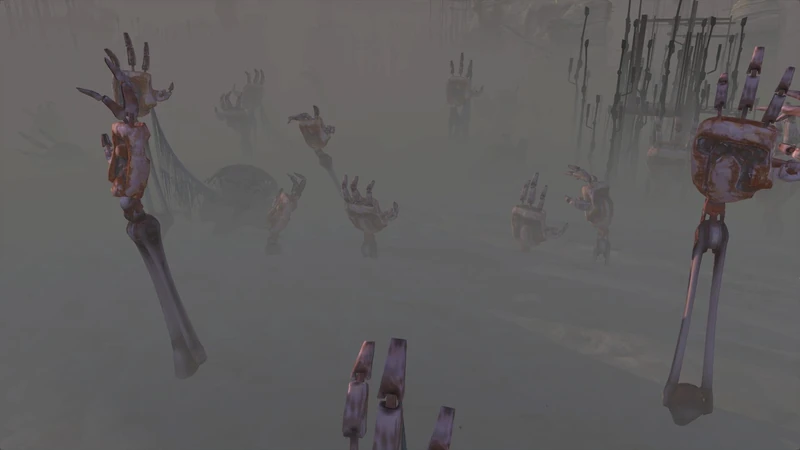
At least one Behemoth escaped this execution: Stobe. His later actions changed the course of the whole world.
The Mass Extinction: five accounts
The end of the First Empire is called the "First Extinction" in Holy Nation scripture. Its cause remains unsettled; the four volumes of the in-game scholarly work Mass Extinction each propose one, which together can be organised into the hypotheses below:
- Natural disaster: Finch's position (volume one). The simplest explanation, covering the wide-area destruction of terrain and matching how primitive tribes understood it, as an "act of God". He adds a guess that the newly made Skeletons may have been incubating somewhere safe at the time, which is why they survived and why they have no memory of it: they had not been born yet.
- Superweapon: Idad's position (volume four). Large stretches of territory simply vanished, and destruction on this scale is within what the Ancients could do.
- Civil war: also from Idad. He thinks excessive power plus internal discontent was finally set off by their own hands.
- Biological warfare: Atticus's position (volume three). It explains why Skeletons survived unscathed while organic life was wiped out, and he also thinks the attack may have been launched by the Skeletons themselves.
- Overmining: another cause mentioned in the same piece by Atticus. The central mining region shows extreme resource extraction, and the by-products could have caused mass mutation and disease.
In volume two, Sabina believes the surviving traces of destruction indicate a natural disaster, or a superweapon plus civil war. Commentators who have gathered these accounts tend to think they are not mutually exclusive options but each hold part of the truth: natural disaster explains the wide-area terrain damage and matches the primitive tribes' "divine punishment", while superweapons, civil war and biological and environmental warfare each explain a different kind of trace[V1 0:05:04].
How the Skeletons survived, Finch lists three explanations in volume one of The Mystery Of Skeletech: new Skeletons hatching safely during the event; Skeletons fleeing to safe places when their masters died; or the masters dying of biochemical means effective on organic life while Skeletons were unaffected. See The Mystery Of Skeletech.
The game's environmental storytelling leans toward a darker answer: it was the Skeletons' revenge. The massacre at Obedience came first and the Skeleton uprising after, and the causal link is hinted at in many dialogues. As for the method, it may have been biological weapons, a forced natural catastrophe, or simply turning the "Eyes" around to aim at the ground.
Another narrative puts the weight on internal causes: the First Empire expanded across the whole continent and most likely declined through a civil war, which set off the First Extinction. Had the Behemoth Stobe not sacrificed himself to save the last humans, the awakened Skeletons would have exterminated their creators[V6 0:00:14]. The "civil war" link is likewise inference; no text in the game directly names civil war as the cause of the fall, and only Idad raises it as a possibility in his book.
The Skeletons' silence
The strongest evidence for "the Skeletons did it" is not any document but the Skeletons' own attitude.
- An NPC in the game who calls himself Finch's deputy states clearly that no one will know the truth, and that he will personally make sure of it.
- A line from passers-by in Skeleton settlements, "Will you forgive us, human?", is an apology of unknown origin.
- The community says books in the ruins were deliberately defaced with spilled ink, but this is not yet confirmed.
- The scholar Idad notes in volume two of The Mystery Of Skeletech that a considerable share of the Skeleton remains recovered by scavengers died by suicide.
Idad's explanation for the mass suicide is that Skeletons are purely logical thinkers, and once "the task of this life" was done, there was no point in continuing to exist. What that task was, he writes plainly: to destroy their enemy, the ancient civilisation. He also lists three possible courses, Skeletons infiltrating society with a mission, falling into their own madness, or rebelling and winning in a civil war; the details are unknown and the aim was one.
What was left
The First Empire left not a single word of its own. What it left was:
- Lost libraries and armouries: Ancient Science Books, AI Cores, mechanical spiders and standby Skeletons.
- Abandoned laboratories and factories: mostly occupied by security robots and Blood Spiders.
- The terrain itself: the Flood Lands, the industrial wreckage of the Deadlands, and permanently altered coastlines.
- The Skeleton race: every surviving Skeleton is a direct relic of that era, including the most famous of them, Cat-Lon.
Data and Formulas
Full figures for players who want to dig deeper, covering the in-game faction record of the same name, "The Old Empire".
| Item | Value | Plain meaning |
|---|---|---|
| Not a real faction | Yes | No members or bases in the world |
| Default relation | -100 | Hostile floor toward everyone |
| With the United Cities, Holy Nation, Trader's Guild, Slave Traders, Desert Bandits, etc. | -100 each | Every listed power is a sworn enemy |
| With the Skeleton legion and Old Machines | 0 | The only two it is not hostile to |
| Max prosperity | 1000 | |
| Roaming population | 50 | |
| Building cost multiplier | 1.2 | |
| Lock level (doors, chests, cages) | 40 each, random spread 10 |
No squad, town or shop references this record, so players cannot meet it in the world.
Research Notes
- An older draft mixed together the claims of the four scholars. After checking the in-game books, the volume matching each of Finch, Sabina, Atticus and Idad is marked in the text; the "foreign settlers" theory comes from Idad's Cultural Groupings And Evolution, not Mass Extinction.
- An older draft put Finch in the "coexistence" camp. That holds in volume two of Cultural Groupings And Evolution, but his position in volume one of Mass Extinction is actually natural disaster plus new Skeletons hatching; added.
- An older draft left out the separate X and Y civilisations of The Lost Ancients; a section has been added.
- An older draft had the Skeleton at Obedience say "humans began to fear the destructive power of their own creations". The subject in the game's line is Man; the meaning is the same, and it has been changed to a paraphrase.
- An older draft said "books in the ruins were deliberately defaced with spilled ink". The game data has no match, so this is now marked unconfirmed.
- An older draft's "toxic mist plus mask" claim for Obedience has no direct support in the game data; removed and replaced with a pointer to the Obedience entry.
- An older draft called The Old Empire a "removed faction". In fact the record is still in the game data, only flagged as a non-real faction; rewritten.
- An older draft said the Ancients called themselves that. That is wrong: it is a later people's name; corrected.
See also
Video citations
- The Whole Story of The First EmpireHeroInHisHead
- Kenshi Lore Master AMAHeroInHisHead
- The Complete Known History of KenshiHeroInHisHead
- The Origins of The First EmpireHeroInHisHead
- The History of Kenshi | DocumentaryCivilizationEx
- Kenshi: History of the Holy NationCivilizationEx
- Kenshi 2 - What We Know So Far and What We Can ExpectHeroInHisHead