
StobeReport
English:Stobe · Characters
A vast carcass lying in the desert, with two zones named after him. Skeletons call him both a god and a butcher, and the most credible account is this: humans still exist today because he died.
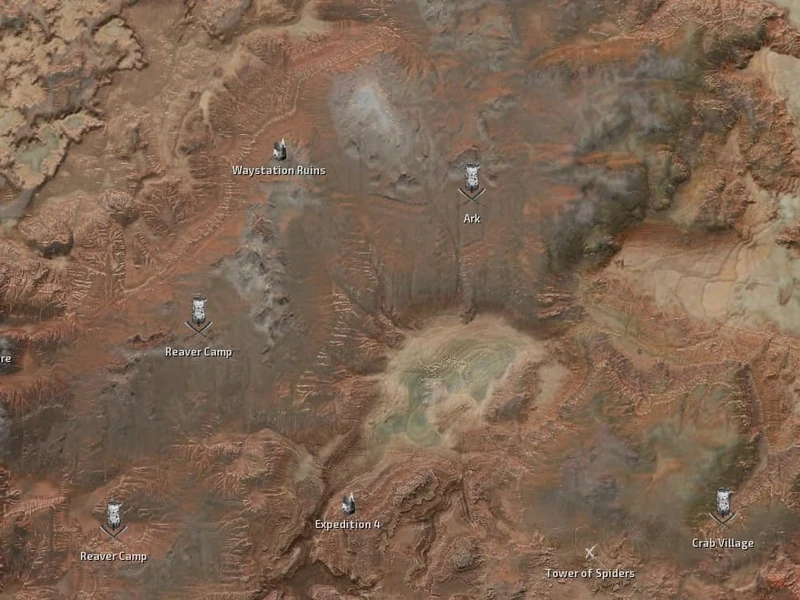
Stobe never appears in the game, because he died thousands of years ago. All the player can see is an enormous carcass lying across the sand of Stobe's Garden, east of a Reaver Camp and west of Ark.
But the faith of an entire continent, the names of two zones, and the Holy Nation's creation myth can all be traced back to that body.
A corpse that makes machines grieve
The first time a player takes a Skeleton character into Stobe's Garden, the line is not a warning but a sigh:
Oh... Damn.... This place is way too sad...
Skeletons are a race without faces, unable to express emotion through expression, and the game very rarely lets them show any — Stobe's Garden is one of the few exceptions. The Skeleton Bandits also talk about him often, and explicitly worship him as a deity.
As for why they grieve, or what Stobe actually did, the game has never said outright.
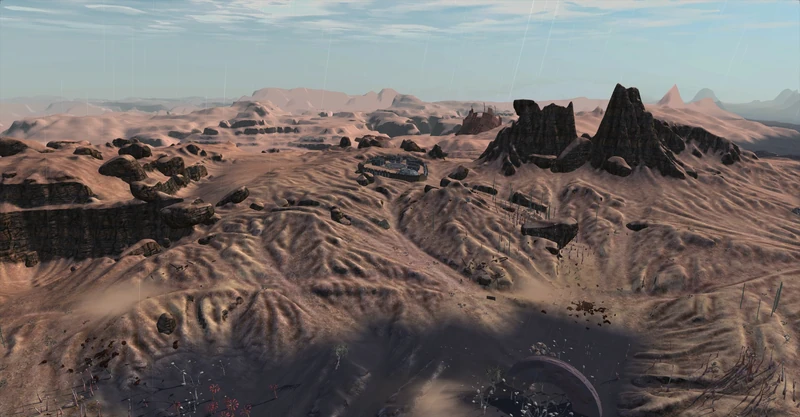
What he is
The most common inference is that Stobe was a Behemoth — one of the super-heavy Skeleton war machines the First Empire built to win that war.
But the inference has an obvious flaw. Stobe, though far larger than an ordinary Skeleton, is noticeably smaller than the Behemoth bodies buried in molten metal at the bottom of Obedience, and looks visibly different.
Hence a second reading: he is not a First Empire Behemoth but a Second Empire imitation of one — much smaller, and built on the same Screamer unit template as other Second Empire soldiers. The Lost Ancients book series hints that the later civilisation was an inferior imitator scrambling to rebuild a lost empire, which fits the imitation theory.
That missile
Not far from his body there is a rocket or missile, half buried in the sand. Unlike the space junk scattered elsewhere on the map, this world item looks deliberately placed.
From it comes the mainstream hypothesis about his death: it was the Ancients' contingency plan for ending all life on this planet after their own collapse or departure, and Stobe sacrificed himself to stop it. Multiple lore videos read the scene this way — someone wanted to land a final blow on a humanity already near extinction, and Stobe put his own body in the way[V1 0:01:19].
The reason this version works better than "he was killed by some army or another Behemoth" is very practical: if an army killed Stobe, that army would then go on to kill the races he was trying to protect. Only something one-use, like a missile, stops killing once he is dead.
But the hypothesis is full of holes of its own:
- Missiles detonate. Even if Stobe crashed into it, it would still explode in the air or on the ground, and everything nearby would die anyway.
- The distance is wrong. Stobe's remains and the missile wreck are extremely far apart, almost a whole mountain between them. If he had "absorbed" the missile, the wreck should be on him, inside him, or right beside him.
- The missile is too intact. It largely retains its original shape. A warhead that actually detonated should be shattered into scattered metal fragments, and completely unrecognisable.
In other words, this is currently both the most explanatory and the least defensible account. Most of Kenshi's lore is like that.
Elder's lie
The only surviving character who can speak about Stobe directly is Elder, leader of the Skeleton Bandits. And the version he gives is completely inverted: Stobe is the "exterminator of the human plague", and also a "martyr".
Those two titles contradict each other. And the game provides the means to expose it: when a Skeleton character talks to Elder, the only reply available is to point out that this is a lie and that Elder knows it. He does not deny it — instead he calls it an "ironic" justice, saying Stobe "is finally getting the recognition he deserves", with "a fitting retribution to top it off".
The "exterminator" claim can be falsified directly: humans are still alive today. What remains genuinely unresolved is motive — did Stobe intend to exterminate humanity and fail, or did he never intend it at all? And who exactly is the target of Elder's "irony" and "retribution"?
Notably, this inverted version does not live only inside Elder's own head: he teaches it as doctrine, and the history Skeleton Bandit followers learn is that "Stobe was a Skeleton hero and martyr who sacrificed himself to help exterminate humanity"[V2 0:02:42]. The question therefore shifts from "why does Elder lie" to "why does he want others to believe it too".
On motive, CivilizationEx offers two directions, both merely speculative: either Elder hates Stobe and has deliberately rewritten his deeds into their opposite, or Elder actually admires him and simply thinks humanity was not worth the sacrifice, and so has rewritten him from "the traitor who saved humans" into "the hero who killed them"[V3 0:22:32]. The second reading fits Elder's "fitting retribution" rather better — if he genuinely holds humans in contempt, then having Stobe remembered by posterity as a butcher is, in his eyes, restoring Stobe's dignity.
The community's integrated narrative
Stitching together the scattered books, dialogue and environmental clues, the community (and a number of lore videos) has settled on one widely circulated narrative:
Stobe was the last Behemoth, the only one to escape the mass disposal at Obedience[V4 0:03:25]. The Skeletons revolted against humanity because of that slaughter and launched an extermination that nearly succeeded; and at the last moment Stobe — the being with the most reason of all to hate his creators — chose humanity's side and used his own life to block that final weapon. A thousand years later, what most people remember is the opposite version: a monster who led the Skeletons in slaughtering humans[V5 0:01:32].
After the war, the victorious Skeletons were crushed by the deaths they had caused and shamed by the contrast with Stobe's nobility: many killed themselves en masse out of guilt, and the survivors fell into lifelong recurring depression[V6 0:00:52]. The mass suicides, the long depressions and the Skeleton habit of periodically wiping their own memories are all attributed to that guilt. Humanity, meanwhile, fell into the Chaos Age, regressed into tribes, and across long ages forgot Stobe down to a name — and then swapped that name for another.
The skeleton of this narrative is consistent across both channels: the First Empire very likely fell in a civil war, which triggered the first mass extinction in the Kenshi world; the awakened Skeletons nearly killed off the humans who created them; and in the end Stobe preserved the remnant through his own destruction[V7 0:00:14]. The disagreements are all in the details, and the details are all inference.
HeroInHisHead's version compresses the timing to the final moment: the Skeletons had already assembled and were ready to deliver a finishing blow to humanity's last capital, and Stobe intervened in that instant and was destroyed for it — and he speculates that the last capital was today's Ashlands[V8 0:02:43]. That is the channel's inference rather than the game's account; but if it holds, then the fact that the Second Empire later built its capital on that very same ground acquires an extra and rather uncomfortable layer.
Another video points out that the intervention had one further, more humiliating consequence: the banner the Skeletons raised in revolt was "vengeance for the Behemoths", and Stobe — the only Behemoth still alive — chose humanity's side, thereby proving on the spot that the banner went against the Behemoths' own will[V9 0:04:31]. On this reading the Skeletons not only killed the wrong target, they defiled the very kin they claimed to be commemorating while doing it. That is what this channel identifies as "the Skeletons' true sin".
From Stobe to Chitrin
The Holy Nation's Book Of Sacrifice records an ancient deity named Chitrin: betrayed by his own children, he forgave them all the same, sacrificed himself to cleanse the planet of its sickness, and then split in two, reborn as Okran of the light and Narko of the dark.
The overlaps are too numerous to treat as coincidence:
- Both are saviours who chose sacrifice after being failed
- Both are cast as "martyrs"
- The line spoken when a Skeleton character enters Obedience notes that Stobe's insistence on saving his children "despite their sins and betrayals" is the same thing as the Behemoths' flaw of "blind obedience and unquestioning loyalty"
Most inferences therefore conclude: Chitrin is Stobe, and the name was simply lost in the memory gap of the Chaos Age. If that holds, then the creator god of the Holy Nation — a religion that treats technology as evil and Skeletons as Narko's minions — is himself a machine.
The two lands named after him
| Region | Features | What the name means |
|---|---|---|
| Stobe's Gamble | Volcanic terrain, site of Spring, the Anti-Slavers' capital; Leviathans and Landbats roam here | "Gamble" — inferred to be where he fought, or staked everything |
| Stobe's Garden | A three-way battleground between Reavers, Crab Raiders and Skeleton Bandits, containing Ark and Crab Village | "Garden" — where he fell, or was laid to rest |
A world that has entirely forgotten why the names were given still goes on using them. It is probably Kenshi's most precise demonstration of how history disappears: the name survives, the content does not.
Stobe's Garden has one further feature that gets pointed out often: in that stretch of badlands in the southeast, it is one of the few patches with fertile soil. From this HeroInHisHead advances a larger claim — that this was humanity's last refuge at the collapse of the First Empire, an Eden Stobe left behind for them; human civilisation restarted from this small patch of green, on a scale so small it could only fall back to hunter-gatherer tribes, and that was the starting point of the total regression that followed[V10 0:13:27].
This account is incompatible with the inference in the previous section that humanity's last capital lay in the Ashlands: one treats Stobe's Garden as the story's end point, the other as its beginning. Both have only environmental clues and no text at all. Kenshi's lore frequently accommodates two mutually exclusive but individually reasonable explanations at once, and this is the textbook case — this site records both and endorses neither.
Trivia
Stobe's image as the one who "stopped a weapon of destruction and sacrificed himself to protect humanity" is frequently compared to the film The Iron Giant.
See also
Video citations
- The Age of Chaos: How Cat-Lon Became OkranHeroInHisHead
- History of Kenshi: Minor Powers | Cults - Crab Raiders, Skel Bandits, Skin Bandits, Preacher CultCivilizationEx
- History of Kenshi: Minor Powers | DocumentaryCivilizationEx
- The History of Kenshi | DocumentaryCivilizationEx
- Kenshi: History of the SkeletonsCivilizationEx
- Kenshi: Major Powers | SkeletonsCivilizationEx
- Kenshi: History of the United CitiesCivilizationEx
- Why Does The Holy Nation Oppress Women?HeroInHisHead
- The Real Crime of the SkeletonsHeroInHisHead
- The Origins of the Crab RaidersHeroInHisHead